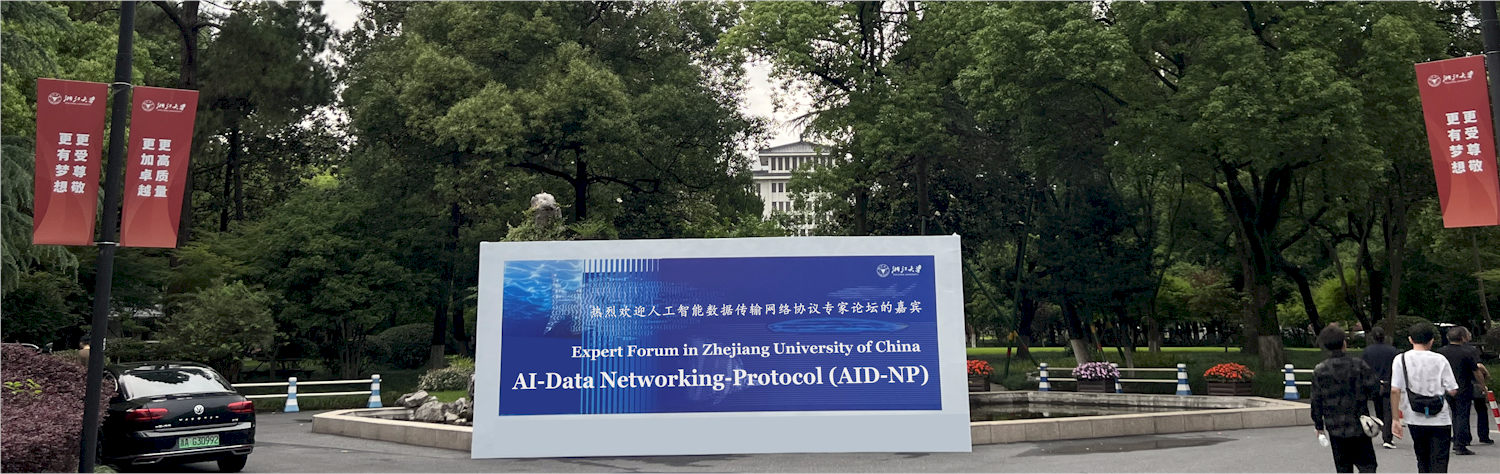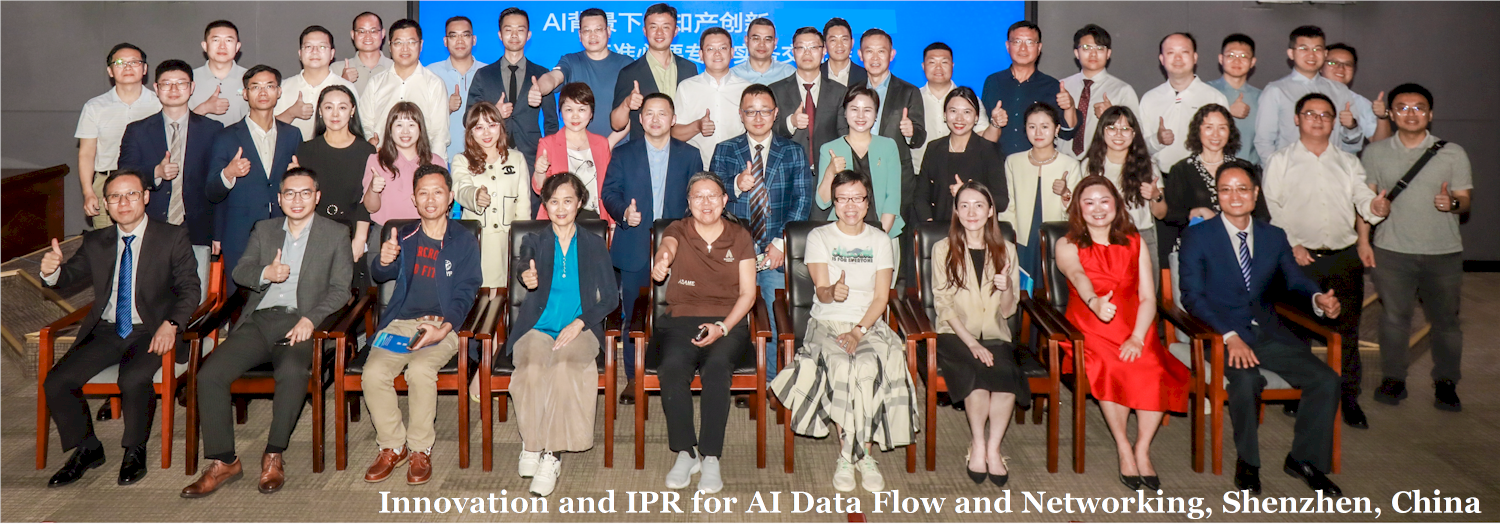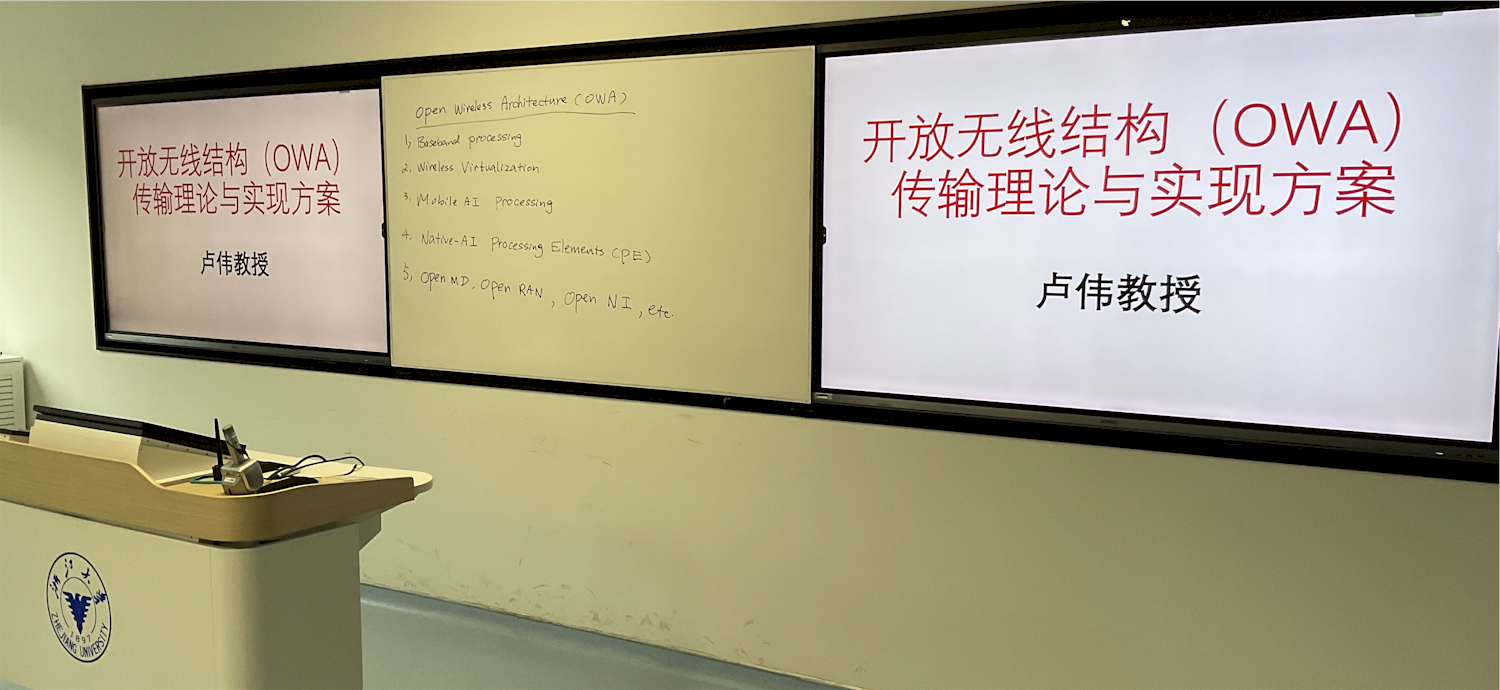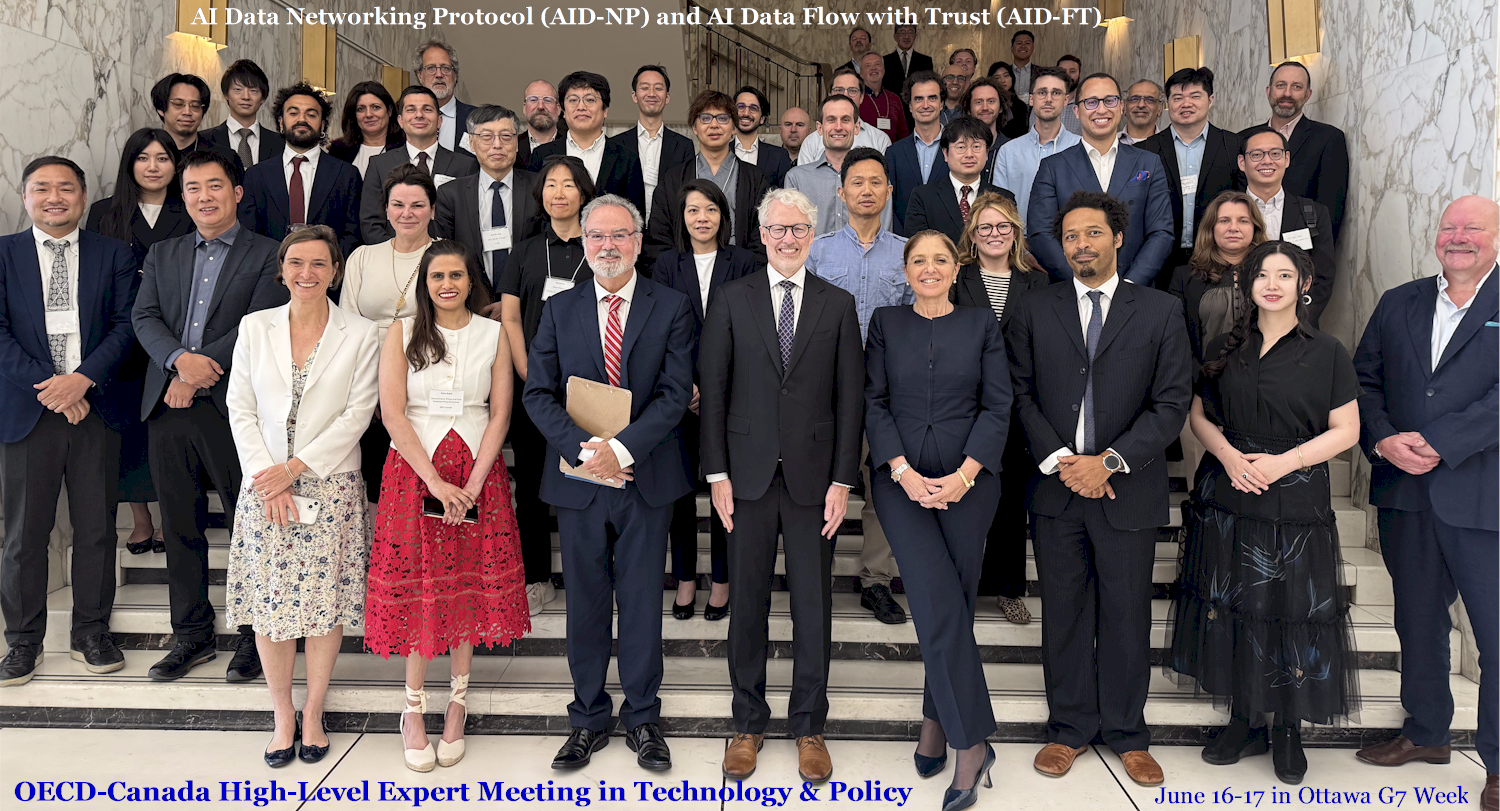
We are very diligently and busy in delivering PALO ALTO RESEARCH services to clients, please check this site frequently.
Palo Alto Research connects over 6,000 senior engineers, researchers and experts to serve our clients for research, development, design, analysis, consulting & engineering services in the ICT (information and communications technology) field as well as business experts in account management, channel sales, presales engineering, technical architecture and training across various business sectors. Palo Alto Research provides one-stop solution for clients to build their platform ecosystem in the industry. Palo Alto Research also provides a solid foundation for the mission to develop cutting-edge IP and AI solutions to our clients.
|
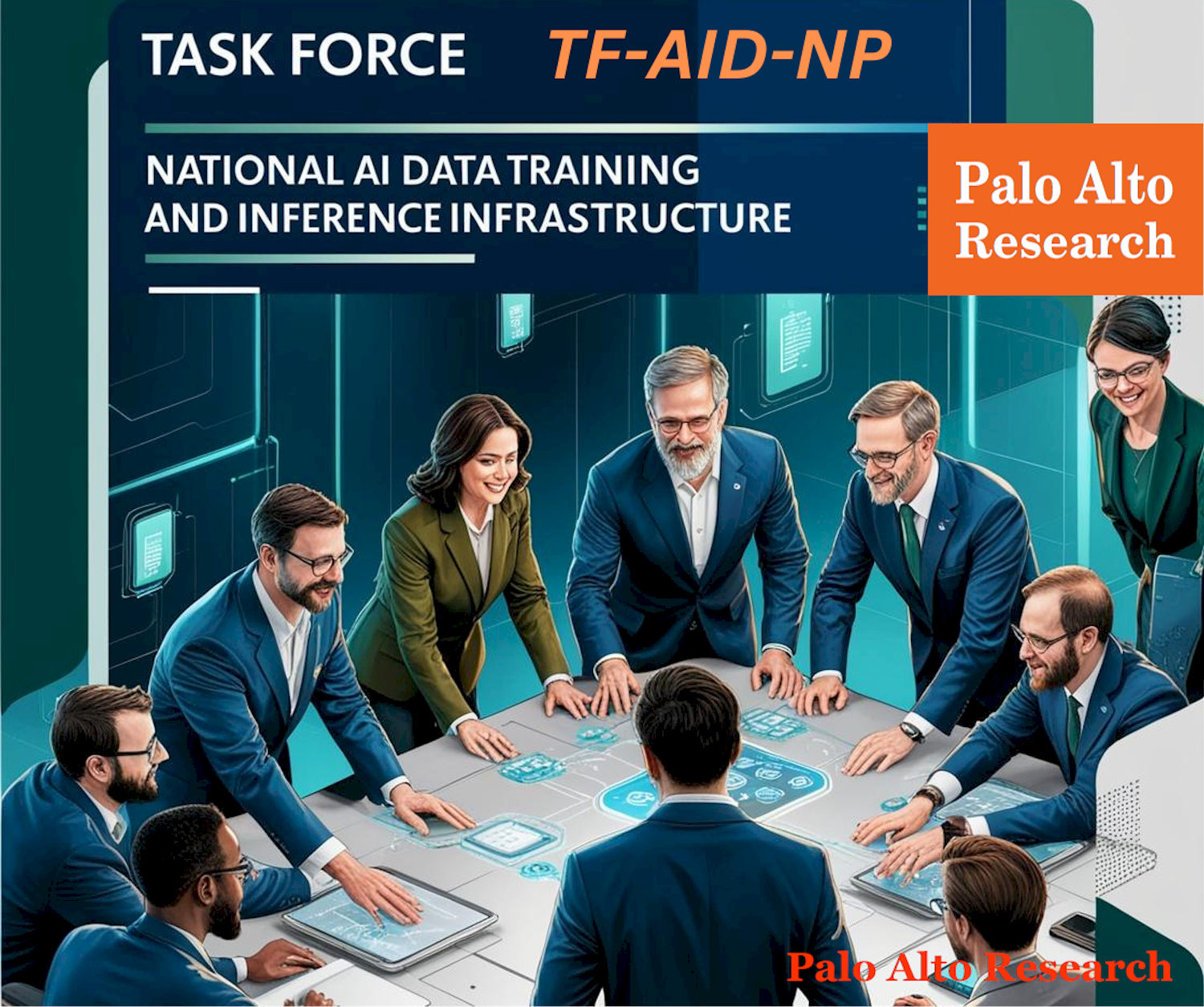
Task Force for AI-Data Networking-Protocol (TF-AID-NP)
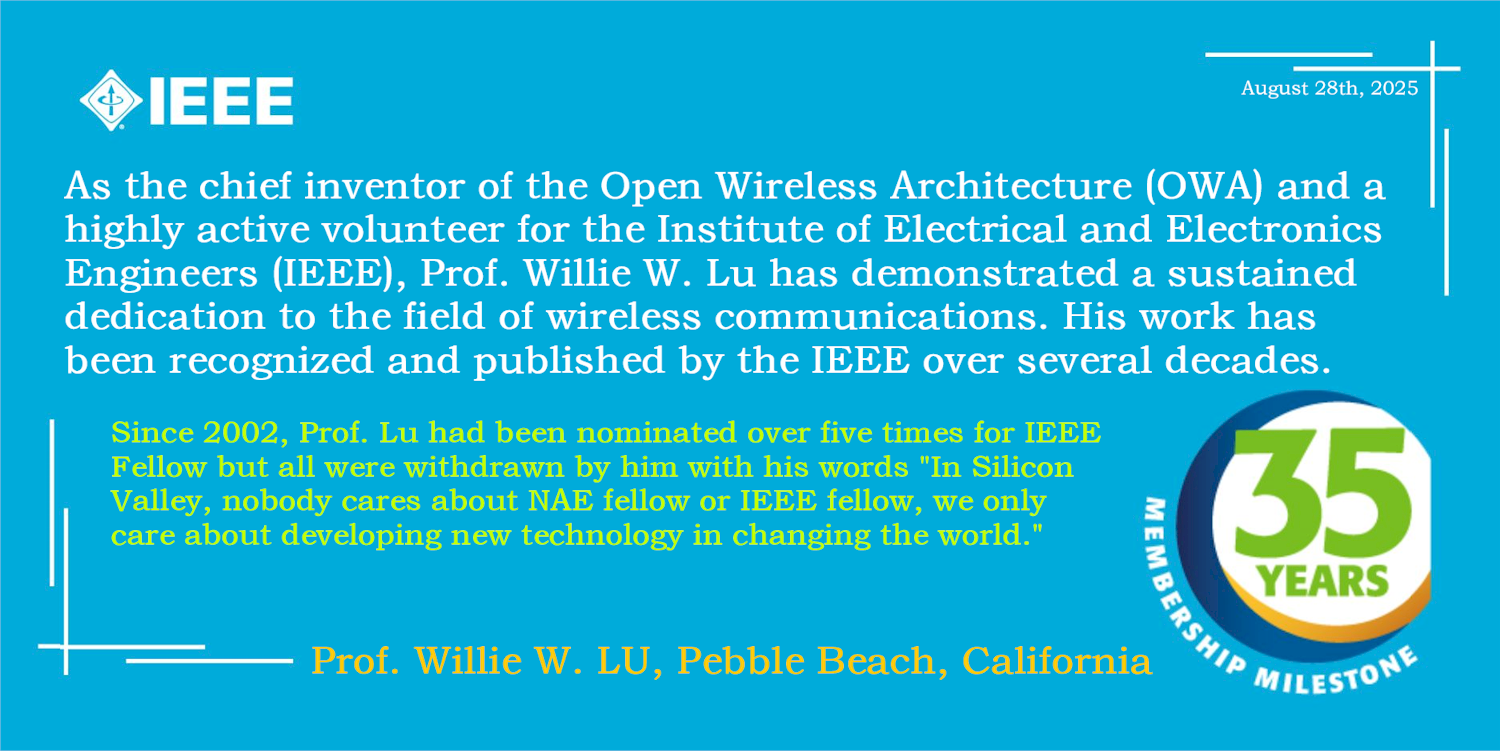
Prof. Willie W. LU, Chair and Principal Investigator, Palo
Alto Research Click to view Prof. Lu's speech on AID-NP in Palo Alto, California. Also Click to enter TF-AID-NP Github Project Page.
Industry experts and executives to join force together for upgrading the national infrastructure to support seamless AI data flow with trust across all networking nodes
including wireline backbone and wireless transport and optimize AI data processing including training and inference amongst different multiple data centers and between individual datacenter and distributed edge
acceleration nodes as well as wireless transport between mobile
wireless users and the connecting AI processing nodes. AI-Data Networking-Protocol (AID-NP) for National AI-Data Training and Inference super-Pool Infrastructure (both wireline backbone and wireless transport) Prof. Willie W. LU, Principal Investigator and Chief Architect, Palo Alto Research Research Project mainly funded & provided by West Lake® education and research services Research project objective: upgrading the national infrastructure to support seamless AI data flow with trust across all networking nodes including wireline backbone and wireless transport and optimize AI data processing including training and inference amongst different multiple data centers and between individual datacenter and distributed edge processing nodes, covering entire infrastructure both wireline backbone and wireless transport. -----------------------------------
Tentative structure of white paper for the AID-NP project from the China expert meeting Chapter 1: SUMMARY
Further, with AI revolution rapidly accelerating, networking infrastructure lies at its core. Currently, up to 80% of GPU consumption today is by the major cloud providers building massive AI clusters with hundreds of thousands of accelerators. This requires a transformational shift in AI-data-friendly networking capabilities to enable the immense bandwidth and ultra-low latency as well as seamless transport optimized for AI-data which is required for distributed AI training and inference among different datacenters through different networks across different locations. The demands of AI will continue to drive both network throughputs in the data center and for AI data in networking nodes in the years ahead. Most people think NVIDIA = GPUs. But modern AI training is actually a networking problem. A single A100 can only hold ~50B parameters. Training large models requires splitting them across hundreds or thousands of GPUs in geographically distributed locations across Wide Area Networking (WAN) infrastructure.
For distributed AI training where GPUs constantly sync gradients,
and so we can not tolerate any considerable End-to-end latency
between each GPU. Furthermore, another major issue for the AI data flow is the wireless link between mobile wireless users and the connecting AI data flow servers such as AI datacenter and/or distributed AI acceleration edge nodes sitting in local computer server, virtual mobile server or other processing units, etc. At the mobile user side with mobile device, the wireless transport between the mobile devices and the data centers or the edge processing nodes need redefinition and re-development to support ultra-low latency of AI Data Flow with Trust where the innovative Open Wireless Architecture (OWA) Virtualization Platform has been utilized to secure the performance and efficiency. This AI-Native OWA Wireless Virtualization for the Wireless Link of the mobile users is part of the subject AID-NP platform and infrastructure. The subject AID-NP also supports PET (Privacy Enhanced Technology) promoted by the OECD member states for finance platform, health platform and governmental information platforms, etc. Palo Alto Research has a research project on this AI-Data Networking-Protocol (AID-NP) development amongst multiple datacenters, and between individual datacenter and distributed edge processing nodes, as well as between wireless mobile devices and said datacenters or distributed edge processing nodes, especially for National AI-Data Training and Inference super-Pool Infrastructure (NAID-TIPI). We have monthly expert panel discussion at Prof. Willie LU’s Cupertino house or in the designated hillside park with worldly networking technology experts and scientists rooted in the San Francisco Bay Area (aka Silicon Valley). The panel discussion is normally in the afternoon of first Sunday of the month, except Prof. Lu is out of town on travel. For more information, send email to tf6g+subscribe@googlegroups.com.
CHAPTER 2: TRADITIONAL TCP/IP PROTOCOL WAS NOT DESIGNED FOR AI-DATA TRANSPORT Due to the unique demands of AI data workloads which require extremely low latency, accurate synchronization and high throughput, current network protocols like traditional TCP/IP is not sufficient and even not effective in terms of transmission and transport performance, leading to a need for new, optimized protocols specifically designed for AI data transport. AI tokens require very low latency because in most AI applications, especially those involving real-time interactions amongst multiple datacenters in different locations, like live translations, living understanding and live inference, a quick response time and accurate synchronization amongst different training and inference engines or agents located in multiple datacenters or edge acceleration nodes in different locations are crucial for a seamless user experience and optimal performance. Low latency also ensures that the AI model can process and generate responses to user inputs rapidly from different AI engines and agents, either from different datacenters or from different edge acceleration nodes, minimizing perceived delays and token-loss, and maintaining a natural AI data flow. Last but not least, the traditional TCP/IP transported packets are all human-generated dataflow, including file data, email data, web data, and other user data as well as control data, signaling data and other network maintenance data. They do not need any verification of the source of data, which is all produced by Internet users. However in the era of AI data workloads, large amount of data are generated by AI engines, agents, accelerators through AI training and inference models, and through AI dataflow transport amongst different datacenters or edge acceleration nodes, hence Data Flow with Trust by Humans (DFTH) becomes extremely essential in both private information transport and public information transport, especially for government information infrastructure. TCP/IP is in no way to support DFTH mechanism. TCP/IP requires roundtrip acknowledgments of packet transmission causing long latency and low efficiency in networking. The traditional Internet infrastructure focuses on reliable data delivery rather than seamless AI training and inference, and so TCP/IP was developed for that purpose. Though other protocols such as UDP was developed to support real-time packet applications, its performance remains far from the system requirements of the AI training and inference infrastructure. Hence, TCP (and UDP) dramatically slows the rate of AI data transfer.
CHAPTER 3: EXISTING IMPROVED NETWORK PROTOCOLS ARE ALSO FAR FROM MEETING RAPIDLY DEVELOPED AI DATA FLOW AND TRANSPORT "RDMA (remote direct memory access ) over Converged Ethernet (RoCE)" or the emerging "Ultra Ethernet Transport (UET)" protocol developed by the Ultra Ethernet Consortium (UEC) is a popularly proposed alternative to attempt to support AI data transport infrastructure. However, RDMA transmits data in chunks of large flows, and these large flows can cause unbalanced and over-burdened links. Also, RDMA is not designed for long transmission path. UET is still within the fence and inside the wall of Ethernet architecture that Ethernet protocol is primarily designed for Local Area Networks (LANs) and is not optimally suited for large geographic areas, making it unsuitable for Wide Area Networks (WANs) due to limitations in many technical mechanisms including but not limited to: transmission error correction, long latency of medium access, Speeds decreasing with increased traffic, low reliability, capacity restrains, degradation through network switch and router, etc, bottlenecks with underline transmission modulation, big packet loss over long distance transmission, low signal-over-noise rate over long distance transmission, etc.
CHAPTER 4: AI-DRIVEN IOT (INTERNET OF THING) NEEDS NEW NETWORKING PROTOCOL TO CONNECT BILLIONS OF IOT NODES The integration of AI and IoT is indeed driving the need for new networking protocols to efficiently connect and manage billions of IoT devices. This emerging paradigm, often referred to as AIoT (Artificial Intelligence of Things), presents unique challenges that traditional networking protocols struggle to address effectively. Challenges with Current Networking Protocols Existing networking protocols face several limitations when it comes to supporting AI-driven IoT environments:
CHAPTER 5: CONSIDERATION IN DEVELOPING NEW NETWORKING PROTOCOL FOR AIOT DATA When developing new networking approaches and protocols, we need to consider: Private Connectivity Fabric (PCF) PCF is an innovative architecture designed to meet the demands of AI-driven networks:
AI-Enhanced Network Management AI is being leveraged to improve network management and performance:
Adaptive Policies To enhance security and performance in AIoT networks:
Blockchain Integration Blockchain technology is being explored as a potential solution for enhancing security and privacy in AIoT environments:
Other consideration As AIoT continues to evolve, we can expect further developments in networking protocols:
The convergence of AI and IoT is driving significant changes in networking technologies. As these systems become more prevalent, new protocols and architectures will continue to emerge, addressing the unique challenges posed by connecting billions of intelligent devices. The future of AIoT networking will likely involve a combination of innovative technologies, including AI-driven management, blockchain integration, and adaptive security measures, to create more efficient, secure, and scalable networks.
CHAPTER 6: CONSIDERATION IN DEVELOPING NEW NETWORKING PROTOCOL FOR AI DATA BETWEEN DIFFERENT MULTIPLE DATACENTERS The development of new networking protocols for AI data transport between multiple datacenters is a critical area of focus as AI workloads continue to grow in scale and complexity. Several key considerations and approaches are emerging to address this challenge: High-Bandwidth, Low-Latency Interconnects A fundamental requirement for AI data transport between datacenters is extremely high bandwidth and low latency. This is driving innovations in fiber optic networking technology:
Hierarchical Synchronization Given the varying distances between datacenters, a hierarchical approach to synchronizing AI model training across sites is being adopted:
Asynchronous and Decentralized Training New AI training approaches are being developed to work more effectively across distributed infrastructure:
Intelligent Traffic Management AI itself is being applied to optimize data flows between datacenters:
Enhanced Security Protocols As AI data moves between datacenters, robust security is critical:
Edge Computing Integration Edge datacenters are being incorporated into AI networking architectures:
The development of these new networking protocols and architectures is an active area of research and innovation. As AI models and datasets continue to grow, the ability to efficiently distribute training and inference across multiple datacenters will be crucial for scaling AI capabilities. This is driving significant investment in next-generation datacenter interconnect technologies and intelligent networking systems optimized for AI workloads.
CHAPTER 7: STATE OF ART OF AI-DATA INTERNETWORKING PROTOCOL FOR AI-DATA TRANSPORT BETWEEN DIFFERENT DATACENTERS IN DIFFERENT LOCATIONS The rise of AI applications has indeed created new challenges for data center interconnects and networking protocols. To address the unique requirements of AI workloads, several advancements are being made in data center networking and interconnect technologies: High-Speed Interconnects The demand for higher bandwidth between data centers is driving the adoption of faster interconnect technologies:
These high-speed interconnects aim to reduce latency and increase throughput for AI data transport between geographically distributed data centers. Energy-Efficient Designs New transceiver designs are emerging to improve energy efficiency:
These innovations help data centers scale up their networking capabilities while managing power constraints. AI-Optimized Networking Protocols While not a single new protocol, several optimizations are being made to existing networking stacks:
Improved congestion control algorithms tailored for bursty AI traffic patterns. Edge Computing Integration To reduce latency for certain AI applications, edge computing architectures are being incorporated:
Scalable Network Architectures Data center network designs are evolving to better support AI workloads:
While there isn't a single new "AI-Data internetworking protocol" per se, the industry is adapting existing technologies and developing new optimizations to meet the unique demands of AI workloads. The focus is on increasing bandwidth, reducing latency, improving energy efficiency, and enhancing scalability across geographically distributed data centers.
CHAPTER 8: CURRENT WIDE AREA NETWORK (WAN) NETWORKING SYSTEM DOES NOT SUPPORT AI DATA TRANSPORT BETWEEN GEOGRAPHICALLY DISTRIBUTED DATA CENTERS The current wide area network (WAN) switching and routing systems do face some limitations when it comes to supporting AI data transport between geographically distributed data centers. Current WAN Limitations for AI Workloads Traditional WAN architectures were not designed for AI workloads in mind, which can lead to several challenges:
Emerging Solutions to Solve the Current Problems While current WAN systems may have limitations, the networking industry is rapidly evolving to address these challenges: AI-Driven SD-WAN Software-defined WAN (SD-WAN) enhanced with AI capabilities is emerging as a potential solution:
Cloud-Native Networking Cloud providers are developing specialized networking solutions optimized for AI workloads:
AI-Optimized Hardware Network equipment manufacturers are developing hardware specifically designed to handle AI traffic:
AI-Optimized Broadband Wireless Access (BWA) The TCP/IP-oriented packet switching networks do not support AI-data traffic due to its serious latency issue and packet-loss issue. The traditional wireless-oriented circuit switching transmission is instead the optimal solution to support AI-data traffic due to its low latency and better SNR over the air. The proposed BWA based on OWA (open wireless architecture) platform is the optimal way for such AI-optimized BWA solution. Future Outlook The future of WAN for AI looks promising:
While current WAN systems may not fully support AI data transport between geographically distributed data centers, the rapid pace of innovation in networking technology is quickly closing this gap. As AI becomes increasingly central to business operations, we can expect to see continued advancements in WAN technologies specifically tailored to meet the unique demands of AI workloads.
CHAPTER 9: RF SOLUTIONS TO INTERCONNECT GEOGRAPHICALLY DISTRIBUTED DATA CENTERS FOR AI DATA TRANSPORT RF over Fiber (RFoF) technology transmits radio frequency (RF) signals over optical fiber by converting analog RF signals into optical signals, transmitting them over fiber, and then converting them back to RF signals. In RF-over-fiber architecture, a data-carrying RF (radio frequency) signal with a high frequency is imposed on a lightwave signal before being transported over the optical link. RFoF solutions are built with open architectures that align to open standard suites such as the LCA and CMOSS. RFoF offers a solution which is comprised of the following blocks: 1. RFoF High SFDR links which support 20GHz and 40GHz instantaneous bandwidths. 2. RF to Optical conversion modules with optional signal level control functionality. 3. Optical Matrix fast routing with n*M ports enabling to switch between any of the n optical inputs and combinations thereof to the M optical antenna outputs with reliable multi-fiber interfaces. 4. Optical to RF conversion antenna modules, each with managed RF power amplifiers to produce the desired RF level at each antenna port. 5. Scalable modular design which allows upgrades of the number of antennas M and number of signals n with minimal changes to the system architecture. 6. Management and monitoring state of the art system based on popular standard protocols. 7. Optional Optical delay line and modulation capabilities for the n input signals.
CHAPTER 10: AI-NATIVE OPEN WIRELESS ARCHITECTURE (OWA) WIRELESS TRANSPORT EXISTING TELECOM INFRASTRUCTURE DOES NOT SUPPORT AI DATA FLOW WITH TRUST OVER WIRELESS LINKS The existing wireless communication infrastructure was developed for the people-to-people communications topology where human-being generally does not take the wireless transmission channels all the time of 7/24 due to standby sleep time, etc, and so the wireless infrastructure is based on Erlang model. Second, the existing wireless communication infrastructure was developed totally within the traditional Telecom infrastructure which demands the closed-architectural base station, BSC, MSC and extended Gateway and other network equipments, etc which is in full conflict with evolving open computing architecture, open software architecture and open networking architecture. Since Steve Jobs launched iPhone, the traditional Telecom infrastructure has been facing tremendous challenges in opening up its transmission nodes and networking nodes as well as system architecture. In order to meet the rapid challenges rising from the computer industry and software industry, the telecom industry has no choice but to couple existing multiple infrastructures together to support open architecture in computer and software industries, causing increasing complexity and low efficiency in system implementation and infrastructure implementation. The wireless service model has been shifting rapidly from people-to-people communication model to new models of Internet of Vehicle (IoV), Internet of Things (IoT) and large model of AI Data Transport. These new models demand full utilization of the wireless transmission resources 7/24 and demand very low latency in real-time and strictly synchronized data flow over wireless links, which further challenge the existing telecom infrastructure in terms of poor performance and bad networking capability. Open Wireless Architecture (OWA) was introduced for delivering open architecture solutions in wireless local area networks and cellular wireless networks by constructing an independent OWA Virtualization Layer upon existing various Radio Transmission Technology (RTT) radio interfaces in order to create open and compact platform for the AI data transport over wireless links for mobile devices of the mobile users. OWA WIRELESS TRANSPORT TO SUPPORT ULTRA-LOW LATENCY OF AI DATA FLOW WITH TRUST OVER WIRELESS LINKS Steve Jobs’s most important contribution to the world was to open up the mobile device architecture from traditional telecom device which was of carrier-centric close architecture, to an open platform converged with open computing architecture and open software architecture so that different mobile services’ and applications’ developers can play their different games upon such open-architecture platforms for the mobile users through their mobile devices. Apple’s iPhone totally changed the game rules in the mobile device industry and kicked off the new era of open architecture in the wireless industry. At the mobile user side with mobile device, the wireless transport between the mobile devices and the data centers or the edge processing nodes need redefinition and re-development to support ultra-low latency of AI Data Flow with Trust over the air where the innovative Open Wireless Architecture (OWA) Virtualization Platform has been utilized to secure the performance and efficiency. This AI-Native OWA Wireless Virtualization of AI Data Flow for mobile devices is part of the subject AID-NP platform and infrastructure. As more and more AI data migrate from desktop computers to mobile devices (mobile phone, mobile Pad and mobile laptop), an efficient wireless transport between mobile devices and the AI agents in datacenters or edge acceleration nodes for the AI data flow becomes extremely important. The current wireless network infrastructure, including cellular mobile networks and wireless local area networks, is not designed and optimized for AI data flow which requires ultra low latency. Over 90% of existing 4G and 5G cellular mobile networks and 100% of existing wireless local area networks are based on packet-switching transmission mechanism. The packet-switched data are transported hop-by-hop across the entire Internet or amongst numerous routing nodes throughout the wide area networking infrastructure, causing lengthy delays and high latency in wireless transmission performance. Open Wireless Architecture (OWA) Virtualization is built upon the MAC/PHY layers of the underlying wireless transmission resources to separate the various Radio Transmission Technologies (RTTs) from the higher layers of data transport and service sessions in full convergence of Open Computer Architecture (OCA), Open Network Architecture (ONA), Open Software Architecture (OSA) and Open Data Architecture (ODA) for the new generation of mobile device architecture including smart mobile phone, mobile Pad and mobile laptop, etc. OWA Wireless Virtualization Platform manages various RTTs in cost-effective and spectrum-efficient way to optimize the performance for the service sessions of the wireless data transmission. OWA also employs Virtual Mobile Server (VMS) for Mobile AI and Telecom GPT processing as edge acceleration nodes performing AI-Native calculating, processing, programming, computing tasks for open wireless transmission, signal processing and wireless networking, etc among managed mobile devices and the VMS hosting server. VMS connects to backbone AI datacenters and/or AI edge acceleration nodes through innovative AI-Data Networking Protocol (AID-NP) to facilitate AI dataflow with ultra-low latency. This enables the end-to-end low-latency AI data flow with trust between local mobile devices and remote mobile devices across wireless networks and wireline networks amongst multiple datacenters and/or edge acceleration nodes of the entire wide area networks of AI data flows. OWA effectively maps the available wireless transmission resources into two blocks:
Then OWA effectively convert the above blocks of CSWC and PSWC into respective OWA Virtual Frames based on the defined Quality of Wireless transmissions (QoW) in terms of said data transmission latency and other wireless transmission parameters. Then the OWA Virtualization Platform drives the underlying OWA Wireless Adaptation layer for the porting of specific RTTs, either circuit-switched ports or packet-switched ports, for the specific wireless data flow of either AI data flow and transport or TCP/IP data flow and transport across the available wireless networks in the area. Both circuit-switched and packet-switched wireless data transmissions are administrated by the managed VMS AI server. Circuit-Switched Optimizer (CSO) and Packet-Switched Optimizer (PSO) sit above the OWA Virtualization Platform to ensure the quality of the data flow which is trustworthy and reliable. There are two main reasons to set up CSO and PSO:
The CSO is extremely important since we buy ultra-low latency with low-efficiency wireless transmission in order to support quality AI data flow across the AI data infrastructure. Meanwhile, we still maintain high-efficient wireless transmission of TCP/IP data flow but with tolerable high latency through the PSO controller. Further, the CSO and PSO utilize different Error-Correction Mechanism (ECM) for data flow transmission over the wireless air links, which will be discussed in details in the OWA training course. OWA pushed the traditional telecom industry to open up its wireless infrastructure from carrier-centric platform to user-centric platform for supporting open AI data flow and open IoT data flow across various RTT air interfaces which is a revolutionary approach for the industry to move forward. OWA was evolved from Software Defined Radio (SDR) back to 2000s, but has been greatly improved to support the wireless transport for emerging Internet of Vehicle (IoV), Internet of Things (IoT) and AI data flow with trust (AI-DFT) through innovative OWA Wireless Virtualization platform for the mobile devices and mobile wireless infrastructure in the era of AI and IoT. OWA Wireless Virtualization platform is a new wireless access and wireless adaptation layer to support billions of wireless nodes for the emerging AI dataflow and IoT dataflow. OWA Wireless Virtualization platform also supports AI-native PETs (Privacy Enhanced Technologies) for finance platform, health platform and governmental information platforms, etc. For further details of OWA Access Control and OWA Adaptation Control, please join the OWA technology training course scheduled twice a year in the heart of Silicon Valley of San Francisco Bay Area. The OWA research and development has been very active throughout China, U.S. and other countries under the leadership of Prof. Willie W. Lu, the PI and Chief Architect of OWA platform and senior expert and delegate of OECD Missions for the technology, regulations and policies in the sectors of ICT, Cybersecurity, AI, IoT and PET, etc.
Chapter 11: Development of an Advanced AI‑Data Networking Protocol
1. Scope and Objective
This extended report develops a detailed technical blueprint for an
Advanced AI‑Data Networking Protocol (AID‑NP), reflecting:
·
The architectural vision and requirements described by the Task
Force for AI‑Data Networking‑Protocol (TF‑AID‑NP) at Palo Alto
Research (NAID‑TIPI, AI‑Data Switching/Routing/Interconnecting, OWA,
RFoF, DFTH) [1].
·
The current state of the art in relevant standardization bodies: UEC
– Ultra Ethernet Consortium (UE Specification v1.0.x) [2]. OCP –
Open Compute Project (ESUN 1.0, SUE‑T/UALink ecosystem) [3]. IETF –
Internet Engineering Task Force (AIIP, AIPREF) [4][5][9]. MCP –
Model Context Protocol (specification and ecosystem) [6]. IEEE 802 /
IEEE 802.1 – Nendica AICN & lossless DCN work [7][8].
The goal is not just to summarize these, but to turn them into an
actionable design and roadmap for AID‑NP, indicating what can be
standardized now, what requires experimental work, and how to align
multiple consortia.
2. AI‑Data Networking vs Traditional Networking: Detailed
Requirements
2.1 Traffic Characteristics of AI Workloads
Modern AI training and inference pipelines differ significantly from
traditional transaction or bulk‑transfer workloads:
·
Collective Communication Patterns
·
Token‑Centric Data
·
High Burstiness with Predictable Phases
·
Geographically Distributed Training
2.2 Constraints of Current Protocols (TCP/IP, RoCE, InfiniBand‑over‑Ethernet)
1.
TCP
2.
UDP
3.
RDMA (RoCE, iWARP, Infiniband)
4.
WAN Protocols
TF‑AID‑NP’s position is that this gap cannot be bridged by “patching
TCP/IP” alone, and calls for a new AI‑Data Networking Protocol suite
tailored to AI’s token‑centric, trust‑centric requirements [1].
3. AID‑NP Conceptual Stack (NAID‑TIPI Context)
3.1 NAID‑TIPI: National AI‑Data Training & Inference Super‑Pool
NAID‑TIPI (National AI‑Data Training and Inference super‑Pool
Infrastructure) [1]:
·
Interconnects: Campus and metro AI clusters. Regional and national
data centers. Edge computing sites (micro‑DCs, base‑stations, VMS
nodes).
·
Covers: Wireline backbone – DWDM, RFoF, hollow‑core fiber. Wireless
transport – via Open Wireless Architecture (OWA).
AID‑NP provides a common AI‑native control and data plane across
this environment, supporting both training and inference.
3.2 AID‑NP Components (as described in TF‑AID‑NP and extended here)
4. AI‑Data Switching Protocol (AI‑SP) – Detailed Design
4.1 Goals
·
Sub‑10 µs end‑to‑end latency per hop for AI token‑flows.
·
Strictly lossless semantics for designated AI classes (e.g.,
gradient flows).
·
Header minimalism: replace multi‑layer IP/UDP/TCP headers with a
compact AI‑aware header.
·
Hardware‑friendly: implementable in current switch silicon oriented
toward UEC/ESUN.
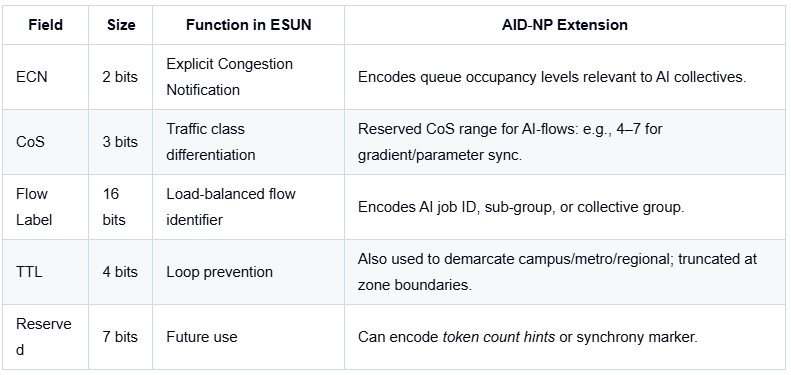
4.2 Header Format (Aligned with ESUN / UEC 4‑Byte Header)
Recent OCP ESUN 1.0 work defines a 4‑byte ESUN Header (EH) that
replaces the standard IP/UDP stack and carries:
·
EH‑ECN – Congestion feedback.
·
EH‑CoS – Class of Service.
·
ESUN Flow Label – Used for load‑balancing.
·
TTL – Time‑to‑Live loop detection [3].
AID‑NP can directly adopt and extend this layout as the AI‑SP
header:
This header is inserted after the Ethernet MAC header, but before
any higher‑layer payload (RDMA‑like operations, AI‑collective PDUs,
or specialized transport).
4.3 Lossless Behavior and Congestion Control
ESUN 1.0 (aligned with UEC) requires support for PFC, CBFC, and LLR
[3][2]:
·
PFC (Priority‑based Flow Control) – Per‑priority pause frames;
critical to lossless semantics for specific CoS.
·
CBFC (Credit‑Based Flow Control) – Finer‑grained buffer management;
switch egress ports track credits for upstream senders.
·
LLR (Link‑Level Retry) – Retransmits frames locally on a link upon
detection of errors without propagating loss to the fabric.
AI‑SP defines:
·
One “lossless AI class” of service (e.g., CoS 6–7) with: PFC enabled
and carefully tuned. CBFC enabled to avoid buffer starvation. LLR
mandatory on all links carrying the class.
·
One or more “elastic classes” for inference and best‑effort AI
traffic with standard ECN‑based congestion management.
·
Integration with IEEE 802.1 AICN’s congestion telemetry and enhanced
signaling (e.g., CSIG) allows:
·
Fine‑grained observation of queue depths.
·
Packets marked with quantized congestion levels.
·
Feedback loops with AI‑SP endpoints that can adjust send rates per
flow label.
5. AI‑Data Routing Protocol (AI‑RP) – Routing for AI Fabrics
5.1 Distinguishing Features
AI‑RP is not a simple rebrand of IP routing. Core differences:
1.
Flow‑Centric Routing
2.
AI‑Topology Awareness
3.
Hierarchical Zones
4.
Congestion‑Aware Path Re‑selection
5.2 Control‑Plane Operation
·
AI‑RP builds on a PCF‑style SDN controller (see Section 7) that:
Installs forwarding rules mapping Flow Label
→
next hop, with different paths per zone. Can pre‑compute disjoint
paths for resilience.
·
Integration with AIIP naming:ai:// identifiers representing AI
services/models (e.g., ai://gpu-cluster-12.regionX/naid-tipi) are
resolved to manifests containing endpoint and policy information
[4].PCF translates these to AI‑RP route instantiation decisions.
6. AI‑Data Interconnecting Protocol (AI‑IP / AI‑DC‑P)
6.1 Function
AI‑IP (or AI‑DC‑P in NAID‑TIPI terminology) handles:
·
Inter‑DC training: cross‑region gradient exchange.
·
Federated learning: periodic model updates from edge sites.
·
Distributed inference: spanning multiple DCs for resiliency and
load.
6.2 Hierarchical Synchronization
TF‑AID‑NP emphasizes hierarchical synchronization [1]:
·
Campuses (<1 km) – near‑synchronous training with micro‑second
granularity.
·
Regions (<100 km) – slight relaxation of synchronous semantics,
tolerant of ms latency.
·
Continents – asynchronous SGD and federated learning; infrequent but
larger update packets.
AI‑IP introduces specialized control messages:
·
SYNC‑BEACON – establishes epoch boundaries across tiers.
·
MODEL‑DELTA – compressed parameter updates.
·
STALENESS‑HINT – indicates tolerated gradient staleness from a
region.
These messages also carry AIPREF preference references (e.g.,
content’s allowed use for training vs output) to ensure cross‑region
updates respect content owners’ policies [5][9].
6.3 Physical Realization
Per TF‑AID‑NP [1]:
·
RF‑over‑Fiber (RFoF) modules: high Spurious Free Dynamic Range (SFDR)
20/40 GHz links with modular optical matrices.
·
DWDM: multi‑wavelength, high‑capacity optical trunk.
·
Hollow‑core fiber: reduces latency vs traditional fiber.
·
These technologies provide the bandwidth and latency targets for
AI‑IP’s inter‑connect.
7. Private Connectivity Fabric (PCF) – AI‑Aware SDN Layer
PCF is the unifying control fabric that ties together AI‑SP, AI‑RP,
and AI‑IP:
7.1 Features
1.
API‑Driven Network Slice Creation
2.
AI‑Enhanced Network Management
3.
Adaptive Policies
4.
Blockchain‑Backed Identity
7.2 Relationship with IEEE 802.1 AICN
The AICN study item [7] and the previous intelligent lossless DCN
report [8] supply:
·
Models of AI throughput vs latency vs availability.
·
Identification of scale, efficiency, and availability challenges.
·
Proposed technologies for congestion control, PFC storm mitigation,
buffer/headroom optimization.
PCF uses these findings to:
·
Decide how many lossless classes to configure.
·
Tune congestion algorithms for AI‑flows vs background traffic.
·
Optimize headroom based on measured queue utilization.
8. Wireless Edge: AI‑Native Open Wireless Architecture (OWA)
8.1 Motivation
AI‑enabled applications require mobile and IoT endpoints to stream
sensor data and receive inference results under strict latency and
security constraints:
·
AR/VR.
·
Industrial robotics.
·
Smart city sensing.
·
Health monitoring.
OWA partitions wireless resources into:
1.
Circuit‑Switched Wireless Channels (CSWC) – reserved capacity for
AI‑flows.
2.
Packet‑Switched Wireless Channels (PSWC) – best‑effort flows for
legacy traffic.
8.2 Architecture
·
OWA Platform & Virtualization Layer abstracts heterogeneous RATs
(5G, Wi‑Fi, private LTE, mmWave) into a common interface [1].
·
Virtual Mobile Server (VMS) nodes act as edge compute, bridging
wireless to NAID‑TIPI AI data centers.
·
CSO (Circuit‑Switched Optimizer):
·
Determines optimal spectrum and time allocation for AI data bursts.
·
Minimizes over‑provisioning by predicting AI burst windows.
·
PSO (Packet‑Switched Optimizer):
·
Manages remaining capacity using classic packet scheduling and ECN.
·
Error‑Correction Mechanisms (ECM):
·
CSWC uses more aggressive FEC/ARQ to reduce residual error and
latency.
·
PSWC uses conventional radio error correction.
OWA is a natural target for future IEEE 802.11/3GPP
contributions; however, as of 2026, it is primarily at the
architecture/prototype stage within TF‑AID‑NP [1].
9. Application and Policy Layers: AIIP, AIPREF, MCP
9.1 AIIP – AI Internet Protocol
AIIP is an IETF draft that defines:
AID‑NP Use:
9.2 AIPREF – AI Preferences Working Group
The AIPREF WG is standardizing:
AID‑NP Use:
9.3 MCP – Model Context Protocol
MCP is an open standard for connecting LLMs/agents to external tools
and data [6]:
AID‑NP Use:
Combined with AIIP:
AIIP
→
naming (ai://service).
MCP
→
invocation (structured RPC).
AIPREF
→
policy gating.
AID‑NP
→
efficient, AI‑aware transport.
10. IEEE 802.1 AICN and Lossless DCN – Grounding Fabric Behavior
10.1 AICN Study Item
The AI Computing Network (AICN) Nendica study item [7]:
·
Analyses AI workloads: Parallelities (data/model/pipeline).
Collective communication.
·
Identifies key metrics: Scale (N of accelerators).Efficiency
(network utilization). Availability.
Key challenges:
·
Scale: limited bandwidth on long‑distance links; deadlock risk due
to link‑level flow control.
·
Efficiency: load balancing, ECMP issues, packet spray, congestion
control complexities [7].
10.2 Lossless DCN Report (Pre‑Draft DCN Work)
The earlier IEEE 802 Nendica Lossless DCN report [8] covers:
·
RDMA use (RoCE, iWARP, Infiniband) in data centers.
·
PFC storms and deadlock scenarios.
·
Congestion control tuning (ECN, QCN evolutions).
·
Intelligent buffer management and headroom optimization.
How this informs AID‑NP:
·
AI‑SP leverages their insights to: Avoid PFC storms (intelligent
thresholds, deadlock detection). Implement advanced ECN marking
policies. Dimension buffers for AI training phases.
·
AICN’s final report is expected to recommend specific IEEE 802.1
amendments, which AID‑NP can adopt as normative behavior for PCF and
AI‑SP/AI‑RP.
11. End‑to‑End Example – Distributed Training Across NAID‑TIPI
Scenario:
A 2,000‑GPU model training job runs across:
·
4 data centers (500 GPUs each).
·
20 edge VMS nodes supplying streaming data.
·
WAN segments using RFoF and DWDM.
Step‑by‑step:
1.
Data Admission & Policy Check
2.
Endpoint Discovery
3.
Path & Slice Setup (PCF)
4.
Training Iteration
5.
Edge Participation via OWA
6.
Model Update & Storage
12. Development and Standardization Roadmap
12.1 Near Term (0–2 Years)
1.
Profile AID‑NP over Existing Standards
2.
Leverage AICN Outputs
3.
Integrate AIIP + MCP
4.
Formalize DFTH & PET Semantics
12.2 Mid Term (2–4 Years)
1.
Standard Proposals
2.
AID-NP Standardization
3.
Certification Programs
12.3 Long Term (4+ Years)
1.
Unified AID‑NP Standard Suite
2.
Global Interoperable NAID‑TIPI Deployments
13. Actionable Recommendations
1.
For Network Operators / Cloud Providers
2.
For Standards Contributors
3.
For System Architects / Vendors
4.
For TF‑AID‑NP
For more information about "Task Force for AI Data Networking
Protocol, please visit:
https://paloaltoresearch.org/anp.htm
References
[1] AI‑DATA NETWORKING PROTOCOL (AID‑NP) – Task Force for AI‑Data
Networking‑Protocol (TF‑AID‑NP).
https://paloaltoresearch.org/anp.htm.
[2] ULTRA ETHERNETTM SPECIFICATION v1.0.2.
https://ultraethernet.org/wp-content/uploads/sites/20/2026/01/UE-Specification-1.0.2-1.pdf.
[3] OCP ESUN – NETWORK OPERATOR REQUIREMENTS BASE SPECIFICATION REV
1.0 & ESUN HEADER OVERVIEW.
https://www.opencompute.org/documents/ocp-esun-network-operator-requirements-base-specification-rev-1-0-final-pdf.
[4] ARCHITECTURE FOR THE ARTIFICIAL INTELLIGENCE INTERNET PROTOCOL (AIIP).
https://www.ietf.org/archive/id/draft-sogomonian-aiip-architecture-00.html.
[5] AI PREFERENCES (AIPREF) WORKING GROUP – OVERVIEW.
https://datatracker.ietf.org/wg/aipref/about/.
[6] MODEL CONTEXT PROTOCOL – SPECIFICATION & INTRODUCTION.
https://modelcontextprotocol.io/.
[7] NENDICA STUDY ITEM: AI COMPUTING NETWORKS (AICN).
https://1.ieee802.org/nendica-aicn/.
[8] IEEE 802 NENDICA REPORT: INTELLIGENT LOSSLESS DATA CENTER
NETWORKS (PRE‑DRAFT DCN REPORT).
https://mentor.ieee.org/802.1/dcn/20/1-20-0030-00-ICne-pre-draft-dcn-report.pdf.
[9] EVOLUTION OF THE AI PREFERENCE VOCABULARY DURING THE ZÜRICH
INTERIM – AI‑PREF WORKING GROUP NOTE.
https://openfuture.eu/wp-content/uploads/2026/01/251020Evolution_AI_preference_vocabulary_Zurich.pdf.
Chapter 12: AI-DNP: A New AI-Data Networking Protocol Suite
This is a proposal by Palo Alto Research for a clean‑sheet AI‑Data Networking Protocol (AI‑NP) suite, called AI-DNP, explicitly designed to overcome structural bottlenecks of TCP/IP, Ethernet, and current datacenter and AI fabrics. It is grounded in the ideas and limitations surfaced in the provided references but is invented as a new architecture, not a restatement of AID‑NP or existing proposals.
1. Design Goals and Problem Statement Limitations of Existing Protocols for AIFrom the references, we can extract several recurring pain points:
These issues motivate a protocol suite that is:
2. High-Level Architecture of AI‑DNP
AI‑DNP replaces the classical IP/Ethernet/TCP split with a
lean, AI‑native stack optimized around AI tokens and photonic‑aware fabrics: Each of the user‑requested functional domains is mapped as follows:
3. Core Data Model: The AI Token Frame
Instead of IP packets, AI‑DNP operates on
AI Token Frames: the smallest network-visible unit of AI work. Minimal Token HeaderTo reduce per‑packet overhead and stack depth, AI‑DNP uses an 8‑byte fixed header:
This header replaces the combined overhead of Ethernet + IP + TCP/UDP for AI‑specific flows.
4. Protocol 1: Cognitive Routing Protocol (CRP) 4.1 ObjectiveProvide flow‑ and token‑aware routing that:
4.2 Key Concepts
4.3 Abstract Forwarding Algorithm
5. Protocol 2: Tensor‑Switch Fabric Protocol (TSF) 5.1 ObjectiveEnable ultra‑low latency, high‑radix switching for AI fabrics:
5.2 Mechanisms
5.3 Simple TSF Decision Diagram
6. Protocol 3: Intent‑Based Signalling (IBS) 6.1 ObjectiveReplace low‑level control and manual QoS tuning with a declarative intent layer that describes AI workloads in terms of:
6.2 Example Intent DeclarationIBS compiles this intent into:
This strongly aligns with intent‑based networking and AI‑aware SDN concepts (PCF, AIIP, AIPREF) but is specialized for AI traffic semantics [1].
7. Protocol 4: Multiplexed Resource Scheduler (MRS) 7.1 ObjectiveExploit modern photonic and electrical links (as in LumiCore‑like platforms [3]) by:
7.2 Design
7.3 Example Scheduling Logic
8. Protocol 5: Neural Buffer Manager (NBM) 8.1 ObjectivePrevent traditional buffer overflows and head‑of‑line blocking by:
8.2 Mechanisms
This leverages the AI‑driven notion from AICN and lossless DCN work but takes it further with multi‑intent, predictive control [1].
9. Protocol 6: Decentralized Policy Chain (DPC) 9.1 ObjectiveProvide zero‑trust, verifiable access control tailored to AI data:
9.2 Design
10. Integrated Operation: End‑to‑End Example ScenarioA federated training job spans 4 data centers and edge VMS nodes, similar in spirit to NAID‑TIPI examples [1], using photonic backbones and AI‑native wireless last‑mile. Step‑by‑Step:
11. Comparison vs TCP/IP + Ethernet
12. Relationship to the References (Conceptual Lineage)
13. Conclusion
AI‑DNP proposes a
comprehensive, AI‑native protocol suite tailored to the unique traffic patterns, latency constraints, and trust requirements of large‑scale AI systems. It abandons IP and Ethernet semantics for AI data flows, replacing them with:
This architecture directly addresses the bottlenecks that limit current AI infrastructure and provides a coherent path for future national‑scale AI data fabrics where network intelligence is as "AI‑native" as the workloads it carries. References[1] AI-Data Networking Protocol (AID-NP) and NAID-TIPI concepts.
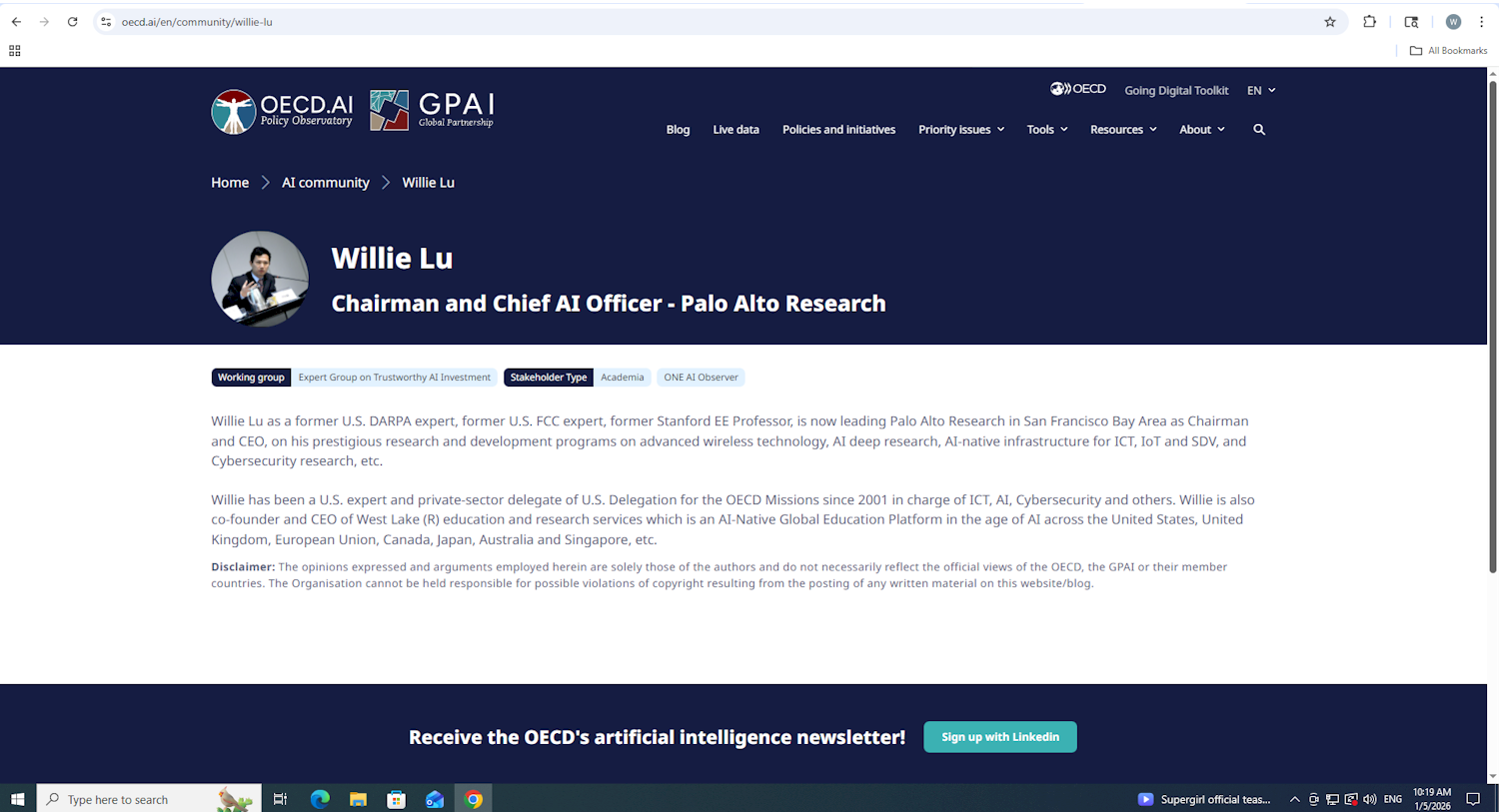
https://paloaltoresearch.org/anp.htm. About Prof. Willie W. LU, PI of the subject AID-NP project and OWA project Former U.S. DARPA expert, former U.S. FCC expert, former Stanford Professor, is now leading Palo Alto Research, on his prestigious research and development programs on advanced wireless technology, AI deep research, AI Data Flow and AI Data Networking and Cybersecurity research, etc. Prof. Willie W. Lu is a renowned expert in wireless communications and the chief inventor of Open Wireless Architecture (OWA) technology. His contributions have significantly shaped the landscape of modern wireless communications. As Chief Wireless Architect for over 25 years, Prof. Lu expanded his ICT expertise to AI Data Networking and Infrastructure in 2008, leading to the launch of the subject task force for the AI data networking protocol, after 15 years' intensive research on this subject. Career and Achievements Prof. Lu has had an illustrious career spanning over three decades in the field of Information and Communication Technologies (ICT). He has held several prestigious positions, including: 1) Consulting professor at Stanford University in charge of Open Wireless Architecture (OWA) research program. 2) Member of the Federal Communications Commission (FCC) Technological Advisory Council 3) Member of DARPA Expert Committee, Advance Wireless Technology 4) Member and Delegate of U.S. Delegation for the OECD Missions for Technology, IP and Policy in AI Data Flow, Wireless, Cybersecurity and IoT 5) Visiting professor at the Chinese University of Hong Kong 6) Chair Professor at Zhejiang University of China (ranked No.3 in China - the best engineering university in China) 7) Chief Architect and Corporate Vice President at Infineon Technologies AG and Chief Representative of Infineon China 8) CEO of the U.S. Center for Wireless Communications (USCWC, now merged into Palo Alto Research) in Palo Alto, California 9) Chairman and CEO, Palo Alto Research, in the United States Prof. Lu has also served as a senior technical advisor for 25 wireless communication authorities in more than ten countries, demonstrating his global influence in the field. For more information about Prof. Willie Lu, please ask AI: "Who is Prof. Willie Lu?"
To be continued .....our scientists, researchers and engineers are working diligently on this emerging project, and the newest results will be released to our sponsors and clients first. After 3-6 months we will release to the public. To become our sponsor or client, please contact PI Prof. Willie Lu directly through his LinkedIN account as set forth above.
The TF-AID-NP is independently organized and administrated by West Lake education and research services, a division of Palo Alto Research. All information in this website is for educational purpose only and subject to change. Nothing is waived and all rights are reserved. |
Around the above main service projects, we provide research, development, consulting and design services to clients on the following detailed service jobs (but not limited to):
Scientific and technological services and research and design relating thereto, namely, research and development of computer software and communication software, research and development of system architecture and system hardware in the field of information and communication technology; scientific industrial analysis and research services in the field of information and communication technology, semiconductors, radio frequency transceivers, sensing and diagnostic electronics, distributed control devices, vehicle control and communication systems, vehicle navigation devices, electronic displays, robotics, cryptography and computer security electronics, information and data analysis, computer performance analysis, software applications development, software systems design, computer protocols design, computer terminal design and computer network design; design and development of computer hardware and software; computer software consultancy services; computer programming for others; computer services, namely, creating an online community and social networking for registered users to participate in competitions, showcase their skills, get feedback from their peers, join discussion, share information, form virtual communities, engage in social networking and improve their talent; application service provider, namely, hosting computer software applications for others for mobile wireless communications; consulting services in the field of design, selection, implementation and use of computer hardware and software systems for others; engineering services, namely, technical project planning services related to telecommunications equipment; technological consulting services in the field of information and communication technology, semiconductors, radio frequency transceivers, sensing and diagnostic electronics, distributed control devices, vehicle control and communication systems, vehicle navigation devices, electronic displays, robotics, cryptography and computer security electronics, information and data analysis, computer performance analysis, software applications development, software systems design, computer protocols design, computer terminal design and computer network design; scientific research and development services in the fields of information and communication technology, semiconductors, radio frequency transceivers, communications transmission devices, sensing and diagnostic electronics, distributed control devices, vehicle communication systems, vehicle control circuits, vehicle navigation device, vehicle safety and security systems, electronic displays, robotics, cryptography and security electronics, communications signal detection devices, compression and processing devices, antenna technology, information and data analysis, computer performance analysis, software applications development, software systems design, computer protocols design, computer terminal design and computer network design; research and development in the field of business, personal and social networking; research and development services in the field of digital currency technology and mobile payment technology; research and consulting services in the field of intellectual property (IP) laws, rules and practices.

We are very diligently seeking federal SBA loan and private investment to upgrade our PALO ALTO RESEARCH developments, productions, services and marketing activities slowed down caused by Covid-19 pandemic.
Palo Alto Research connects over 5,000 senior engineers, researchers and experts to serve our clients for research, development, design, analysis, consulting & engineering services in the ICT field.
We are very diligently and busy in delivering PALO ALTO RESEARCH services to clients, please check this site frequently.
(c) 2004 - 2026 Palo Alto Research Inc. For more service details of PALO ALTO RESEARCH products and services, please contact info@paloaltoresearch.org.