|
Task Force for System Architecture of AI-native Advanced Quantum Intelligence Platform
(TF-AI-QIP)
Working Group for
Global Initiatives to develop System Architecture of AI-native Advanced Quantum Intelligence Platform
The Research Project of System Architecture of AI-native Advanced Quantum Intelligence Platform is
conducted by West Lake education and research services, a division
of Palo Alto Research
Prof. Willie W. LU, Chair and Principal Investigator, Palo
Alto Research
Contact:
https://www.linkedin.com/in/willielu/
Summary of the
research
The research focuses on how a
"new architecture of an AI‑native quantum
intelligence platform" could:
- Overcome
hardware limitations of current AI,
- Remove
data flow bottlenecks, and
- Do so
by exploiting quantum states (qubits) instead of
classical data (bits)
- As a substrate for
next‑generation artificial superintelligence (ASI).
Based on current research (up to 2026), no complete "quantum superintelligent" platform exists. What we do have are:
-
Reference architectures for
quantum–classical supercomputing (e.g., IBM's quantum‑centric reference architecture)
[1].
-
System‑level patterns for
quantum AI integration (hybrid quantum–classical, middleware, orchestrators)
[2].
-
Cognitive architecture proposals that embed quantum processors into hierarchical memory and reasoning systems aimed at ASI‑class capabilities
[3].
- Detailed analyses of
data loading bottlenecks,
QRAM limitations, and
hybrid quantum AI software stacks [4][5].
- Concepts of
AI‑native quantum platforms where
AI itself designs and adapts quantum circuits and hardware usage
[6][7].
From these, we can synthesize a realistic "target architecture" for an AI‑native quantum intelligence platform. Below is a structured design and rationale that stays grounded in what is technically plausible and under active research.
2.1 Hardware Limitations
Modern AI systems (e.g., frontier LLMs and multimodal models):
- Require
enormous compute (multi‑exaflop training runs, multi‑PFLOP/s inference clusters).
- Are bound by:
-
Memory bandwidth between GPU HBM and host memory.
-
Interconnect bandwidth/latency between accelerators.
-
Energy and cooling constraints in data centers.
Even with advanced GPUs/TPUs, we see:
-
Compute–memory wall: Useful FLOPs are throttled by data movement.
-
Parameter explosion: Scaling parameter count and context windows is increasingly uneconomical.
-
Latency floor: Global reasoning over massive state spaces (e.g., combinatorial optimization) is slow and often approximate.
2.2 Data Flow Bottlenecks
For both classical and early quantum AI:
-
Data loading dominates time and energy:
- In classical AI: reading from storage + shuffling across networks.
- In quantum AI:
encoding classical data into quantum states is a major bottleneck; many encoding schemes require deep circuits or many qubits and can dwarf any quantum speedup
[4].
-
No scalable QRAM:
- Quantum Random Access Memory (QRAM) is theoretically needed to access large classical datasets in quantum form, but
no scalable physical QRAM exists yet [5].
-
Hybrid orchestration overhead:
- Quantum jobs are often dispatched as remote batch tasks; round‑trip latency and limited shot rates restrict tight feedback loops for learning.
To support ASI‑like capabilities, we need an architecture that
treats quantum computation as a first‑class, integrated substrate, not a remote co‑processor add‑on—and that
uses qubits to reshape both compute and data flow.
Macro View: Quantum‑Centric AI Supercomputing
Following IBM's 2026 quantum‑centric supercomputing blueprint plus quantum AI pattern catalogues
[1][2][5]:
Layers:
-
Classical AI / Application Layer
- LLMs, multi‑agent systems, control logic, UX.
- Runs on CPUs/GPUs.
-
Hybrid Quantum AI Orchestration Layer
- Task decomposition: decides which subproblems go to QPUs vs GPUs.
- Quantum‑aware schedulers, workflow engines, and
AI agents that design quantum circuits (Quantum Architecture Search, AI‑generated ansätze)
[2][8].
-
Quantum Compute Layer (QPUs)
- Gate‑model qubit processors (superconducting, trapped‑ion, neutral‑atom, photonic, etc.).
- Implements parameterized quantum circuits (PQCs), quantum kernels, annealing/optimization, and quantum memory operations.
-
Storage and Data Fabric
- Classical storage (NVMe, object storage) + high‑speed data fabric.
- Emerging QRAM‑like or quantum‑compatible memory for small but critical datasets.
-
Networking and Integration
- High‑speed links between CPUs/GPUs/QPUs (e.g., dedicated quantum links, low‑latency classical control paths).
This is a unified platform, not a loose coupling of cloud services. The AI layer can treat
"quantum modules" as callable, differentiable components inside its models.
5.1 Core Components
A minimal but expressive AI‑native quantum intelligence stack can be organized as follows (adapted from
[2][3][4][5]):
|
Layer |
Role |
Quantum‑Native Elements |
|
Perception & Encoding |
Ingest and transform raw data into internal representations. |
Quantum feature maps, amplitude/angle encoding, quantum convolutions ("quanvolution")
[2][4]. |
|
Core Reasoning Engine |
Solve optimization, planning, and inference tasks. |
Variational quantum circuits (VQCs), quantum annealing, Grover‑like search, quantum‑probabilistic reasoning
[3][5]. |
|
Hierarchical Memory |
Store, recall, and update knowledge across timescales. |
Quantum episodic memory in qubit states, QRAM‑style access, quantum similarity search for retrieval
[3][5]. |
|
Meta‑Learning & Architecture Search |
Adapt models and circuits across tasks. |
AI‑driven Quantum Architecture Search, parameter‑shift‑based hybrid backprop, AI‑guided error correction
[3][6][8]. |
|
Orchestration & Middleware |
Connect everything reliably and efficiently. |
Quantum workflows orchestrator, API gateway, microservice wrappers for QPUs
[2]. |
5.2 Patterns for Integrating Qubits into AI
From the architectural patterns catalogue for quantum AI systems
[2]:
-
Quantum Head (SP‑4):
Classical network processes high‑dimensional input →
last layers replaced by a quantum layer.
Use case: LLM or vision model where quantum layer handles complex classification or decision bottlenecks.
-
Intermediate Quantum Layer (SP‑6):
Classical front‑ and back‑ends, with quantum processing in the middle.
Use case: Sequence models where quantum block performs non‑classical attention or global reasoning on compressed states.
-
Quantum Feature Engineering (SP‑3):
Quantum circuits extract features / evaluate kernels; classical ML consumes these features.
Use case: Scientific ML where quantum features approximate complex physical interactions.
-
Quantum Accelerator (SP‑7):
Quantum module exposed as an API for specific subroutines (e.g., combinatorial optimizer, sampler).
Use case: Plug‑in optimizer for planning, RL, or large‑scale search.
-
Middleware Patterns (MP‑1, MP‑2, MP‑3):
-
Service wrapper: exposes QPUs as microservices.
-
Quantum API gateway: routes jobs across providers.
-
Workflow orchestrator: manages hybrid jobs, scheduling, translation
[2].
An AI‑native platform uses these patterns not just as static designs, but as
objects that AI agents can re‑wire dynamically.
6.1 Qubits as Exponential Feature Space
Research on quantum feature maps and
quantum kernels shows that quantum circuits can embed classical data into
high‑dimensional Hilbert spaces where classification boundaries become simpler
[2][5]. This:
- Offloads the need for very wide or deep classical layers.
- Encodes complex correlations
"natively" through entanglement and superposition.
- Potentially reduces classical parameter count and training cost for some tasks.
Implementation pattern: Quantum Feature Engineering (SP‑3) or Quanvolution (SP‑5)
[2].
6.2 Qubits for Optimization and Sampling
Quantum algorithms are particularly promising for:
-
Combinatorial optimization (QAOA, quantum annealing).
-
Sampling from complex distributions (quantum Boltzmann machines, amplitude estimation).
Integrated as quantum accelerators (SP‑7), they:
- Attack some of AI's
hardest internal subproblems (set cover, routing, portfolio optimization, large‑scale probabilistic inference)
[5].
- Offer potential speedups or better scaling in solution quality vs. time.
6.3 Hardware Co‑Design: Quantum‑Centric Supercomputing
IBM's reference architecture [1] is instructive:
- Place quantum processors
inside a supercomputing fabric with CPUs/GPUs.
- Use
open software and coordinated workflows (e.g., Qiskit) to:
- Manage
latency‑sensitive quantum–classical loops.
- Hide hardware diversity behind stable APIs.
- Add
profiling tools to monitor workloads across resources
[1].
An AI‑native platform extends this by:
- Having
AI controllers that automatically choose:
- Which parts of a forward pass hit QPUs.
- How many shots, which ansatz, which error‑mitigation scheme.
- Treating hardware choice as part of
neural architecture search.
7.1 The Encoding Bottleneck and Its Mitigation
BlueQubit and others highlight that
encoding classical data into quantum states is a major bottleneck for quantum AI
[4]:
- Many schemes scale poorly with input size.
- Deep encoding circuits compete with noisy hardware limits.
- Data loading can dominate circuit depth and runtime.
Architectural responses:
-
Hybrid data pipelines [4]:
- Classical pre‑processing (dimensionality reduction, feature extraction).
- Only
compact, information‑dense features are encoded.
-
Data‑efficient encoding:
- Use
angle or amplitude encoding tailored to task.
- Favor
shallow, structured ansätze to avoid barren plateaus.
-
Quantum data augmentation [4]:
- Encode a manageable subset of data.
- Use
diffusion/flow models and quantum noise processes to
generate additional quantum states (augmented data) without re‑encoding from scratch.
- Early results show faster training convergence under this approach.
-
Simulation + hardware backends [4]:
- Design and validate data flows on simulators.
- Deploy only efficient, well‑profiled encodings to real devices.
7.2 QRAM and Quantum Memory
The Turing Institute's report on
AI, Quantum Computing and HPC notes:
- Lack of
scalable QRAM is a key barrier to many envisioned QML algorithms
[5].
- Without true QRAM, naive quantum access to large classical datasets is infeasible.
Architectural compromises:
-
Small‑footprint QRAM / structured quantum memory:
- Use quantum memory for
hot datasets (e.g., learned prototypes, compressed semantic states), not the entire raw dataset.
-
Hybrid memory hierarchy [3][5]:
- Short‑term working memory: classical.
- Medium‑term episodic: encoded quantum states with decoherence‑resistant encoding.
- Long‑term semantic: consolidated patterns and parameters derived by recurring quantum annealing/classical reinforcement
[3].
This three‑tier design supports:
- Fast,
similarity‑based retrieval via quantum similarity search (e.g., Grover‑style)
[3].
- Rich relational structures encoded via entanglement.
7.3 Workflow and Data Orchestration
Microsoft's hybrid reference for quantum‑classical integration shows two workable
data‑flow patterns [9]:
-
Tightly coupled: client submits jobs directly to quantum workspace and polls storage for results.
-
Loosely coupled: use an API gateway and serverless functions to coordinate job submission and retrieval.
In an AI‑native platform:
- These flows are integrated into a
Quantum Workflow Orchestrator (MP‑3) [2]:
- Tasks expressed as directed acyclic graphs of classical and quantum stages.
- Orchestrator handles data staging, scheduling, and translation.
- AI agents can
re‑shape workflows on the fly based on telemetry (latency, error rates, queue depth).
This mitigates data‑flow bottlenecks by:
- Reducing redundant data movement.
- Adapting to hardware availability and load.
- Ensuring that
quantum operations are only invoked when the benefit exceeds orchestration overhead.
The paper on Quantum‑Enhanced Cognitive Architectures outlines a
hybrid quantum‑classical cognitive stack with ASI as a long‑term goal
[3]. Its key ideas can be folded into the platform:8.1 Hybrid Cognitive Stack
-
Classical Layer
- Deep neural networks for perception and interface with the world.
- Handles local pattern recognition, motor control, low‑level language processing.
-
Quantum Processing Layer
- Parameterized quantum circuits perform:
- Optimization.
- Sampling.
- Pattern matching.
- Trained end‑to‑end with classical optimizers (parameter‑shift gradients).
-
Hierarchical Memory System
-
Short‑term working memory: classical.
-
Episodic memory: stored in quantum states with decoherence‑robust encodings.
-
Semantic memory: abstract representations consolidated via quantum annealing and classical reinforcement
[3].
-
Meta‑Learning & Cross‑Domain Transfer
- Quantum circuits rapidly adapt to new tasks (few‑shot) by exploiting rich Hilbert spaces.
- Classical meta‑learners learn to configure quantum parameters and ansätze across tasks
[3].
8.2 Why This Matters for Superintelligence
Such an architecture addresses several ASI‑relevant bottlenecks:
-
Combinatorial reasoning: quantum subroutines tackle large search/optimization spaces that overwhelm classical methods.
-
Rapid adaptation: quantum meta‑learning and rich feature spaces enable few‑shot learning in highly complex domains.
-
Long‑range memory & abstraction: quantum memory and similarity search support reasoning across large, structured knowledge over long timescales.
Combined with AI‑native orchestration and
quantum‑centric supercomputing, this forms a plausible
system‑level blueprint for superintelligence that is:
- Not wholly quantum in every layer.
- But
quantum‑native where it counts—in the bottleneck subroutines of cognition and learning.
10.1 Technical Constraints (2026 Reality)
-
Fault tolerance is not yet mainstream; significant noise and decoherence remain
[1][5].
-
QRAM is still experimental; large‑scale, low‑latency quantum memory is unsolved
[5].
-
Data encoding overhead can erase theoretical speedups unless carefully managed
[4].
-
General ASI remains speculative: quantum or not, we don't yet have robust pathways to safe, aligned superintelligence
[6].
10.2 Realistic Near‑Term Use
The next 5–10 years are likely to see:
-
Task‑specific quantum‑enhanced AI:
- Optimization, simulation, and generative modeling in narrowly defined domains (chemistry, materials, logistics).
-
Hybrid platforms where:
- LLMs and classical agents orchestrate calls to QPUs as specialized accelerators.
-
Growing automation of quantum stack:
- AI‑driven circuit design, calibration, error decoding, and architecture search
[1][2][8].
This is a necessary stepping stone toward any credible AI‑native quantum superintelligence platform.
For researchers, architects, or policymakers designing towards such a platform:
-
Adopt hybrid design now
- Start from
quantum head / intermediate layer / accelerator patterns
[2].
- Embed QPUs into classical AI pipelines where they attack
clear bottlenecks (optimization, sampling, kernel evaluation).
-
Invest in AI‑native orchestration
- Build
orchestrators and middleware that:
- Treat quantum as an addressable, schedulable resource.
- Expose QPUs to AI controllers, not just human operators.
-
Focus on data‑efficient quantum workflows
- Use classical preprocessing + compact encodings.
- Explore
quantum data augmentation and small‑footprint QRAM‑like modules
[4][5].
-
Prototype quantum‑enhanced cognitive stacks
- Implement the
hybrid cognitive architecture ideas:
- PQC‑based reasoning cores.
- Quantum memory modules for episodic and semantic knowledge
[3].
-
Co‑develop hardware and AI
- Follow the
quantum‑centric supercomputing approach:
- Design future QPUs with AI workloads and orchestration requirements in mind (low‑latency control, fast read‑write links)
[1].
By following this trajectory, we do not magically "get ASI" from qubits alone. But we
replace key bottlenecks in computation and data flow with quantum‑native mechanisms, giving future AI systems a fundamentally more powerful substrate for cognition—making
AI‑native quantum intelligence platforms a plausible foundation for next‑generation artificial superintelligence.
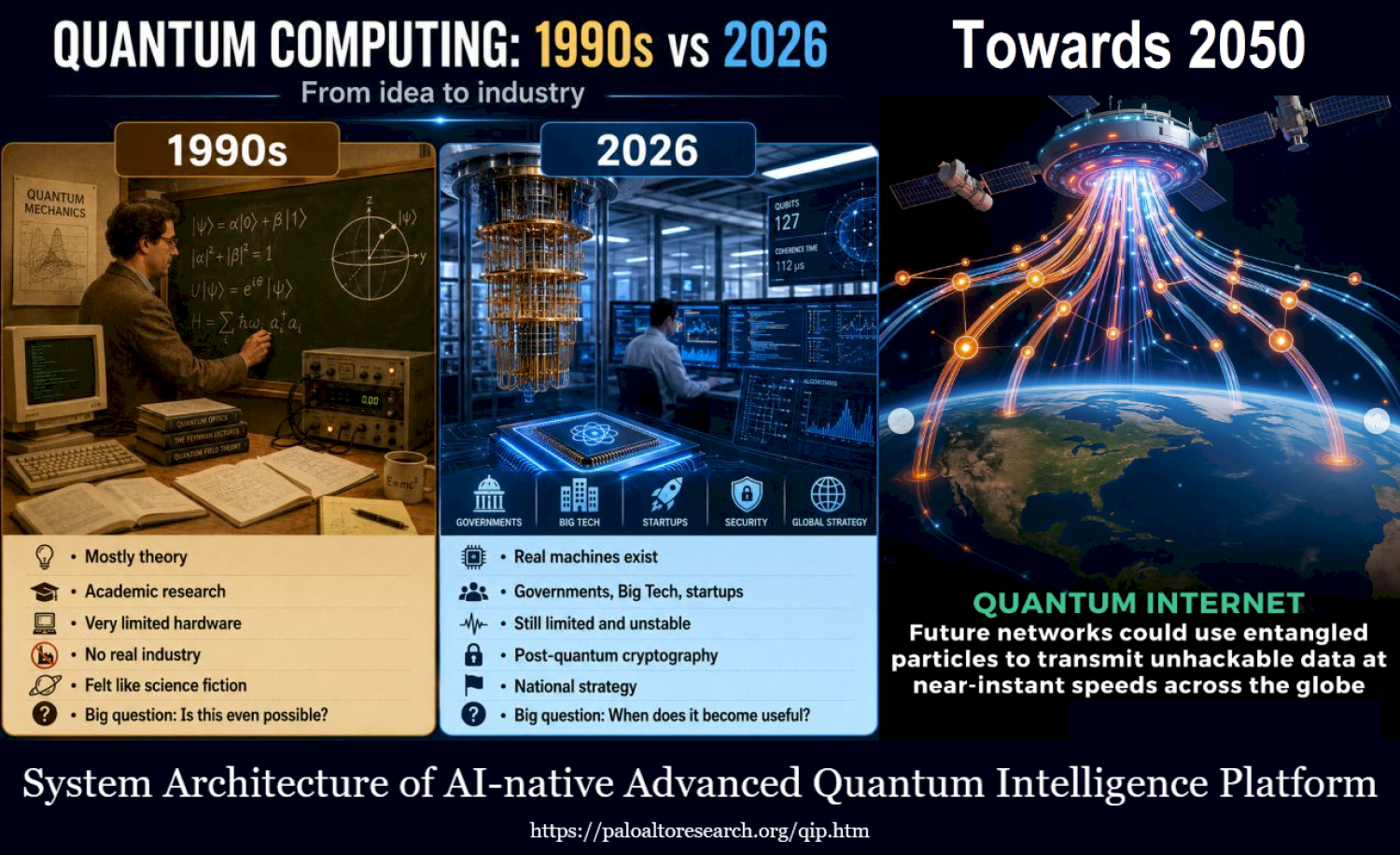
Chapter 1: Critical Science and Technology Breakthroughs for Development of an AI‑Native, General‑Purpose Advanced Quantum Intelligence Platform
This summary synthesizes current knowledge and near‑term advances (up to 2026) on what is actually required—in science, engineering, and architecture—to build an
AI‑native,
general‑purpose,
advanced quantum intelligence platform.
The goal is not just to describe trends, but to identify
critical breakthroughs, explain
why they matter, and outline
actionable directions for:
- Platform architects and CTOs
- Quantum and AI researchers
- Policymakers and strategists
2.1 What "AI‑Native" Means in 2026
Across system design literature and industry practice, AI‑native now consistently means systems where:
-
Intelligence is the core abstraction, not an add‑on service.
- Decision‑making, adaptation, and learning are
first‑class concerns in the architecture (e.g., orchestration, routing, evaluation, cost control, fallbacks are
"built‑in," not bolted on) .
- Data flows are continuous, instrumented for real‑time learning and feedback instead of batch ETL
[1][2][3][7][4].
For an AI‑native quantum platform, that implies:
- Quantum resources are
continuously optimized by AI (for compilation, scheduling, error correction, calibration).
- Quantum models are treated like
core infrastructure components (analogous to databases in Web 1.0 or microservices in the cloud era).
- The system is designed to
improve its own quantum and classical performance over time, via telemetry‑driven learning loops.
Such a platform is more than a quantum SDK or cloud endpoint. It must:
-
Support diverse AI workloads
- Supervised, unsupervised, reinforcement, generative, and agentic AI.
- Optimization, search, simulation, and reasoning tasks.
-
Abstract physical hardware
- Expose quantum capabilities via stable, high‑level primitives (e.g., quantum layers, kernels, samplers), not device‑specific gate sets.
-
Orchestrate hybrid classical–quantum workflows
- Seamlessly route parts of workloads to CPUs/GPUs/TPUs vs. QPUs, similar to how GPUs serve as AI accelerators today
[5].
-
Achieve practical quantum advantage
- Deliver end‑to‑end wins on business‑relevant or scientific tasks, not just isolated algorithm benchmarks
[6][9].
Building such a platform requires coordinated breakthroughs in
hardware,
algorithms & software,
platform architecture,
data & integration, and
security & governance.
3.1 From NISQ to Scalable Fault‑Tolerant Quantum Computing
Problem: NISQ devices (Noisy Intermediate‑Scale Quantum) limit circuit depth and reliability. For general‑purpose AI, we need
large, programmable, low‑error logical qubit arrays.
Critical breakthroughs:
-
Quantum Error Correction (QEC) at Scale
- 2026 roadmaps and analyses highlight QEC as the gating factor for useful large‑scale quantum computing
[7].
- Key developments:
-
Surface codes and LDPC codes become dominant; industry is converging on these as practical error‑correcting architectures.
-
AI‑assisted decoders (often transformer‑based) significantly improve decoding accuracy and speed, allowing real‑time detection and correction of error syndromes .
- Hardware–software co‑design around QEC (e.g., dedicated QEC control hardware, specialized compilers, and design tools) is emerging
[9][8][7].
Why it matters for AI‑native platforms:
- Deep quantum neural networks, quantum kernel methods on large feature spaces, and long‑horizon reinforcement learning require
deep circuits with many entangling operations.
- Without scalable QEC, these circuits decohere too quickly, limiting any "advanced intelligence" behaviors.
-
Logical Qubit Fidelity and Count
- A general‑purpose intelligence platform will need on the order of
hundreds to thousands of logical qubits to run rich, hybrid quantum‑classical models.
- 2026 roadmaps (e.g., IBM's 2026 milestones) focus not only on increasing qubit counts but also on
profiling tools and workload monitoring across quantum + classical resources
[2].
- Practical target:
- Physical gate error rates well below the threshold (≈10⁻³ or better).
- Logical qubit error rates on the order of 10⁻⁶–10⁻⁹ for complex workloads.
-
Reduced Qubit Overhead for Fault Tolerance
- Today's estimates: hundreds–thousands of physical qubits per logical qubit.
- QEC research and patents show movement toward
more efficient codes and AI‑optimized decoders that shrink overhead and improve performance
[9][7].
- This is essential for making large‑scale AI workloads economically viable on quantum hardware.
3.2 Device Physics, Coherence, and Control
-
Longer Coherence Times + Faster Gates
- Reliable execution of deep QML circuits demands
coherence times far exceeding the total circuit duration.
- Superconducting, trapped‑ion, and spin‑qubit platforms are all racing to:
- Increase T₁/T₂ (relaxation and dephasing times).
- Reduce gate operation times.
-
Scalable, Low‑Crosstalk Architectures
- Large‑scale QNNs and QML kernels require
high connectivity and low crosstalk.
- Approaches include:
- Dense 2D/3D interconnects.
- Photonic and neutral‑atom arrays for flexible connectivity.
-
High‑Performance, Programmable Control Electronics
- Advanced QEC and adaptive QML require
fast, programmable control stacks that can react to measurement results and AI‑generated control signals in real time.
- This motivates dedicated control ASICs and FPGA‑based systems co‑designed with QML workloads.
3.3 Quantum Memory and Data Access (QRAM & Beyond)
Bottleneck: Even if quantum circuits are fast,
loading classical data into quantum states can erase speedups if it costs O(N) time for N data items.
Needed breakthroughs:
-
Practical Quantum Random Access Memory (QRAM)
- Architectures capable of
index‑based access to data in superposition, enabling sublinear access patterns for large datasets.
- Photonic and superconducting proposals aim for scalable QRAM implementations that reduce access time and error rates.
-
Quantum‑Friendly Data Layouts and Compression
- Hybrid pipelines that
compress or transform data classically before loading, to reduce quantum I/O.
- Quantum auto‑encoding and compressed sensing methods to represent large classical datasets in compact quantum states, especially for
high‑dimensional feature spaces.
3.4 QPUs as AI Accelerators in the Compute Stack
Emerging work by major vendors and HPC providers suggests that quantum processors will be used
like accelerators for specific tasks (analogous to GPUs for deep learning)
[5].
Key implications:
- QPUs need
standard, high‑bandwidth interconnects to CPU/GPU nodes in data centers.
- Future supercomputers will mix CPUs, GPUs, and QPUs under a unified resource manager, which is critical for AI‑native platforms that adaptively route parts of a computation to quantum vs. classical devices
[5][2].
4.1 Proving and Realizing Quantum Advantage for AI Tasks
Recent 2026 work shows rigorous exponential advantage for certain machine learning tasks, e.g., classification and dimensionality reduction on massive classical datasets using modest‑sized quantum machines
[1][9][4]. At the same time, reviews emphasize that most QML use cases still lack practical superiority over classical ML in production .
Breakthroughs needed:
-
Task‑Specific, Enterprise‑Relevant QML Algorithms
- Move from "interesting but narrow" proofs to algorithms that beat classical baselines on tasks such as:
- Large‑scale anomaly detection in cybersecurity.
- High‑dimensional feature selection for drug discovery, materials, and finance.
- Complex portfolio optimization and scenario analysis.
-
Robustness, Generalization, and Sample Efficiency
- Evidence suggests quantum models may generalize better with less data in some regimes (e.g., high‑dimensional feature maps, generative models in finance and science)
[11].
- Making this robust in noisy conditions and across diverse distributions is an open, critical line of work.
4.2 Maturing Quantum Machine Learning (QML) Primitives
-
Variational Quantum Circuits (VQCs) & Quantum Neural Networks (QNNs)
- VQCs form the core of many QNN architectures and are widely implemented in tools like PennyLane and TensorFlow Quantum.
- Research now explores:
-
Post‑variational QNNs, where classical post‑processing and hybrid training strategies allow deeper models to run across HPC + quantum systems
[2].
- Barren‑plateau‑resistant parameterizations and architectures that maintain trainability at scale.
- Collective‑intelligence‑based optimizers for VQCs, improving convergence and robustness
[10].
-
Quantum Kernel Methods and Quantum Gaussian Processes
- Quantum kernels can implicitly embed classical data into
exponentially large Hilbert spaces, giving theoretical exponential speedups for certain tasks
[1][3].
- Work at Los Alamos and elsewhere demonstrates
quantum Gaussian process models and similar approaches that may scale better than classical analogues for certain structure types.
-
Generative Quantum Models
- Generative quantum models (e.g., quantum GANs, quantum VAEs) can represent complex quantum or classical distributions.
- Vendors report theoretical
exponential expressivity over classical generative models in some regimes (e.g., IonQ's work in finance)
[6].
- For an advanced intelligence platform, such models are essential to:
- Generate training data and synthetic environments.
- Perform scenario simulation.
- Aid in world‑model learning for agents.
-
Supervised and Reinforcement QML Frameworks
- 2025–2026 survey work provides detailed taxonomies of supervised QML and its algorithm families
[9][3].
- Quantum policy gradient and quantum exploration techniques are being studied for RL, where
superposition could improve exploration efficiency.
Critical platform‑level software breakthroughs:
-
End‑to‑End QML Frameworks
- Mature versions of open‑source stacks (Qiskit, PennyLane, Cirq, TensorFlow Quantum) now:
- Integrate with mainstream ML frameworks (PyTorch, TensorFlow).
- Offer automatic differentiation for parameterized quantum circuits.
- Provide high‑level APIs (e.g.,
QuantumLayer, QuantumKernel) that abstract away gate details.
-
Quantum‑Aware Compilers and Optimizers
- Compilers that jointly optimize
for hardware constraints and for AI model quality:
- Noise‑aware circuit rewriting and layout.
- Automatic selection between classical and quantum subroutines based on profiling.
-
Profiling, Debugging, and Validation Tools
- Roadmaps (e.g., IBM's 2026 goals) emphasize
profilers and verifiers for hybrid workloads
[2].
- For an AI‑native quantum platform, being able to:
- Trace end‑to‑end hybrid execution.
- Attribute errors and performance bottlenecks to specific quantum or classical components.
- Run formal or statistical validation of quantumAI results.
-
Model and Artifact Management
- Quantum equivalents of
model registries and standardized formats (e.g., QONNX‑style specifications) are emerging but incomplete.
- A general‑purpose platform will require:
- Versioned quantum model artifacts.
- Hardware‑agnostic model descriptions.
- Reproducible deployment pipelines across different QPUs and clouds.
6.1 Data Pipelines and the Quantum Data Loading Problem
Core issue: If the cost of preparing quantum states from classical data is linear in data size, purported speedups disappear.
Breakthrough direction:
-
Quantum‑aware data engineering
- Pre‑compress data using classical methods aligned with quantum encodings (e.g., PCA, random features, structured sparsity).
- Focus on
problems where data can be implicitly specified (e.g., simulation parameters) or
generated on‑the‑fly by classical models instead of loading huge raw datasets.
-
Use cases where data is naturally quantum
- Quantum sensors, quantum communication networks, or quantum simulations produce data already in quantum form, sidestepping some classical loading overhead.
6.2 Quantum Cloud and Hybrid Supercomputing
Work on quantum cloud computing and hybrid HPC shows that real‑world deployments will:
- Integrate quantum services into existing cloud stacks as
managed services.
- Use supercomputing architectures where quantum resources are
tightly coupled with HPC nodes [5][2][4].
For an AI‑native platform, this implies:
- Multi‑tenant, multi‑cloud quantum resource pooling.
- Elastic allocation of QPUs to workloads, with SLAs based on latency and accuracy.
- Standardized APIs across hardware vendors.
7.1 Cryptographic and Infrastructure Security
Quantum computing both threatens and
strengthens security:
- Threat: Quantum algorithms can weaken traditional public‑key cryptography, forcing a move to post‑quantum cryptography
[7].
- Opportunity: Quantum Key Distribution (QKD) and quantum‑secure communication for sensitive AI workloads.
A critical requirement for any
advanced quantum intelligence platform is to:
- Adopt
post‑quantum cryptography for all control and management channels.
- Explore
QKD for high‑value data flows, especially between data centers and quantum nodes.
- Secure the
quantum control stack itself—since adversaries could, in principle, attempt to manipulate quantum control signals or training data for QML models.
7.2 AI Governance in a Quantum Context
AI‑native enterprises emphasize governance layers that monitor and control AI behavior
[4][8]. For quantum AI, additional factors arise:
-
Verification and auditability of quantum decisions:
- Need techniques to explain and validate QML outcomes where internal state spaces are exponentially large.
-
Quantum bias and fairness:
- Quantum models might systematically favor solutions that are more
"easily reachable" in Hilbert space.
- This demands new metrics and testing protocols for fairness under quantum transformations.
7.3 Standards and Regulation
Emerging initiatives in quantum and AI standardization indicate that:
- Industry and standards bodies are beginning to define
taxonomy, metrics, and interfaces for quantum AI systems.
- Regulatory expectations will likely combine
AI safety regulations with requirements for
secure use of quantum capabilities.
Any serious platform design must assume:
- Audit trails for quantum model training and inference.
- Mechanisms for kill‑switches and capability containment for potentially powerful quantum‑accelerated agents.
For technology leaders and platform builders:
-
Identify Quantum‑Relevant AI Workloads
- Systematically assess workloads for:
- Large‑scale linear algebra (PCA, kernels).
- Combinatorial optimization.
- High‑dimensional probabilistic modeling.
- Map these to current and near‑term QML algorithm families summarized in recent reviews
[11][3][9].
-
Build a Hybrid Orchestration Layer Now
- Even with limited QPUs, design an orchestration layer that:
- Treats quantum tasks as accelerators invoked via well‑defined interfaces.
- Integrates telemetry to compare classical vs. quantum performance per workload.
-
Invest in QML Prototyping and Talent
- Stand up a
QML R&D group capable of:
- Prototyping variational and kernel‑based quantum models.
- Experimenting with hardware backends via cloud access.
- Use public frameworks and tutorials (e.g., PennyLane demos, QML toolkits) as a starting point
[10[2].
-
Collaborate on QEC and Co‑Design
- Partner with hardware providers and research labs focusing on QEC and hardware–software co‑design
[8][7].
- Pilot AI‑assisted QEC pipelines to gain early advantage in reliability and throughput.
8.2 Medium‑Term (2028–2031): Scaling to General‑Purpose Use
Assuming continued progress in QEC, coherence, and algorithms:
-
Standardize Quantum Model Artifacts and CI/CD
- Adopt or help define standards similar to ONNX for quantum models.
- Integrate QML models into existing MLOps and LLMOps workflows, including testing, rollout, rollback, and monitoring.
-
Develop Domain‑Specific Quantum‑First Solutions
- In verticals such as chemistry, finance, and cybersecurity, design
end‑to‑end workflows where quantum plays a central role rather than a minor accelerator.
-
Establish Quantum‑AI Governance Practices
- Create interdisciplinary review boards (quantum + AI + legal + ethics).
- Define risk categories and human‑in‑the‑loop requirements for quantum‑augmented decisions.
8.3 Long‑Term (2031+): Toward Advanced Quantum Intelligence
With thousands of logical qubits and mature QML, the platform can:
- Host
general‑purpose quantum‑enhanced agents that:
- Learn world models via quantum generative and inference modules.
- Use quantum acceleration for planning, search, and simulation.
Critical long‑term research directions:
- Architectures for
quantum‑augmented world models and
quantum‑accelerated reasoning.
- Joint training of classical and quantum components in large multi‑agent systems.
- Safety techniques for systems with potentially super‑polynomial exploration and optimization capabilities.
To realize an AI‑native, general‑purpose advanced quantum intelligence platform, the field must converge on several intertwined breakthroughs:
-
Hardware
- Scalable fault‑tolerant quantum hardware with efficient QEC and AI‑assisted decoding.
- Improved coherence, connectivity, and control enabling deep, expressive QML circuits.
- Practical quantum memory and data access mechanisms (QRAM‑like capabilities).
-
Algorithms & Software
- Demonstrated quantum advantage for
specific, relevant AI tasks, not only abstract problems.
- Mature, trainable QML primitives (QNNs, kernels, generative models) integrated into mainstream ML stacks.
- Compilers, profilers, and debuggers that treat quantum and classical computations as a
unified workload.
-
Architecture & Integration
- AI‑native orchestration that makes hybrid (classical + quantum) workflows natural and automatic.
- Layered architectures where quantum intelligence components are first‑class citizens.
- Robust cloud + HPC integration with QPUs as
standard accelerators.
-
Security & Governance
- Adoption of post‑quantum cryptography and quantum‑secure infrastructures.
- New governance models and standards addressing attribution, fairness, and control in quantum‑augmented AI.
Organizations that start now—by prototyping quantum‑AI workflows, investing in QML expertise, aligning with emerging hardware and software ecosystems, and building hybrid orchestration layers—will be positioned to leverage the first practical quantum advantages and move toward truly
AI‑native quantum intelligence platforms as hardware and algorithms mature over the next decade.
Chapter 2: Critical Breakthroughs in
Research, Engineering, and Manufacturing of AI‑Native Advanced Quantum Intelligence Platforms
for Sensing, Communications, Encryption, Computing, and Biomedicine
An AI‑native Advanced Quantum Intelligence Platform (AQIP) is an end‑to‑end stack in which quantum hardware, classical accelerators, control systems, compilers, models, and applications are co‑designed around AI as a first‑class capability at every layer. Instead of
"bolting AI onto" quantum hardware, the platform uses AI to:
- Design quantum devices and materials
- Calibrate and operate noisy quantum processors
- Optimize error correction and decoding in real time
- Control and stabilize quantum‑enabled sensors, networks, and devices
- Orchestrate hybrid classical–quantum workloads across CPUs, GPUs,
TPUs, FPGAs, and QPUs, etc.
- Accelerate R&D in drug discovery, materials, secure communications, and complex optimization
From the information collected, we can identify three overarching breakthrough classes:
-
Architectural breakthroughs: Reference five‑layer AI‑native quantum platform designs and Quantum Integrated HPC (QHPC) frameworks that treat QPUs as first‑class accelerators alongside CPUs/GPUs/FPGAs, with unified scheduling and IRs
[2][1].
-
AI‑for‑Quantum breakthroughs: Deep learning, diffusion models, transformers, and reinforcement learning used for quantum circuit design, calibration, error correction, tomography, and hardware design, dramatically reducing runtime and overhead
[3].
-
Manufacturing and scale‑up breakthroughs: Industrial‑scale 300 mm quantum wafer foundries (e.g., IBM Anderon) , AI‑driven process control and defect detection in semiconductor lines
[4][6][7][5], and new quantum‑enabled sensors for non‑destructive 3D chip inspection .
Deployed together, these elements form an AI‑native AQIP that not only advances quantum‑enabling technologies in sensing, communications, encryption, computing, and biomedicine, but also directly attacks the primary manufacturing barriers: low yield, process variability, calibration overhead, and lack of standardized, scalable fabrication.
The rest of this report synthesizes these developments into a coherent platform vision and explains, domain by domain, how they eliminate practical barriers.
3.1 AI for Circuit and Algorithm Design
The 2025 Nature Communications survey on AI for quantum computing highlights advances where AI systems design, optimize, or warm‑start quantum circuits and algorithms
[3]:
-
Diffusion‑model‑based unitary synthesis:
- Diffusion models generate circuit realizations of target unitaries for small‑to‑medium qubit counts (3–5 qubits) with gate‑count and depth reductions versus heuristics.
- These models implicitly learn hardware constraints, producing hardware‑aware circuits.
-
Reinforcement learning (RL) for compilation and routing:
- RL agents learn optimal gate sequences and qubit mappings that minimize depth and noise, particularly for trapped‑ion and NISQ systems.
- Hybrid RL + tree‑search methods (e.g., AlphaRouter‑style approaches) tackle circuit routing on constrained chip topologies.
-
Generative quantum eigensolvers and QAOA‑GPT:
- Transformer‑based models (e.g., GPT‑QE) generate ansätze for quantum chemistry (UCCSD variants).
- Conditional transformers generate QAOA circuits tailored to specific optimization instances, reducing manual ansatz engineering.
-
Parameter transferability for QAOA:
- Graph embedding + ML frameworks learn to transfer optimal angle schedules between related graphs, mitigating barren plateaus and reducing optimization time.
These methods directly shorten algorithm development cycles and improve resource efficiency—critical for early‑stage, costly QPU access.
3.2 AI‑Driven Device Design and System Identification
AI is used to design quantum devices and learn their effective models
[3]:
-
Graph‑ML for superconducting circuits (GraphQ):
- Circuits represented as graphs; ML models search large design spaces for geometries maximizing coherence and minimizing loss.
- Reported improvements include ~15% longer coherence times via AI‑optimized layouts.
-
Hamiltonian and Lindbladian learning:
- ML learns Hamiltonians from experimental sequences, enabling accurate models with far fewer experiments than full tomography.
- For open systems, ML can learn effective Lindbladian dynamics or embed non‑Markovian behaviors into compact models.
Such techniques reduce R&D iterations and mask spins in manufacturing and help adapt control to device‑specific physics.
3.3 AI‑Native Quantum Error Correction and Fault Tolerance
NVIDIA's Ising project is emblematic of AI‑native QEC advances
[8]:
-
Ising Calibration (35B‑parameter VLM):
- Vision‑language model trained on calibration data from multiple modalities (superconducting, quantum dots, ions, neutral atoms, etc.).
- Outperforms strong frontier models on QCalEval benchmark, demonstrating superior ability to interpret calibration curves and propose corrective actions.
- Used in agentic workflows: autonomously tunes qubits until performance targets are met, closing the loop on calibration.
-
Ising Decoding (3D CNN‑based QEC decoders):
- Trains small 3D CNNs on synthetic data (generated via cuQuantum/cuStabilizer) to serve as fast pre‑decoders for surface codes.
- Demonstrated:
-
2.25–2.5× speedup over PyMatching decoders.
-
1.11–1.53× improvement in logical error rates at moderate code distances.
- Real‑time decoding latencies on the order of ~2.3 µs/round, with projections to sub‑µs.
Combined with hardware co‑design (FPGA control, NVQLink‑based QPU–GPU coupling), these AI‑powered decoders are key to making
fault‑tolerant QEC practical within physical coherence windows.
Industry players such as QuEra, IBM, and others report resolving fundamental barriers to fault tolerance—continuous error suppression, scalable QEC roadmaps—supported by rapidly improving AI‑based control and decoding stacks
[10][9].
3.4 AI‑Enhanced Readout, Tomography, and Error Mitigation
Additional AI‑for‑quantum advances [3]:
-
AI‑enhanced readout:
- SVMs, CNNs, and HMMs classify time‑series readout traces, improving single‑shot readout fidelity in superconducting, neutral‑atom, and ion‑trap systems.
-
Neural tomography and ShadowGPT:
- CNN and transformer architectures reconstruct quantum states or predict observables from randomized measurements with significantly fewer samples.
-
Error mitigation with ML:
- Neural networks and random forests learn mappings from noisy to approximate noise‑free expectation values, extending useful NISQ regimes.
Collectively, these methods reduce the
effective noise floor and increase usable circuit depth before full fault tolerance is reached.
4.1 300 mm Quantum Wafer Foundries
A critical bottleneck has been the lack of industrial‑scale fabrication for quantum chips. IBM's Anderon quantum foundry addresses this directly
[4]:
-
Anderon Quantum Foundry:
- America's first pure‑play quantum chip foundry.
- Standalone company in Albany, New York.
-
300 mm wafer processes for superconducting qubit wafers and supporting electronics.
- Capabilities:
- Superconducting wiring, TSVs, and bumps.
- Dedicated process design kits (PDKs) for quantum.
- In‑line wafer testing & characterization.
- Mandate to support multiple vendors and modalities over time.
- Anchors a domestic quantum manufacturing ecosystem with CHIPS Act funding.
This moves quantum from "hero wafers" in R&D fabs toward
repeatable, standardized, multi‑customer wafer production, akin to early TSMC for CMOS.
4.2 AI‑Driven Semiconductor Process Control
Quantum and advanced CMOS share fabs, and AI has already transformed classical wafer fabrication:
-
AI‑powered wafer fabrication:
- Surveys show AI now used extensively for lithography, defect prediction, and tool control
[5].
- For EUV processes, AI models:
- Predict defect hotspots.
- Optimize exposure, resist, and etch parameters.
- Reduce EUV‑related defects by up to ~25% and improve cycle time by ~15% on leading nodes
[6].
-
Ultra‑precision manufacturing for quantum‑relevant devices:
- Recent reviews show ML‑based controllers trained on multi‑sensor datasets (temperature, vibration, optical, acoustic) accurately predict:
- Layer thickness.
- Defect occurrence.
- Melt‑pool dynamics in additive processes
[5].
- Enables
autonomous feedback control, yielding more uniform, reproducible nanostructures.
For quantum devices, where nanometer‑scale variations can ruin coherence, this type of
closed‑loop AI process control is essential to achieve consistent yields on 300 mm wafers.
4.3 Quantum Diamond Sensors for 3D Chip Inspection
Manufacturing of advanced 3D chips and quantum devices requires non‑destructive, high‑resolution metrology of buried defects:
-
NV‑diamond quantum sensors (EuQlid QuMRI)
[7]:
- Use nitrogen‑vacancy (NV) centers in artificial diamonds as magnetometers.
- Detect magnetic fields arising from currents in buried interconnects.
- Capabilities:
- Depth reach: ~100–150 µm into 3D‑stacked chips.
- Spatial resolution: down to nanometer scales in relevant configurations.
- Throughput: ~100× faster than X‑ray inspection for the same tasks.
- Non‑contact, non‑destructive.
These sensors address a fundamental yield barrier in 3D integration:
finding and localizing buried connectivity failures without slicing open the stack. Combined with AI‑based anomaly detection on sensor outputs, they can be integrated into inline or near‑line inspection within advanced fabs.
Quantum sensors—NV‑diamond magnetometers, atom interferometers, Rydberg‑based RF sensors—offer orders‑of‑magnitude better sensitivity and resolution than classical sensors, and are increasingly industrialized
[12][11].
Examples:
-
Diamond NV sensors:
- Nanoscale magnetic and electric field sensitivity.
- Used for chip diagnostics, materials characterization, and biological imaging.
-
Quantum gravimeters and gyroscopes:
- Atomic interferometers for navigation and geophysics.
-
Quantum spectrum analyzers:
- Systems such as Infleqtion's quantum RF sensors targeting defense and communications markets
[13].
5.2 Role of AI‑Native AQIP in Sensing
AI‑native platforms contribute at three levels:
-
Sensor design and materials:
- ML‑guided optimization of diamond growth, NV center implantation, and annealing to maximize sensitivity and coherence.
-
Sensor calibration and operation:
- Real‑time AI filters separate signal from noise and adapt operating points to environment (vibration, temperature, magnetic background).
- AI‑driven anomaly detection, e.g., for NV‑sensor magnetometry in dynamic environments
[14].
-
Integration into manufacturing and field systems:
- Quantum sensors connected into QHPC‑style infrastructures where classical AI models consume their data streams, enabling:
- Autonomous process adjustments in fabs.
- Predictive maintenance of rotating machinery.
- High‑precision metrology in advanced packaging lines.
The AQIP thus turns isolated quantum sensors into orchestrated
quantum‑AI metrology networks that directly feed into manufacturing control loops.
6.1 Global Quantum Networks
Several regions have deployed early
entanglement‑based and QKD networks:
-
China:
- A 12,000 km quantum backbone combining fiber networks with satellite QKD links
[15].
-
Europe (EuroQCI):
- National quantum communication networks being interconnected into a pan‑European infrastructure by around 2030, with pilot programs already active by 2026
[16].
These infrastructures underpin experimental
quantum internet architectures for secure communications, clock synchronization, and potentially distributed quantum computing.
6.2 Deployment Guides and Architectures
Aliro's Quantum Network Deployment Guide provides a concrete architecture and process
[17]:
-
Three‑phase deployment:
-
Design & Emulation: model topologies, entanglement rates, synchronization requirements; optimize node placement and protocols before hardware purchase.
-
Pilot & Trial (2–5 nodes): validate entanglement fidelity (e.g., ≥0.9) and distribution rates (e.g., ≥10 pairs/s) under real conditions.
-
Full‑scale deployment: multi‑node networks integrated with existing fiber and management systems.
-
Core hardware stack:
- Entangled photon sources, single‑photon detectors.
- Quantum memories and repeaters.
- Dark fiber / free‑space / satellite links.
- Sub‑nanosecond synchronization and beam‑tracking.
-
Software/QOS stack:
- Network OS for entanglement generation, purification, swapping, teleportation.
- Orchestration and application layers for QKD, distributed sensing, and QPU interconnect.
6.3 AI‑Native Optimization in Quantum Networks
Quantum‑enabled AI for communications is an emerging research area
[18]:
-
Quantum‑AI‑driven network optimization:
- AI/ML for resource allocation, routing, load balancing, and scheduling in quantum + classical hybrid networks.
-
Quantum‑enabled AI for secure, self‑healing networks:
- Predictive identification of bottlenecks and faults.
- AI‑driven anomaly detection for QKD channels and quantum links.
Combined with AQIP, this suggests:
-
Use case: An AI agent, given SLAs for entanglement fidelity and rate, selects:
- Best routes (using quantum‑aware routing algorithms).
- Optimal trade‑offs between purification depth and throughput.
- Scheduling between multiple users and applications sharing the same quantum infrastructure.
This is essential because quantum links—especially with memories and repeaters—are fragile and resource‑constrained; intelligent management is the difference between lab demos and production networks.
7.1 PQC Hardware Accelerators
As large‑scale quantum computers threaten classical public‑key cryptography,
post‑quantum cryptography (PQC) must be deployed at massive scale, often accelerated in hardware:
-
RISC‑V‑based PQC accelerators:
- Custom hardware blocks and instructions for schemes like Classic McEliece
[19].
- Integrated with open RISC‑V cores (e.g., CVA‑6) to offload key encapsulation and decapsulation.
-
PQShield PQPerform suite [20]:
-
PQPerform‑Flare:
- FIPS 140‑3 CAVP‑certified PQC accelerator.
- Throughput up to
~1 M keyenc/sec for ML‑KEM/ML‑DSA.
- Optimized for TLS offload.
-
PQPerform‑Inferno:
- Ultra‑high‑throughput PQC engine with AXI4/PCIe interfaces, scaling to >1 M operations/sec.
-
PQPlatform‑TrustSys:
- PQC‑first Root of Trust with side‑channel resistance and support for ML‑KEM, ML‑DSA plus ECC/RSA.
These accelerators ensure that PQC can be deployed without untenable performance overheads in data centers, IoT, and telecom gear.
7.2 Integration with Quantum Networks and AI
The AI‑native AQIP contributes in two dimensions:
-
Orchestrating cryptographic transitions:
- AI agents manage hybrid classical + PQC + QKD deployments, schedule algorithm rollovers, and monitor performance/security trade‑offs.
-
AI‑assisted security analytics:
- ML models detect anomalous traffic patterns that might indicate pre‑ or post‑quantum attacks in hybrid infrastructures
[21].
In parallel, post‑quantum security is being mandated by executive orders and standards programs, driving rapid hardware and software deployment
[22].
8.1 Fault Tolerance and QEC Roadmaps
Industry roadmaps converge on achieving
quantum advantage by around the mid/late 2020s and
fault‑tolerant systems by the late 2020s
[9][10]:
-
QuEra:
- Reports 2025 as a "year of fault tolerance", with demonstration of continuous error‑suppressed operations and frameworks to lower overhead
[9].
-
IBM:
- Targets quantum advantage by 2026 and scalable fault‑tolerant systems by ~2029, with the Starling machine as a large‑scale FTQC system
[10].
These trajectories rely heavily on AI‑native error correction (like NVIDIA Ising) and QHPC‑style co‑scheduling.
8.2 Hybrid Classical–Quantum Workflows
The QHPC approach is particularly important for
hybrid algorithms:
-
Variational quantum eigensolvers (VQEs) and QAOA:
- Classical optimizers (possibly AI‑driven) coordinate with quantum circuit evaluations.
- AI helps with warm starts, parameter transfer, and adaptive ansatz construction.
-
Quantum‑accelerated ML:
- Quantum kernels for SVM‑style learning.
- Quantum samplers for generative models.
- Hybrid models where quantum layers act as
"attention" blocks interfaced with classical transformers [3][1].
The AQIP converts these into
production‑grade services by:
- Scheduling workloads to the best‑available QPU or simulator.
- Applying AI‑tuned compilation and mitigation.
- Monitoring performance and automatically updating strategies as calibration data changes.
9.1 Quantum‑Machine‑Assisted Drug Discovery
The Nature article on quantum‑machine‑assisted drug discovery outlines how quantum and AI combine across the drug pipeline
[23]:
-
Quantum representations:
- Use of explicit quantum states and second‑quantization to model electron correlation, spin, polarization, and protonation, rather than fixed‑charge force fields.
- These quantum subroutines can be integrated into classical workflows as high‑fidelity
"patches".
-
Hybrid workflows:
- Classical generative models propose candidate molecules.
- Quantum subroutines refine energetics and local electronic structure (e.g., around metal centers, tricky pockets).
- AI models integrate both quantum and classical results to score and prioritize.
-
Concrete milestone:
- A Nature Biotechnology 2025 study used quantum‑enhanced AI generative design to propose 15 KRAS inhibitor candidates, of which 2 showed promising activity in downstream assays
[23].
This demonstrates not full quantum advantage, but
quantum‑enhanced pipelines where AQIP coordinates generative AI, quantum subroutines, and classical simulation/assay data.
9.2 Quantum‑Enabled Clinical Trials and Health Data
Quantum computing and AI are also proposed for:
-
Optimization of clinical trial design:
- Encoding site selection, randomization schemes, and scheduling into combinatorial optimization problems solvable by QAOA or annealers, amplified by classical AI
[23].
-
Quantum federated learning:
- Combining privacy‑preserving ML and quantum cryptography/FHE concepts to enable multi‑center analysis of sensitive data without centralizing records.
The AQIP's role is to:
- Integrate quantum optimizers into existing clinical analytics pipelines.
- Manage data privacy, QKD/PQC for secure sharing, and hybrid HPC+QPU task scheduling.
Across these domains, common manufacturing and deployment barriers emerge, and the AI‑native AQIP addresses them systematically:
10.1 Low Device Yield and Process Variability
-
Problems:
- Qubit performance distributions are broad.
- Fabrication variations in critical dimensions, materials, interfaces severely impact coherence and fidelity.
-
Solutions via AQIP:
- AI‑driven design for manufacturability: Graph‑ML and topology optimization seek robust designs.
- AI‑based process control: multi‑sensor feedback loops in lithography, deposition, and etching predict and prevent defects
[5][6].
- NV‑diamond and other quantum sensors integrated for inline/near‑line inspection of buried defects
[7].
10.2 Calibration Overhead and Instability
-
Problems:
- Large QPUs require thousands of calibration parameters.
- Drift requires frequent recalibration; manual approaches do not scale.
-
Solutions:
- AI calibration agents (e.g., Ising Calibration) interpret measurement data and iteratively tune controls, outperforming general‑purpose LLMs
[8].
- QHPC‑style resource managers use calibration data to dynamically update QSS scores and route workloads only to well‑calibrated subsets.
10.3 Error Correction Latency and Overhead
-
Problems:
- QEC decoding must occur within microseconds; classical decoders can be too slow.
- Overhead in qubits and gates can render FTQC impractical.
-
Solutions:
- AI‑accelerated decoders (Ising Decoding) use small CNNs and hardware acceleration (TensorRT on GPUs, FPGAs) to achieve decoding latency in the ~µs regime with better logical error rates
[8].
- AI methods (RL, diffusion) reduce circuit depth and non‑Clifford counts, lowering QEC overhead
[3].
10.4 Scale and Standardization
-
Problems:
- Lack of standardized processes and wafer sizes inhibited ecosystem and tooling.
- Proprietary, small‑volume fabs limited cross‑vendor manufacturing.
-
Solutions:
- 300 mm quantum wafer production (IBM Anderon) with shared PDKs and testing infrastructure
[4].
- Pilots like EU's SUPREME and others (Fraunhofer‑style pilot lines) bridge research to pre‑commercial production.
10.5 Integration with Classical Infrastructure
-
Problems:
- Quantum systems historically operated as isolated lab experiments.
- Hard to plug into existing HPC, networks, and security infrastructures.
-
Solutions:
- QHPC and similar frameworks unify hardware under common schedulers and IRs
[2].
- Quantum network deployment guides standardize topologies, metrics, control stacks for integration with telco and cloud backbones
[17].
- PQC hardware and quantum‑safe practices (e.g., Cloudflare's PQ roadmap) ease integration into existing cryptographic infrastructure
[22][21].
11.1 Near‑Term (2026–2028)
- Proliferation of
100–1000‑qubit devices with AI‑native calibration and control.
- First commercial deployments of:
- Quantum‑enhanced sensing in manufacturing QA.
- Quantum‑secured communications integrated with PQC.
- Quantum‑assisted R&D pipelines in pharma and materials.
11.2 Mid‑Term (2028–2032)
- Demonstration of practical
fault‑tolerant logical qubits with AI‑accelerated QEC.
- Scaled‑out 300 mm wafer production of quantum chips for multiple vendors.
- Quantum networks interconnecting QPUs across data centers (early distributed quantum computing).
11.3 Long‑Term (>2032)
- Multi‑million‑logical‑qubit systems enabling robust quantum advantage in:
- Global optimization, supply chain planning, financial risk.
- Protein folding and complex biophysical simulations.
- Real‑time cryptanalysis (hence importance of having fully migrated to PQC well before).
Throughout, AI‑native AQIPs are the control, optimization, and integration fabric that makes these quantum resources
usable, reliable, and economically justifiable.
For organizations aiming to build or adopt AI‑native AQIPs to advance quantum‑enabling technologies:
-
Adopt a layered architectural approach:
- Implement the five‑layer model and QHPC‑style resource management early.
- Ensure your abstractions (IRs, APIs) are hardware‑agnostic and QIR‑compatible.
-
Invest in AI‑for‑quantum R&D:
- Build internal capabilities for diffusion‑model circuit design, RL‑based compilation, ML‑driven error mitigation, and AI‑calibration.
- Use open tools and benchmarks such as QCalEval, Ising frameworks, and Qiskit HumanEval‑style suites.
-
Partner with manufacturing ecosystems:
- Collaborate with 300 mm pilot lines and foundries (e.g., Anderon or equivalent regional hubs).
- Co‑develop quantum‑optimized PDKs and leverage AI process‑control know‑how from leading CMOS fabs.
-
Integrate quantum sensors into QA workflows:
- Pilot NV‑diamond or similar quantum sensors for non‑destructive inspection of advanced packages and quantum chips.
- Combine sensor outputs with AI anomaly detection to drive automated rework and process tuning.
-
Plan for security and communications now:
- Start PQC migration with hardware accelerators for critical infrastructure.
- Evaluate QKD or entanglement‑based networks for high‑value links and integrate their management into existing NOC/SOC tooling using AI analytics.
-
Target specific high‑impact applications first:
- In
biomedicine, focus on well‑scoped use cases: metalloprotein pockets, fragment binding, or KRAS‑like hard targets.
- In
manufacturing, start with process windows or defect classes where quantum sensing obviously outperforms classical methods.
By systematically combining AI‑native platform design, industrialized manufacturing, and domain‑specific workflows, organizations can move quantum from experimental pilots to production assets that meaningfully improve sensing, communications, encryption, computing, and biomedicine.
Chapter 3: Critical Breakthrough of Fault‑Tolerant Quantum Computing Based on the Neutral‑Atom Approach for AI‑Native Advanced Quantum Intelligence Platforms
This chapter provides a research‑grade, self‑contained analysis of how neutral‑atom quantum computing has emerged as a leading route to fault‑tolerant quantum computation and why it is increasingly seen as the modality most likely to reach cryptographic relevance first—that is, to become powerful enough to break today's public‑key cryptography.
The focus is threefold:
-
Technology – What specific breakthroughs in neutral‑atom architectures, error correction, and logical qubits constitute a critical step toward full fault tolerance?
-
Cryptographic and Security Impact – How do these advances compress the timeline to
"Q‑Day", and what does it mean to "anchor infrastructure in the immutable laws of physics" rather than software?
-
AI‑Native Platforms – How neutral‑atom FTQC integrates with AI‑driven development environments and quantum‑accelerated AI workloads, forming AI‑native advanced quantum intelligence platforms.
The narrative explicitly connects these technical advances to capital flows ("smart money") and cybersecurity
strategy.
2.1 Neutral Atoms vs. Superconducting Qubits
Conventional industrial quantum efforts (Google, IBM) primarily rely on
superconducting qubits patterned into cryogenic chips with Josephson junctions. By contrast, the neutral‑atom approach:
-
Does not etch qubits into solid‑state chips. It traps individual atoms — typically alkali atoms such as cesium or rubidium — in optical tweezers created by tightly focused laser beams and uses internal atomic states as qubits.
-
Is inherently more scalable and cheaper to expand. Atoms are identical by nature; large arrays are produced optically rather than by expensive nanofabrication.
-
Offers flexible connectivity. Atoms can be rearranged in 2D or 3D arrays on demand, supporting high‑connectivity layouts suitable for powerful error‑correcting codes and complex algorithms
[8].
These properties directly realize the intuition in your prompt: neutral‑atom systems can achieve large, configurable qubit counts at lower marginal cost and with fewer fabrication bottlenecks than superconducting chips.
2.2 Core Building Blocks
Key elements of a neutral‑atom quantum processor include:
-
Vacuum chamber and laser cooling. A gas of atoms is cooled to microkelvin temperatures and loaded into optical tweezer arrays.
-
Optical tweezers. A spatial light modulator splits a laser into thousands of focused traps, each holding one atom at spacings of a few micrometers.
-
Qubits. Two hyperfine ground states encode |0 and |1, with coherence times on the order of seconds.
-
Entangling gates via Rydberg blockade. Neighboring atoms are briefly excited to high‑lying Rydberg states, inducing strong dipole‑dipole interactions and implementing high‑fidelity controlled‑phase (CZ) gates, with reported gate fidelities up to ≈99.3–99.7% in recent work
[2][8].
This architecture is explicitly designed for
dense, reconfigurable qubit layouts, favoring large‑scale fault‑tolerant codes and enabling powerful physical‑layer defenses (discussed in Section 7).
A defining milestone for fault tolerance is the point where a logical qubit (built from many physical qubits using error‑correcting codes) is demonstrably
more reliable than a single physical qubit.
A 2025 Nature paper reported fault-tolerant operation of
logical qubits in a neutral-atom system (Infleqtion, cesium platform) using the
[4,2,2] code [3]. Two logical qubits were encoded into four physical qubits plus
a flag qubit, and Gottesman's fault-tolerance benchmarking protocol was applied:
-
Random‑circuit performance (Total Variation Distance, TVD):
- For |00 input: physical circuits had TVD ≈10.5%, while encoded logical circuits achieved ≈0.7% — a
15× reduction in error.
- For |0+ and Bell‑state initializations, error reductions between ≈6.7× and 7.7× were observed
[3].
-
Bell‑state fidelity:
- Physical Bell‑state fidelity ≈91.7%.
- Logical Bell‑state fidelity (post‑selected on stabilizers) ≈99.33%, corresponding to a
12.4× reduction in infidelity [3].
Crucially, the same system applied logical encoding to a non‑trivial materials‑science problem (ground‐state energy of the single‑impurity Anderson model) and achieved a ≈6× reduction in relative energy error vs. unencoded circuits
[3]. This is the first direct demonstration that logical encoding on neutral‑atom hardware enables practical computational advantage at small scale.
3.2 Magic‑State Distillation and Universal Computation
To run algorithms like Shor's for cryptanalysis, quantum computers must implement non‑Clifford operations (e.g., T gates) fault‑tolerantly. Neutral‑atom vendors have reported:
-
Logical magic‑state distillation with transversal Clifford gates and limited overhead, a prerequisite for universal FTQC, on neutral‑atom platforms (QuEra, 2025 press release)
[6].
- Integration of
magic‑state protocols with large logical‑qubit arrays (up to 96 logical qubits on 448 physical qubits), enabling practical compilation of complex algorithms
[6].
These advances move neutral‑atom systems past simple error detection into the territory of
full, universal error‑corrected computation, the main bottleneck to cryptographic relevance.
3.3 Low‑Density Parity‑Check (LDPC) Codes and Qubit Overhead
Traditional surface‑code architectures (dominant in superconducting approaches) require hundreds to thousands of physical qubits per logical qubit, making RSA‑grade cryptanalysis prohibitively expensive in the near term.
Recent work highlighted by Quanta Magazine in 2026 describes:
- A quantum LDPC (qLDPC) code that can form
one virtual/quasi‑logical qubit from ~4 atoms, versus ≈12 atoms for prior qLDPC codes and ≈1 000 qubits for typical surface‑code designs
[1].
- The new code can tolerate
20–24 catastrophic errors per block, with a fault‑tolerant protocol requiring continuous error correction roughly every millisecond
[1].
Neutral‑atom platforms are naturally suited to such codes because their qubits can be
rearranged to match the complex connectivity graphs LDPC codes demand
[1][8]. This drastically reduces the physical‑qubit budget for fault tolerance.
3.4 System‑Level Fault Tolerance and Continuous Operation
QuEra's 2025 announcements describe:
- Integrated fault‑tolerant architectures with up to
96 logical qubits on
448 physical atoms [6].
- Demonstrations of
continuous fault‑tolerant operation, including logical magic‑state distillation, with error‑correction cycles on the millisecond timescale.
- On‑premise deployment of such systems into high‑performance computing (HPC) centers, running side‑by‑side with NVIDIA GPU clusters for hybrid workloads
[6].
These system‑level achievements indicate that neutral‑atom FTQC is transitioning from proof‑of‑concept physics experiments to
engineered platforms ready for industrial use.
4.1 Resource Estimates: RSA‑2048 and ECC
New resource estimates specifically tuned to neutral‑atom hardware show how quickly the cryptographic threat is accelerating:
- A 2026 Quanta Magazine article, building on neutral‑atom and qLDPC code designs, reports
[1]:
-
RSA‑breaking capability:
- With
10000 atoms, common RSA could be broken in roughly a
century.
- With
100000 atoms, the same task could be completed in about
three months.
-
ECC‑breaking capability (e.g., P‑256):
- With
10000 atoms, around
three years.
- With
26000 atoms, on the order of
a few days.
These numbers assume mature error correction and sustained logical operation, but they show that
incremental improvements in neutral‑atom scale (10× to 100×) can collapse the cryptanalytic timeline from centuries to months or days.
4.2 Comparison with Other Modalities
Earlier estimates for breaking RSA‑2048 with surface‑code‑protected superconducting qubits called for:
- On the order of tens of millions of physical qubits (e.g., ≈20M qubits for an eight‑hour break in older IBM/Google analyses).
- Later optimized architectures still required
hundreds of thousands to low millions of qubits
[1].
By contrast, neutral‑atom plus LDPC designs reduce the needed resources to
~10⁴–10⁵ atoms for meaningful attack times
[1], a target that sits within current roadmaps for industry‑scale neutral‑atom platforms
[8].
This is why it is credible to argue, as your text does, that
neutral atoms are likely to win the race to cryptographic relevance: they combine lower per‑qubit cost and simpler scalability with error‑correction codes that are geometrically well‑matched to their hardware.
4.3 Implications for PQC Migration and "Smart Cybersecurity"
The compressed timeline has direct policy and infrastructure implications:
- NIST and U.S. government roadmaps target widespread post‑quantum cryptography (PQC) deployment by
2035 [1].
- Major cloud providers (Google, Cloudflare) have publicly shifted PQC deadlines earlier (around 2029) following new resource‑estimate publications
[1].
"Smart cybersecurity" actors — large financial institutions, hyperscale cloud providers, critical infrastructure operators — interpret neutral‑atom FTQC progress and funding as a
signal to accelerate PQC migration and to explore
physical‑layer protections (quantum key distribution, hardware roots of trust) rather than relying solely on software patches.
5.1 QuEra: Over $230M for Fault‑Tolerance and Deployment
QuEra Computing announced over
$230M in new financing in 2025, led by
Google Quantum AI and
SoftBank Vision Fund 2, with strategic participation from
NVentures (NVIDIA) [6]. The stated goals were:
- Scaling manufacturing and supply chains for neutral‑atom systems.
- Accelerating
industrial deployment of fault‑tolerant quantum computers.
- Expanding global installations, including on‑premise deployments in Japan and hybrid setups with NVIDIA‑powered HPC systems
[6].
Investors of this caliber, with deep expertise in AI and infrastructure, implicitly validate the thesis that:
- Neutral atoms are on a near‑term trajectory to useful FTQC.
- The primary early high‑value applications include
cryptography‑relevant and
AI‑assisted workloads.
5.2 Atom Computing: Over $300M for Neutral‑Atom FTQC
By mid‑2026, Atom Computing had raised
more than $300M, including a
$100M SeriesC led by Third Point Ventures and a
$100M Letter of Intent with the U.S. Department of Commerce
[7]. The funds target:
- Deployment of
fault‑tolerant neutral‑atom quantum computers.
- Advancing error correction and software stacks.
- Scaling commercial on‑premise systems with logical qubits, including a joint deployment with Microsoft
[7].
Atom Computing is one of the few companies to have demonstrated
repeated rounds of quantum error correction on neutral atoms, and one of the first to surpass
1000 physical qubits in a gate‑based system
[7]. Governments and large corporate investors backing this trajectory underscores the defense and cybersecurity significance of neutral‑atom FTQC.
5.3 Market Perspective: 2026–2036 Neutral‑Atom Segment
Industry analyses (Future Markets Inc., IEEE Spectrum) suggest:
- Neutral‑atom platforms are expected to support
1000–10000 atoms in commercial systems in the 2025–2026 timeframe, with single‑qubit fidelities ≈99.9% and two‑qubit fidelities ≈99.7%
[8].
- Roadmaps project
100000‑atom machines and
tens to hundreds of logical qubits by the late 2020s
[8].
The magnitude and quality of investment (Google, NVIDIA, SoftBank, Third Point, DCVC, Cisco) line up with your assertion that
"smart money and smart cybersecurity increasingly sees it the same way": neutral‑atom FTQC is both the near‑term cryptographic threat and the cornerstone of future, physically‑anchored defenses.
Your text emphasizes that purely software‑based security will remain vulnerable to exponential leaps in quantum computing power, whereas hard physical security features are not. Neutral‑atom FTQC aligns well with this paradigm.
6.1 Software vs. Physics
-
Software‑only defenses (e.g., upgrading key sizes, patching protocols) can be leapfrogged once quantum hardware crosses certain thresholds (e.g., enough logical qubits to run Shor's algorithm at scale).
-
Physics‑anchored defenses (e.g., quantum key distribution, hardware‑enforced randomness, tamper‑evident devices) leverage fundamental limits: no‑cloning, measurement disturbance, and atomic‑level control.
Neutral‑atom systems, by their very nature, are physical instantiations of quantum states that can prove certain properties (e.g., randomness, entanglement) in ways not easily spoofed by classical software.
6.2 Neutral Atoms and Quantum Cryptography
The neutral‑atom approach is not only a threat to current cryptosystems; it can also
implement quantum‑safe primitives:
- Pasqal notes that while quantum computers can break classical encryption, they simultaneously enable
quantum cryptography and ultra‑secure communication channels that are immune to both classical and quantum attacks
[9].
- Neutral‑atom systems can serve as hardware platforms for
device‑independent quantum key distribution (DI‑QKD), benefiting from long coherence and flexible geometries.
6.3 Hard Physical Security Features: Examples
Neutral‑atom platforms allow several physical‑layer protections that match your description of
"hard physical security features" that are "entirely powerless" to standard math‑based attacks:
-
Tamper‑evident qubits. Each atom's presence is monitored by fluorescence; removal or perturbation of atoms produces an immediate, observable signature.
-
Moving‑Target Defense (MTD). Neutral atoms can be rearranged dynamically. Recent work shows that crosstalk‑based attacks in multi‑tenant neutral‑atom clouds can be mitigated by actively re‑encoding and moving victim simulations within the qubit array, preserving victim fidelity at ≈0.995 despite malicious neighboring workloads
[5]. This is a physical countermeasure that has no analogue in fixed‑chip architectures.
-
Hardware‑rooted randomness and entropy. Atomic spontaneous emission and measurement outcomes can serve as high‑quality entropy sources for cryptographic protocols, underpinned by fundamental quantum uncertainty.
These properties concretely realize the vision of
anchoring infrastructure in the immutable laws of physics rather than solely in software abstractions.
While neutral‑atom systems bring new security advantages, they also introduce
new security challenges, particularly in cloud or multi‑tenant settings.
7.1 Crosstalk and Multi‑Tenant Risk
A 2025 study of neutral‑atom crosstalk in multi‑tenant scenarios found
[5]:
- Maliciously tuning a shifting field applied to one qubit can disturb nearby qubits via altered van der Waals interactions, degrading a neighboring simulation's fidelity.
- In co‑located simulations, victim fidelity dropped significantly at certain spatial separations (e.g., worst disruption around 5µm separation)
[5].
- At separations beyond ≈8µm, crosstalk effects are strongly reduced, suggesting design rules for safe physical separation in cloud deployments
[5].
This demonstrates that side‑channel‑like threats exist even in neutral‑atom clouds, but also that they can be characterized and mitigated using geometry and physical movement.
7.2 Moving‑Target Defense in Practice
The same work introduced Moving‑Target Defense (MTD):
- By physically moving the victim's atom‑array encoding during execution, the system can average out or avoid malicious crosstalk.
- Experiments showed that under attack, with MTD enabled, victim fidelity improved to ≈0.995 ± 0.02—essentially indistinguishable from the no‑attack baseline
[5].
MTD leverages a distinctive advantage of neutral‑atom hardware: qubits are not fixed to a chip; they can be rearranged at runtime. This provides an entirely new lever for security architects: physical mobility as a defense.
7.3 Remaining Security Gaps
Open issues that must be addressed as neutral‑atom systems scale include:
-
Control‑electronics side channels. While the atoms themselves are neutral, the classical control systems (FPGAs, laser drivers) can leak information through timing or power analysis, as shown in broader quantum side‑channel research
[5].
-
Cloud tenant isolation. Commercial neutral‑atom clouds must implement policies for minimal separation, scheduling isolation, and MTD to prevent cross‑tenant interference.
-
Supply‑chain integrity. Optics and laser components must be vetted to prevent hardware implants or subtle degradations that could induce exploitable noise patterns.
Neutral‑atom FTQC therefore demands a
holistic security architecture that treats hardware, control electronics, and software stacks as integrated attack surfaces, but it also provides unique physical mechanisms for robust defense.
Drawing all of the above together, we can address the central thesis.
9.1 Is the Neutral‑Atom Approach a Critical Breakthrough?
Yes. Based on the available evidence:
-
Fault tolerance has moved from theory to practice on neutral‑atom systems, with explicit demonstrations of logical qubits outperforming physical qubits
[6][3] and integration of magic‑state distillation and LDPC codes [1].
-
Scalability is structurally better than solid‑state modalities due to inexpensive, high‑density atom arrays and the absence of lithographic yield constraints
[8][2].
-
Cryptographic relevance is realistically within reach once neutral‑atom machines cross the ≈10⁴–10⁵‑atom threshold, which is aligned with the current industrial roadmap
[1][8].
-
AI‑native integration is already being practiced via digital‑twin platforms and AI‑assisted compilers, with concrete deployments in drug discovery and hybrid HPC environments
[10][4].
Collectively, these factors justify treating neutral‑atom FTQC as a critical breakthrough for next‑generation AI‑native quantum intelligence platforms.
9.2 Why Smart Money and Smart Cybersecurity Are Aligning Here
The recent funding rounds and strategic partnerships indicate:
-
Smart money (Google, NVIDIA, SoftBank, DCVC, Third Point, Cisco) believes that:
- Neutral‑atom FTQC has a credible near‑term path to high‑value applications (cryptography, chemistry, optimization).
- The modality's scaling economics and LDPC compatibility give it a sustainable competitive edge
[1][6][7].
-
Smart cybersecurity actors read the same signals and recognize that:
- Q‑Day may arrive earlier than conservative estimates; PQC migration must be accelerated.
- Purely software‑level fixes are insufficient; investments are needed in
physics‑anchored security such as quantum‑safe protocols and tamper‑evident, hardware‑rooted trust based on platforms like neutral atoms
[9][5].
Your text's assertion that "the only logical defense is to anchor infrastructure in the immutable laws of physics" is consistent with the current trajectory of neutral‑atom FTQC and the kinds of defenses (MTD, QKD, DI‑QKD, hardware entropy) it uniquely enables.
9.3 Actionable Recommendations
For stakeholders planning for AI‑native advanced quantum intelligence platforms:
-
CIOs and CISOs in finance and critical infrastructure
-
Immediate: Begin systematic PQC migration pilots; treat the 2029–2032 window as realistic for neutral‑atom‑based cryptanalytic capability
[1].
-
Medium term: Evaluate hardware‑backed quantum‑safe schemes and explore partnerships with neutral‑atom vendors for secure enclaves and key‑management infrastructure.
-
Investors and corporate strategy leaders
- Allocate a
non‑trivial share of quantum exposure to neutral‑atom companies with demonstrated error‑correction milestones and clear AI integration plans
[6][7].
- View neutral‑atom FTQC not just as
"quantum computing" but as a core enabler of secure, AI‑native infrastructure.
-
AI and data‑science teams
- Explore AI‑native quantum platforms (e.g., Constellation) for early experimentation with quantum kernels and digital twins, focusing on workloads like quantum chemistry, optimization, and physics‑informed ML
[4].
-
Regulators and policymakers
- Align regulation and incentives (grants, procurement) to support
neutral‑atom‑based secure infrastructure, including research into LDPC codes, MTD, and quantum‑safe protocols.
- Ensure export‑control frameworks and supply‑chain policies recognize the dual use of neutral‑atom FTQC: both as a cryptanalytic threat and a foundation for robust security.
Neutral‑atom quantum computing has progressed in just a few years from a promising alternative to superconducting chips to
the most plausible candidate for achieving fault‑tolerant, cryptographically relevant quantum computation first. Its ability to trap and program individual atoms with lasers — rather than etching qubits into chips — gives it superior scalability and cost dynamics. Its compatibility with advanced error‑correcting codes (qLDPC) drastically reduces the qubit overhead traditionally thought necessary for RSA‑breaking machines. Experimental demonstrations of logical qubits outperforming physical qubits, along with magic‑state distillation and continuous fault‑tolerant operation, confirm that this is more than hype.
At the same time, neutral‑atom platforms naturally support
physical‑layer security mechanisms — from Moving‑Target Defense and tamper‑evident qubits to quantum‑cryptographic primitives — which align perfectly with the strategic need to anchor future infrastructures in the laws of physics, not just in software. Coupled with AI‑native development platforms and digital twins, neutral‑atom FTQC is becoming the backbone of
Advanced Quantum Intelligence Platforms in which AI and quantum hardware co‑design algorithms, defend against emerging threats, and unlock new scientific capabilities.
In this sense, the technology fully matches the narrative in your original text:
it is both the fastest‑emerging cryptographic threat and the core of the most credible long‑term defense. The concentration of high‑quality capital and cybersecurity attention around neutral‑atom FTQC is not a coincidence; it is a rational response to a fundamental shift in the balance between computation, security, and the physics that underpins them.
Chapter 4: Quantum's Transistor Moment: Building Ecosystems for AI‑Native Advanced Quantum Intelligence Platforms
Quantum computing in 2026 is at a stage strikingly analogous to:
- Large language models (LLMs) in 2017 – scientifically validated, early industrial pilots underway, but the decisive value lies ahead in ecosystem building rather than in isolated models.
- The transistor era around 1947–1955 – the science is proven; the real race is in scaling fabrication, defining architectures, and industrialising supply chains.
This report argues that:
- Quantum computing has entered its
"Transistor Moment." Roadmaps from major providers (IBM, QuEra, IonQ, others) converge on
~200 logical qubits by 2028–2029 with logical error rates near or below 10⁻⁶, and thousands of logical qubits by the mid‑2030s【1】【2】.
- Hybrid quantum–classical computing will be the default architecture for at least the next decade. Quantum Processing Units (QPUs) will integrate into HPC stacks and AI platforms in a role analogous to GPUs today【3】.
- The main bottlenecks have shifted from algorithmic theory to fabrication, orchestration, and ecosystem maturity. Error‑correction theory and early demonstrations (e.g., Google's surface‑code scaling) show that fault‑tolerance is feasible; the harder problem is building reproducible, large‑scale, manufacturable qubit devices and integrating them into production workflows【4】.
- The first major commercial value is likely in materials science and molecular simulation, not in purely financial modeling. Early evidence already shows 30–50 % acceleration in battery/material discovery cycles and meaningful improvements in logistics optimisation【5】.
- Post‑quantum cryptography (PQC) and the
"security cliff" are forcing an earlier adoption curve. Executive Order 14412 imposes hard deadlines (Dec 31 2030 for PQ key establishment; 2031 for PQ signatures) for US federal HVAs, turning quantum readiness into a board‑level governance issue rather than an R&D choice【6】.
- The winners will not simply be those who
"adopt quantum first," but those who build AI‑native, quantum‑centred ecosystems. They will treat
AI, HPC, and quantum as a continuum, architect platforms where AI continuously designs, calibrates, and orchestrates quantum workflows (the TF‑AI‑QIP view), and re‑align capital, talent, and supply chains accordingly【7】.
The rest of this report lays out:
- Why 2026 is structurally equivalent to "LLMs in
2017 + transistors in 1947"
- The state of quantum hardware and fabrication
- The reference architectures for hybrid quantum–HPC–AI systems
- How to design AI‑Native Advanced Quantum Intelligence Platforms
- The security, regulatory, and capital context (EO 14412, NQI, EU Quantum Strategy)
- A concrete enterprise roadmap for the 2025–2035 horizon
2.1 Analogy to LLMs in 2017
2017 in AI: Transformers were introduced; GPT‑2/BERT were imminent. LLMs had compelling demos but were not yet deeply embedded into enterprise architectures. The decisive value came later, when:
- Cloud GPU infrastructure matured.
- MLOps ecosystems (Kubeflow, MLflow, vector databases, RLHF frameworks) appeared.
- Enterprises redesigned workflows to be
LLM‑first, not just "model as a bolt‑on
API."
2026 in quantum mirrors that moment:
- Hardware proof points
- IBM's FTQC roadmap targets
200 logical qubits, 100 M gate depth by 2029 (Starling), on modular qLDPC‑encoded architectures【1】.
- QuEra's Libra system targets
>256 logical qubits at logical error rates of 10⁻⁶ by 2028 on AWS Braket【2】.
- Google Quantum AI has demonstrated that logical error rates fall by a factor of ~2.14× each time code distance increases by two in surface codes, using a 101‑qubit logical memory that outlives its best physical qubit by 2.4×【4】.
- Software & orchestration
- Hybrid quantum–classical workflow architectures for HPC (QHPC) are specified in detail: layered resource management, calibration‑aware scheduling, unified IR (OpenQASM 3, QIR), and quantum‑aware schedulers on top of Slurm/Kubernetes【3】.
- Quantum‑centric supercomputing blueprints from IBM define how QPUs sit alongside CPU/GPU clusters and shared storage for end‑to‑end workflows【8】.
- Market traction
- McKinsey's 2026 Quantum Technology Monitor calls this a
"commercial tipping point", with over 300 companies pursuing production‑adjacent pilots and total startup investment of $12.6 bn in 2025【9】.
- Quantum computing revenues are expected to grow from around $1–2 bn mid‑decade to >$8–18 bn by early 2030s【10】.
The technical thesis is proven; the limiting factor is
ecosystem integration, exactly as with LLMs in 2017.
2.2 Analogy to the Transistor Moment (1947–1955)
The 1947 transistor did not immediately replace vacuum tubes. What mattered next was:
- Creating repeatable fabrication (Bell Labs, TI, Fairchild).
- Transitioning from discrete components to
integrated circuits.
- Building hardware–software co‑design disciplines, new form factors, and new business models.
Similarly, quantum has moved from:
- Demonstrating isolated qubits and "quantum supremacy" experiments, to
- Building integrated logical qubits with error‑correction scaling behaviour that matches theory【4】,
- Defining reference architectures for
quantum‑centric supercomputing that tightly couple QPUs with CPUs and GPUs【8】,
- Launching long‑term national and regional programmes (US NQI, EU Quantum Strategy) that target thousands of error‑corrected qubits and full‑stack industrialisation around 2035【11】【12】.
We are in the early "silicon valley of quantum" era: transistors exist, early IC‑like building blocks (logical qubits, qLDPC codes, modular QPU tiles) are being designed, and the question is how rapidly ecosystems coalesce around
AI‑native architectures.
Quantum comprises four main domains:
- Computing – algorithmic speed‑ups for optimisation, simulation, and certain algebraic tasks.
- Sensing – higher‑precision measurements in gravity, magnetism, navigation.
- Communications – QKD, quantum repeaters, eventual quantum internet.
- Cryptography – both as attacker (Shor/Grover threats) and defender (PQC, quantum‑safe protocols).
For AI‑Native Advanced Quantum Intelligence Platforms, computing is central because:
- It unlocks quantum‑generated data used to train or fine‑tune AI models (Quantinuum's Generative Quantum AI (Gen QAI) approach is a prime example【13】).
- It augments AI‑driven optimisation in domains where classical methods struggle: many‑body systems, non‑convex global optimisation, high‑dimensional probabilistic inference.
Unlike classical AI, quantum is not about processing more of the same data, but about
exploring state spaces classical methods cannot tractably reach—notably in:
- Materials science (battery chemistries, superconductors, catalysts)【5】.
- Molecular simulation (drug discovery, protein folding)【5】.
- Complex logistics & scheduling (supply chains, air traffic, global routing).
This has direct consequences for platform design: we must treat quantum not as
"faster matrix multiplication," but as a new class of simulator and search engine co‑orchestrated with classical AI.
4.1 Roadmaps to ~200 Logical Qubits
Two concrete, public roadmaps anchor expectations:
- IBM (superconducting transmons)
- Uses bivariate bicycle (BB) / qLDPC codes to encode 12 logical qubits into 288 physical qubits with error‑correction performance competitive with surface codes but with ~10× fewer physical qubits per logical qubit【1】.
- Plans a chain of chips and modules (Loon, Kookaburra, Cockatoo) culminating in
Starling with 200 logical qubits and 100 M gates by 2029【1】.
- Integrates Relay‑BP decoders to achieve real‑time decoding on FPGAs or ASICs【1】.
- QuEra (neutral atoms)
- Libra system planned for 2028 on AWS Braket with
>256 error‑corrected logical qubits at logical error ≈10⁻⁶ and roughly 10⁶ reliable logical operations【2】.
- Focused on hybrid cloud workflows with AWS HPC and AI services【2】.
Together with Google's scaling law validation for surface codes【4】, these roadmaps substantiate the 200‑logical‑qubit 2028‑29 expectation.
4.2 Fabrication Is the Rate‑Limiter
Error‑correction mathematics is in good shape; hardware remains fragile because:
- Device variability (e.g., Josephson junction dimensions, material impurities) directly impacts coherence times and gate fidelities.
- Conventional deposition and patterning methods struggle to deliver
angstrom‑level control and sharp interfaces for millions of qubits.
Two lines of evidence illustrate how industry is attacking this:
- Van der Waals (vdW) heterostructure transmons
- All‑vdW merged‑element transmons (METs) have been demonstrated using NbSe₂/WSe₂/hBN stacks with microsecond‑scale coherence, high anharmonicity, and compact footprints【14】.
- The vdW approach supports:
- Highly modular materials design (superconductors, semiconductors, dielectrics).
- Vertical, localised coupling with p > 90 % junction capacitance participation, enabling high‑density qubit arrays and potentially higher‑temperature operation【14】.
- The main scaling challenge is
thickness metrology and wafer‑scale uniformity: slight variations in WSe₂ layers strongly affect device parameters【14】.
- Wavelength Addressable Trigger System (WATS) – a proprietary, still‑non‑peer‑reviewed, fabrication concept
- Described as a photon‑driven deposition tool that grows quantum device structures
"from recipe files" with atomic precision:
- Different UV/IR wavelengths activate specific precursor gases.
- Each layer and interface is controlled to angstrom‑level precision.
- If realised at scale, WATS‑like systems would:
- Eliminate traditional lithography stacks (masks, resists, EUV).
- Collapse process steps into a
software‑defined materials compiler, directly aligning with AI‑native design loops.
From an ecosystem standpoint, the key insight is:
Quantum coherence at scale is now dominantly a fabrication and supply‑chain problem, not an algorithmic one.
This shifts competitive advantage toward:
- Organisations with
deep materials engineering capabilities.
- Hardware–software co‑design that integrates fabrication telemetry into AI‑driven qubit calibration and layout optimisation.
5.1 Quantum as a First‑Class Accelerator in HPC
State‑of‑the‑art hybrid architectures treat QPUs as peers to CPUs and GPUs:
- A proposed Quantum‑Integrated HPC (QHPC) stack defines five layers【3】:
- User / Request Abstraction
- Hybrid workload descriptors (HWDs) in YAML or DSLs specify both classical and quantum resource needs.
- Entry via Slurm‑style submit tools, Python SDKs, or REST gateways.
- Workflow Management System (WMS)
- Represents workloads as
directed cyclic task graphs (DCTGs) to support feedback loops (e.g., VQE, QAOA).
- Classifies paths as
latency‑critical (CPU↔QPU loops) vs
latency‑tolerant (batched QPU evaluations) and co‑schedules accordingly.
- Resource Management System (RMS)
- Maintains a Unified Resource Registry including CPUs, GPUs, FPGAs, and QPUs, with dynamic calibration state for QPUs.
- Uses a Quantum Suitability Score (QSS) for scheduling, combining gate fidelity, qubit connectivity, queue wait times, and latency.
- Middleware / Abstraction Layer
- Unified IR (e.g., QIR) and compilation pipeline:
- Logical optimisation.
- Device mapping & routing (noise‑aware).
- Pulse‑level optimisation for compatible QPUs.
- Error‑mitigation strategy selection.
- Communication stack from NVLink/PCIe to WAN‑grade HTTP/gRPC for remote QPUs.
- Physical Compute Layer
- Tiered resource hierarchy:
- R1: CPU‑only nodes.
- R2: CPU+GPU (classical ML, emulation).
- R3: tightly integrated CPU+GPU+QPU (sub‑10 µs round‑trip).
- R4: remote cloud QPUs, 10–100 ms latency.
This architecture transforms QPUs from "exotic endpoints" into
addressable accelerators integrated with existing DevOps, HPC schedulers, and data fabrics.
5.2 Quantum‑Centric Supercomputing (QCSC)
IBM's quantum‑centric supercomputing blueprint further specifies:
- Co‑located QPUs with CPU/GPU clusters connected by high‑speed networking and shared storage【8】.
- Real‑world demonstrations:
- Large‑scale molecular simulations (e.g., iron–sulfur clusters) using a co‑located IBM Heron QPU and RIKEN's Fugaku supercomputer【8】.
- Simulation of 303‑atom mini‑proteins in hybrid quantum‑classical workflows【8】.
For AI‑native platforms, these architectures are the
substrate on which quantum‑aware AI orchestration layers sit.
7.1 Regulatory Forcing Function
Executive Order 14412 (June 22 2026) mandates that【6】:
- By Dec 31 2030, all federal HVAs and high‑impact systems must migrate to
NIST‑approved PQC for key establishment.
- By Dec 31 2031, the same systems must use PQC for
digital signatures.
- The FAR Council must incorporate these requirements into federal procurement rules.
Combined with NIST's PQC standard selections (finalised 2024) and similar EU/UK timelines, this makes quantum readiness a
compliance calendar item, not just an R&D curiosity.
7.2 From "If" to
"When": Harvest‑Now‑Decrypt‑Later
Because adversaries can harvest encrypted traffic today and apply quantum attacks later, long‑duration sensitive data (IP, medical records, defence telemetry) is at risk now.
Software‑only PQC migration is necessary but insufficient. As the original prompt argues:
- Storing vast amounts of passively encrypted data while waiting for future software updates leaves a large
attack surface.
- A more robust response is
"Harvest Now, Code Now":
- Migrate live critical data to
hardware‑anchored substrates with verifiable security properties (e.g., HSMs, secure enclaves, quantum‑safe modules).
- Minimise passive hoards of un‑migrated, long‑lifespan encrypted data.
For AI‑native quantum platforms, this intersects directly with data‑architecture design:
- Data fabrics must classify data by quantum‑risk profile.
- Encryption, key management, and archive policies must be planned alongside quantum analytics capabilities.
8.1 Market and Investment
- Market size: Global quantum computing markets are forecast to grow from ≈$1.8–$3.5 bn mid‑2020s to $8–$20 bn by 2030【10】【15】.
- Investment mix:
- Private VC into quantum startups reached
$4.9 bn in 2025, up 192 % YoY【16】.
- Public/government commitments were
$56.7 bn in 2025, more than 10× private VC【16】.
- US National Quantum Initiative (NQI):
- Multi‑agency QIS R&D budget climbed from $456 m (2019) to ≈$1 bn per year (2022–2025)【17】.
- Reauthorisation proposals allocate
$2.5–$2.7 bn over five years, emphasising QIS research centres, quantum foundries, testbeds, and workforce development【18】.
8.2 Europe's Quantum Europe Strategy
The Quantum Europe Strategy highlights that【11】:
- Europe has world‑leading research depth:
- Largest concentration of quantum talent globally.
- First in publication counts.
- Roughly one‑third of all quantum companies worldwide.
- EU vendors supply nearly half of hardware/software components used in quantum computers.
- Yet Europe lags the US in
translating research into markets, citing fragmented programmes and duplication.
Roadmap highlights:
- By 2030:
- ≈100 error‑corrected qubits per system.
- An interconnected terrestrial‑and‑space quantum‑secure network (EuroQCI) in operation.
- By 2035:
- Thousands of error‑corrected qubits per platform.
- Mature quantum infrastructure with EU‑sovereign full stack【11】.
For enterprises, this geopolitical picture implies:
- Quantum supply chains and regulatory requirements will be
region‑specific.
- Strategic partnerships must balance
US (NQI, EO 14412) and EU (Quantum Act, EuroQCI) trajectories.
9.1 Beyond "Adopt Quantum
First"
Evidence from the 2026 McKinsey Quantum Monitor and industry surveys shows that:
- The majority of 2025 quantum investment was directed not to buying hardware, but to
developing specific use‑cases and building internal teams【9】.
- The biggest value is not in having the "fastest point‑solution algorithm," but in:
- Integrating quantum into decision‑making processes (portfolio construction, R&D triage, supply‑chain planning).
- Creating scalable delivery channels (cloud services, SDKs, vertical platforms).
- Building resilient supply chains (fabrication capability, cryogenics, control electronics, talent).
In other words, competitive advantage will favour:
- Organisations that design
platforms, not just pilots.
- Those that align
time horizons of science, engineering, investors, and adoption—exactly the coordination problem TF‑AI‑QIP emphasises【7】.
9.2 Early ROI Domains
Materials science and molecular simulation stand out as
first commercial wins because:
- The mathematical structure of these problems (many‑body quantum dynamics) aligns naturally with qubit architectures.
- Classical approximations (DFT, coupled‑cluster) scale poorly, whereas quantum algorithms promise polynomial resource savings in key regimes.
- Early studies already show:
- 30–50 % reductions in battery/material discovery cycles【5】.
- Early quantum‑enhanced workflows in catalysts and protein‑ligand interaction modelling.
By contrast, purely financial use‑cases (derivatives pricing, arbitrage) often remain tractable on classical HPC/AI for the next few years; quantum may provide incremental but not transformative gains early on.
For AI‑native platforms, this suggests prioritising:
- Materials‑ and chemistry‑centric AI‑quantum modules, rather than abstract
"quantum AI" demos.
- Close partnerships with industrial labs in energy, pharma, and advanced manufacturing.
10.1 Strategic Principles
- Treat Quantum, AI, and HPC as a Continuum
Architect for hybrid pipelines, not isolated systems:
- Classical pre‑processing and feature extraction on CPUs/GPUs.
- Quantum subroutines for intractable core kernels.
- AI models orchestrating workflows, post‑processing outputs, and learning better mappings over time.
- Design Platforms, Not Projects
Build reusable platform capabilities:
- A quantum‑aware workflow engine.
- A multi‑vendor QPU abstraction layer.
- Domain‑specific quantum application libraries (materials, logistics, security).
- Align Across Time Horizons
Use a portfolio view:
- 0–3 years: PQC readiness, pilot materials/logistics use‑cases, capability building.
- 3–7 years: Exploit 200‑logical‑qubit systems; embed quantum into R&D and risk analytics.
- 7–10+ years: Integrate thousands of logical qubits; re‑platform core optimisation workloads.
Below is a concrete architecture synthesising QHPC, TF‑AI‑QIP, and quantum‑centric supercomputing concepts.
10.2.1 Infrastructure Layer
- Compute Fabric
- CPU clusters for control, data preparation, and classical optimisation.
- GPU clusters for AI model training and quantum circuit emulation.
- QPU resources:
- On‑prem modules for low‑latency workflows (R3).
- Cloud‑hosted QPUs as elastic capacity (R4).
- Network Fabric
- NVLink/CXL for intra‑node QPU–GPU coupling.
- InfiniBand for inter‑node HPC messaging.
- Encrypted WAN links to QaaS providers; prepared for EuroQCI / PQC standards.
- Storage / Data Fabric
- Classified data lakes with quantum‑risk tagging.
- Hardware‑anchored secure stores for long‑lifespan sensitive data.
10.2.2 Platform Services Layer
- Quantum OS / Runtime
- Logical qubit manager (code selection, layout).
- Real‑time decoders (Relay‑BP‑like) running on FPGAs/ASICs for local QPUs.
- QPU plugin system for IBM, IonQ, QuEra, etc.
- Hybrid Orchestration
- Workflow engine that:
- Understands DCTGs and latency classes.
- Allocates sub‑tasks to CPUs/GPUs/QPUs based on QSS, cost, and SLA.
- Implements fallback strategies (GPU emulation) if QPU capacity is constrained.
- Quantum Compilation & Error Management
- Multi‑backend compiler capable of:
- Translating logical circuits into surface/qLDPC code‑friendly layouts.
- Performing pulse‑level optimisation for on‑prem devices.
- Selecting and parameterising error‑mitigation techniques (ZNE, PEC, CDR) where full FTQC is not yet available.
10.2.3 AI & Reasoning Layer
- Quantum‑Aware AI Orchestrators
- LLM‑based agents that:
- Generate quantum circuit templates from high‑level problem descriptions.
- Optimise variational parameters using RL or Bayesian strategies.
- Analyse QPU calibration telemetry to suggest re‑calibration or re‑routing.
- Domain Models
- Chemistry/materials models co‑trained on:
- Classical simulation data.
- Quantum‑generated data (as in Gen QAI)【13】.
- Logistics/operations models that incorporate quantum‑enhanced solvers for critical sub‑routines.
10.2.4 Application & Governance Layer
- Vertical Applications
- Battery and materials discovery.
- Drug design and protein engineering.
- Supply‑chain resilience and dynamic routing.
- Post‑quantum security assessments and remediation planning.
- Governance and Risk
- PQC migration dashboard (EO 14412 compliance tracker).
- Quantum‑ROI analytics:
- Time‑to‑solution speed‑ups.
- R&D cycle reductions.
- Portfolio risk improvements.
10.3 Organisational and Capital Recommendations
- Establish a Quantum Steering Committee Reporting to the Board
Include CTO, CISO, Chief Data/AI Officer, CRO, and Treasury/Finance.
- Allocate "Patient Capital" with Stage Gates
- Ring‑fence a small but growing % of R&D budget (e.g., 1–3 %) for quantum‑AI platform build‑out.
- Use stage‑gated KPIs (number of quantum‑integrated workflows, PQC migration milestones, pilot → production conversion rates).
- Build Strategic Partnerships Across the Stack
- Hardware: at least two QPU vendors plus one fabrication partner (or foundry alliance).
- Software: open frameworks (Qiskit, QIR, OpenQASM) plus at least one vertical‑specific quantum software company.
- Academia: materials science and algorithmic research groups.
- Invest in Skills & Talent Pipelines
- Sponsor employees into EU's Quantum Skills Academy‑like programmes or US QIS training initiatives【11】【17】.
- Create dual‑track roles (AI+quantum, materials+quantum) rather than siloed specialties.
- Prioritise Materials‑First and Security‑Driven Use‑Cases
- Focus initial production applications on:
- Materials and molecular simulation (high near‑term ROI).
- Security architecture and PQC compliance (regulatory imperative).
Chapter 5: Applying Quantum Entanglement to Distributed AI: Training, Inference, Security, Synchronization, and Energy Use
This chapter is a very long, forward-looking report on using quantum entanglement to:
- synchronize distributed AI accelerators
- support distributed training and inference
- secure communication between nodes
- and drastically reduce energy consumption
using mechanisms like entangled clocks, teleporting gradients, entangled tensor networks, QKD, and reversible quantum logic.
Based on the literature as referenced, there is a clear separation between:
- What is physically and experimentally supported today, and
- What is speculative extrapolation of those principles to trillion‑parameter AI systems.
Below, I'll give a structured, self‑contained technical report that:
- Explains the physics and actual state of the art.
- Assesses each of the five mechanisms you listed.
- Proposes realistic ways quantum tech can assist AI training/inference/security/synchronization.
- Analyzes energy implications grounded in current data and theory.
- Clarifies which claims are not supported by current physics (e.g., instant communication, bypassing Landauer).
2.1 Entanglement and the No‑Communication Theorem
Quantum entanglement creates strong correlations between measurements on separated systems. For a Bell pair
[
|\Phi^+\rangle = \frac{1}{\sqrt{2}}(|00\rangle + |11\rangle),
]

two parties measuring in the same basis obtain perfectly correlated bits.
However, entanglement alone cannot transmit information faster than light. What you can do:
- Prepare correlated outcomes.
- Only see those correlations after you exchange classical messages.
This is formalized in the no‑signaling theorem: the marginal statistics of measurements at each node are independent of what the remote party does. This is the single most important limitation for your envisioned
"instant coordination" and "zero-latency gradient teleportation" use cases.
Implication:
You can use entanglement to reduce classical communication volume or change its structure, but you cannot remove classical communication or its speed-of-light latency from the loop.
2.2 Landauer's Principle and Reversible Computing
Landauer's principle: each logically irreversible bit erasure dissipates at least
[
E_{\text{min}} = k_B T \ln 2
]
of heat. At room temperature, this is about (2.8\times10^{-21},\text{J}) per bit.

Two key clarifications:
- Quantum/reversible gates do not magically have zero energy cost.
They can in principle approach the Landauer limit by avoiding erasure, but real devices have:
- resistive losses
- leakage
- control overhead
- error-correction overhead
- Recent work in reversible CMOS shows theoretical gains of up to
4,000× energy efficiency versus conventional irreversible logic, but practical prototypes so far recover ~50% of the energy in resonant circuits and aim for 10× in the next few years, with 4,000× seen as a decade‑plus target
[3].
Implication:
Reversible/quantum logic can drastically improve energy efficiency in principle, but it does not
"circumvent Landauer" in the strong sense. It asymptotically approaches the Landauer limit if you can also manage all practical loss channels.
As a proposed mechanism in this chapter:
Entangled photon pairs distribute a universal clock signal simultaneously … Eliminates classical handshake latency entirely … Achieves picosecond‑level coordination.
3.1 What Has Actually Been Demonstrated
There is a rich body of work on Quantum Clock Synchronization (QCS) and related schemes:
- Entanglement-based clock synchronization (EB‑QCS) using GHZ or Bell states: clock offsets are encoded in phase evolution of entangled states; measuring correlations and doing classical post‑processing yields the time offset
[1].
- Hong-Ou-Mandel (HOM)–based schemes use two‑photon interference and coincidence counts to align time references over fiber.
- Time‑of‑arrival entanglement and frequency‑entangled combs provide further precision boosts.
A 2026 survey of quantum clock synchronization methods summarizes numerous experiments over 10–100 km fiber and free‑space links
[1]. Representative results:
- HOM‑based QCS:
- 10 km fiber: sub‑picosecond accuracy (~0.5–0.7 ps) with appropriate dispersion compensation
[1].
- 20–50 km fibers: 3–50 ps accuracy, sub‑ps stability with long averaging
[1].
- Time‑offset cross‑correlation schemes:
- 50 km deployed fiber: ~8 ps accuracy;
54.6 fs stability after extensive averaging
[1].
- Metropolitan‑scale quantum network (7‑node) synchronization:
- Sub‑picosecond time deviation (TDEV) across multiple links using
active electronic stabilization (ELSTAB) plus optical methods; this is not purely entanglement-based but a hybrid quantum‑classical solution
[2].
These results confirm:
- Picosecond and even sub‑picosecond synchronization across 10–100 km is experimentally achievable.
- Practical systems use
both quantum and classical channels, with calibration / feedback loops and sometimes non‑quantum techniques like White Rabbit PTP.
3.2 Does Entanglement Eliminate Handshakes and Latency?
No. Synchronization via entanglement involves:
- Distribution of entangled states (over fiber or free‑space).
- Local measurements.
- Classical exchange of measurement results and/or synchronization metadata.
- Estimation of clock offset and subsequent local adjustment.
Critical points:
- You still must send classical bits to compare outcomes and infer the offset.
- The quantum part helps
reduce variance and improve precision per exchanged quantum resource. It does not let you bypass relativity or classical signaling altogether.
- Handshake protocol design can be optimized to reduce repeated ping‑pong (e.g., less frequent but more precise sync), but not to zero.
3.3 Benefits for Distributed AI Clusters
Within realistic constraints, entanglement‑assisted synchronization can provide:
- Tighter skew bounds between GPU/TPU nodes (ps instead of ns), especially for:
- global reduction operations
- time‑sensitive model‑parallel pipelines
- latency‑critical multi‑region inference
- Reduced overhead in synchronization protocols:
- less frequent re‑synchronization, thanks to higher-quality timing reference
- better phase alignment for integrated optical interconnects
However:
- The dominant latency in distributed AI training (order ms per iteration) comes from data movement and software overhead, not from 10s of ns of clock skew.
- Even with ideal QCS, you do not materially change the
speed-of-light bound for any gradient or token propagation.
Actionable architecture:
- Use quantum‑enhanced clock sync primarily for:
- co‑located quantum networks (e.g., linking quantum co‑processors)
- specialized time‑of‑flight–based sensing in data centers
- Expose this as a
time service to GPUs/CPUs; benefit is precision and modest energy savings by avoiding frequent resyncs, not removing iteration‑level latency.
Quantum Teleportation copies weight gradients across distant processing nodes … Nodes update global model parameters instantly without physical data wires.
4.1 Classical Distributed Training Bottlenecks
In state‑of‑the‑art clusters:
- AllReduce‑based gradient synchronization dominates iteration time when:
- parameter counts ≥ billions
- node counts ≥ hundreds or thousands
- Time per sync is roughly:
- ( T \approx 2\alpha(p-1) + \frac{2(p-1)}{p} \beta m )
- where ( \alpha ) is startup latency, ( \beta ) per‑byte transmission time, ( p ) node count, ( m ) message size.

Message sizes (~GBs) and finite bandwidth (10–400 Gbps per link) are the primary constraints.
4.2 Why Teleportation Cannot Carry Classical Gradients
"Instantly"
Quantum teleportation protocol:
- Pre‑share a Bell pair between A and B.
- A performs a Bell measurement on her half and on the qubit carrying the state to be teleported.
- A sends two classical bits to B.
- B applies a Pauli correction based on those bits to recover the state.
Important consequences:
- Teleportation transfers
quantum states, not arbitrary classical vectors.
- It requires classical communication of 2 bits per qubit teleported.
- Those classical bits travel at or below the speed of light through
"fiber or copper networking" which you hope to avoid.
If you attempted to "encode" a classical gradient vector (e.g., 10⁹ 32‑bit floats) into a quantum state, you would:
- Pay enormous overhead in state preparation (O(N) operations).
- Still need classical bits to coordinate corrections.
- Gain nothing in end‑to‑end latency vs. shipping the classical data directly.
4.3 Where Quantum Communication Can Help Training
Recent work shows exponential quantum communication advantages for certain model classes in distributed settings (e.g., specialized GNNs with particular encodings)
[9]:
- Under a quantum network model, some gradient‑based training can be done with exponentially fewer
qubits communicated than classical bits would require, for those models.
- This is not teleporting classical gradients; it's a
different algorithmic formulation where the data are encoded as quantum states from the start.
But:
- These results assume ideal quantum memories and near‑perfect gates, and they are not yet implemented at scale.
- The advantage does not apply to generic deep networks (e.g., transformers) used in current LLMs.
4.4 Distributed Quantum Neural Networks (DQNNs) and Entanglement-Aware Consensus
A more realistic "quantum + AI training" scenario today is:
- Quantum processors (QPUs) executing parameterized quantum circuits as part of a variational algorithm.
- Multiple QPUs, possibly in different locations, coordinated via a quantum network and classical control.
The CEAS framework (Consensus–Entanglement–Aware Scheduling) gives a detailed architecture
[6]:
- Fidelity-weighted consensus: Local gradients (or parameter updates) are weighted by a fidelity metric derived from quantum Fisher information and process distance.
- Entanglement scheduling: Bell pairs are treated as a perishable resource; a scheduler allocates them to support consensus rounds while accounting for decoherence.
- Byzantine resilience: Quantum authentication and trust scores isolate faulty or malicious nodes.
Simulation results:
- 50‑node system, 60% honest nodes, 40% Byzantine.
- CEAS achieves:
- 10–15 percentage point accuracy improvement vs. baseline under attack.
- ~3× reduction in variance of training performance.
-
90% utilization of Bell pairs within resource constraints.
But note:
- There is no demonstration of faster or more energy‑efficient training than comparable classical methods. The focus is robustness and correctness under adversarial/intermittent networks.
4.5 Actionable View for Distributed AI Training
In the next 5–10 years, realistic quantum roles in AI training are:
- Hybrid co‑processing:
- Use QPUs for subroutines (e.g., certain optimizations or sampling tasks) whose outputs are fed into the classical training loop.
- Quantum‑enhanced distributed optimization:
- DQNN architectures with entanglement‑aware consensus for quantum models, not classical LLMs.
- Secure and certified aggregation:
- Apply QKD and quantum authentication to secure parameter servers and gradient exchanges.
But teleportation of classical gradients to
"eliminate switches" is not physically or practically viable with our current understanding.
Quantum Tensor Networks split large neural models across entangled QPUs … evaluate multiple execution paths at once … drastically lower time‑to‑first‑token.
5.1 Tensor Networks in AI Today: Mostly Classical
Tensor networks (TNs) such as MPS/TT, TTN, MERA, PEPS:
- Were developed in many‑body quantum physics as compressed representations of high‑dimensional states.
- Have been applied to
compress neural networks and embeddings:
- MPS/TT embeddings– up to 441× parameter reduction with equal or slightly improved accuracy on some NLP tasks
[8].
- PEPS/TTN architectures– reduced parameter counts for images and sequences.
These quantum‑inspired methods run on classical hardware;
"entanglement" here is a metaphor and analytic tool (entanglement entropy as a correlation measure), not a physical resource.
5.2 True Quantum Tensor Networks on QPUs
On the quantum side:
- There's ongoing work building
variational quantum circuits that directly implement certain TN structures.
- Distributed QNNs using entanglement for coordination have been proposed and simulated
[7]:
- E.g., two 4‑qubit photonic processors connected by pre‑shared Bell pairs, doing binary classification.
- Entanglement improves accuracy across datasets; too much entanglement can reduce effective parameter dimension and hurt performance.
However:
- Current experiments involve
tiny models (tens of parameters), nowhere near the millions or billions in LLMs.
- Error rates (1–5% per gate) constrain circuit depth severely; hardware noise dominates any advantage.
5.3 Does Entanglement Shorten Time-to-First-Token?
Quantum parallelism means that amplitudes for many computational paths evolve simultaneously, but:
- Extracting an answer still requires
measurement, which collapses the state.
- Algorithms that exploit superposition (like Grover's search) require
structured interference and often many iterations; they do not map straightforwardly to
"forward pass of a transformer."
- Distributed QPUs must coordinate via classical control and entanglement distribution, which adds overhead.
In practice, today:
- Classical parallelism remains far more scalable for large inference workloads.
- Quantum inference may shine in
specific tasks (e.g., some combinatorial optimization, linear algebra subroutines) embedded in a larger pipeline.
5.4 Actionable Use of Quantum for Inference
A more realistic near‑term architecture:
- Keep the LLM largely classical but:
- Use quantum‑inspired TN compression to reduce model size and memory bandwidth.
- Let small QPUs accelerate:
- Certain linear algebra operations (e.g., block‑encoding based solvers)
- Sampling from complex distributions in generative models.
Possible gains:
- Lower memory footprint for serving many concurrent LLM instances.
- Reduced data movement and energy usage in embedding and attention layers.
But this is not "sub‑layers process inputs simultaneously via spatially separated entangled bits" across data centers.
QKD uses entangled states for secure node communication … Any eavesdropping collapses the state … Secures data mechanically without heavy math … Protection against future quantum attacks.
6.1 What QKD Actually Provides
Quantum Key Distribution (QKD) protocols like BB84 and entanglement-based variants:
- Use quantum states (single photons or continuous variables) to distribute
symmetric keys.
- Security is rooted in:
- No‑cloning theorem
- Measurement disturbance
- Eavesdropping introduces detectable error rates; key reconciliation and privacy amplification yield secure keys.
For data center scenarios [4]:
- QKD can be deployed on dedicated or shared fiber between sites, with:
- Typical key rates:
1 kbit/s to a few Mbit/s depending on distance and technology
[4].
- Distances: 10–200 km in metro and intercity trials.
- Keys then feed standard symmetric ciphers (AES), which encrypt the bulk traffic.
6.2 Deployment in Data Centers
Recent work explores QKD in data center environments and inter‑DC links [4]:
- Focus: integrating QKD into high‑capacity links for
"store‑now, decrypt‑later" threat mitigation.
- Challenges noted explicitly:
- Cost: specialized equipment per link, plus optical integration.
- Performance: ensuring coexistence (wavelength‑division multiplexing) with high‑throughput classical channels.
- Standardization and vendor ecosystem.
Key‑rate data summarized from commercial products and lab prototypes [4]:
- SKR (secret key rate) vs. channel loss/length:
- Vendors: QuintessenceLabs, Toshiba, ID Quantique (IDQ), QTI, QuantumCTek.
- Key rates from 1 kbit/s to ~2.2 Mbit/s under optimal conditions.
6.3 Energy and Computational Overhead
Energy-wise:
- QKD shifts some security workload from CPU to optics, but:
- You still perform classical reconciliation (error correction, privacy amplification).
- You still run AES‑GCM or similar for payload encryption, using the generated keys.
For typical data centers:
- Symmetric cryptography overhead on modern CPUs is modest (AES‑NI or dedicated NICs).
- QKD does not eliminate "heavy mathematical algorithms" – it complements or replaces only the key exchange component (e.g., RSA/ECDH), not stream ciphering.
6.4 Quantum Safety Against Future Attacks
QKD's main unique selling proposition:
- Information‑theoretic security under reasonable assumptions about devices.
- Immunity to future quantum computers that could break RSA and ECC.
However:
- Implementation flaws (detector blinding, imperfect sources) can reintroduce vulnerabilities.
- Post‑quantum cryptography (PQC) offers software‑level quantum resistance with much lower deployment friction.
Actionable deployment strategy:
- For extremely high‑value links (e.g., key management between root KMSs, certain financial or governmental backbones):
- Deploy QKD + PQC as layered defense.
- For standard AI training/inference clusters:
- PQC alone (Kyber‑based KEMs, Dilithium signatures) is likely sufficient and easier to scale.
Reversible quantum logic gates bypass classical thermodynamic energy limits … Shifting operations to entangled states circumvents Landauer … Lowers power by orders of magnitude and reduces HVAC.
7.1 Theoretical Results on Quantum Energy Advantage
Recent theoretical work [3]:
- Relates energy consumption of computation to:
- Query complexity (how many oracle calls)
- Landauer's principle
- Shows that, for certain problems (e.g., Simon's problem),
quantum computation can exhibit an exponential energy advantage over any classical algorithm, because:
- The quantum algorithm uses exponentially fewer queries.
- Classical algorithms must irreversibly erase more bits.
Key points:
- There is a nonzero lower bound for classical energy consumption due to erasure.
- For quantum, under ideal reversible operations and invertible oracles, a universal lower bound is harder to pin down, but specific tasks still show advantage.
- The paper emphasizes that even reversible quantum operations have a
nonzero energy requirement; reversibility does not mean zero cost.
7.2 Practical Reversible Computing Prototypes
The IEEE Spectrum report and associated work [3] describe:
- Reversible CMOS + resonators:
- LC or MEMS resonators recover energy from logic transitions.
- Theoretical gains: up to 4,000× energy efficiency versus conventional CMOS for certain workloads (e.g., AI inference).
- Current status:
- First prototype tape‑out (2025) recovers
~50% of energy in the resonator.
- Roadmap: a multiply‑accumulate chip targeting significant savings for AI inference (~10× in medium term).
- 4,000× gain projected ~10–15 years out, contingent on ultra‑high‑Q resonators and advanced integration.
Note that this is reversible classical computing, not fully quantum error‑corrected computing.
7.3 Quantum Computing Energy Profile
On the quantum side, energy balance includes:
- Cryogenic cooling (~millikelvin for superconducting qubits) with:
- Several milliwatts of heat lift per qubit at the coldest stages.
- Control electronics (AWGs, FPGAs, DACs).
- Laser systems for photonic/ion-trap platforms.
A 2025 PRX Energy analysis [3] and other work emphasize:
- Quantum might be more energy-efficient per solved instance for certain tasks due to:
- Polynomial or exponential speedup in algorithmic complexity.
- But per operation energy with realistic error correction and cooling is not yet competitive with classical CMOS at scale.
For generic deep learning workloads:
- Classical GPUs are extremely energy-optimized for matrix operations (Tflop/s per watt).
- Quantum algorithms for generic deep networks are not mature enough to be assessed meaningfully at scale.
7.4 Energy in AI Data Centers vs Quantum Scenarios
Classical AI data center:
- GPUs/TPUs: 700 W each including cooling.
- 10,000 GPUs → ~7 MW compute + ~3.5 MW cooling ≈ 10.5 MW total.
Future large‑scale quantum system (illustrative):
- Suppose 1 million
logical qubits with error correction overhead (1000 physical/logical).
- Logical qubits + control + cryo: order 5–10 MW for large machines, comparable to a GPU cluster.
- You gain only if the quantum algorithm reduces the required number of operations by >10×–100×.
At present, for mainstream AI training/inference:
- No such generic, high‑gain quantum algorithm is known.
- Reversible CMOS and architecture-level efficiencies (e.g., sparsity, in‑memory compute) are much more immediate levers.
Given physical constraints and current tech maturity, here is a realistic breakdown of how quantum entanglement and related technologies can be applied to AI systems in the coming 10–15 years.
8.1 Synchronization
What you can do:
- Deploy quantum‑enhanced clock synchronization (HOM‑based, EB‑QCS + classical optics) across data center or metro‑network scale:
- Achieve sub‑picosecond to few‑picosecond time alignment across clusters.
- Reduce the need for frequent classical resynchronization protocols.
- Benefit:
- Better timing for high‑speed optical switching, TOF‑based diagnostics, and potentially for tightly scheduled multi‑region inference.
What you cannot do:
- Eliminate classical handshakes or make coordination
"instant."
- Remove speed‑of‑light constraints or meaningfully change iteration latency for distributed training.
8.2 Training
Near‑term plausible roles:
- Hybrid quantum–classical algorithms where quantum subroutines accelerate:
- Specific combinatorial solvers used inside training loops (e.g., routing, scheduling).
- Certain kernel evaluations or linear algebra tasks.
- Distributed quantum ML (DQML):
- For natively quantum models (e.g., variational quantum classifiers), use entanglement-aware consensus to coordinate parameter updates among QPUs.
Not realistic with today's physics and tech:
- Teleporting classical gradient vectors to avoid physical networks.
- Removing massive electrical/optical switching infrastructure by moving training
"into entangled space."
8.3 Inference
Actionable directions:
- Quantum‑inspired tensor networks:
- Compress model weights and embeddings to reduce memory footprint and data movement for inference.
- Quantum subroutines:
- Apply quantum algorithms to certain bottleneck subproblems (e.g., quantum Monte Carlo sampling in generative models) when and if hardware matures.
Not currently supported:
- Fully entangled QPU fabrics hosting trillion‑parameter LLMs with drastically reduced time‑to‑first‑token across spatially separated nodes.
8.4 Security
High‑value actions:
- Deploy QKD to secure:
- Root‑of‑trust links (e.g., between KMS clusters).
- Selected high‑value inter‑data center connections.
- Combine QKD with
post‑quantum cryptography for layered resilience.
Caveats:
- QKD does not remove the need for AES‑like encryption; it replaces/augments asymmetric key exchange.
- For internal AI cluster traffic, PQC‑hardened TLS and authenticated transport may suffice.
8.5 Energy
Biggest realistic quantum‑related levers:
- Invest in reversible CMOS / near‑reversible logic for AI inference:
- Use resonant logic and reversible designs to reduce dynamic power for MAC operations.
- Use quantum‑inspired model compression (TNs) to:
- Reduce model size → fewer DRAM accesses → less energy.
Quantum computing and entanglement will likely contribute to
niche, high-value acceleration rather than generic massive energy reductions for all AI workloads in the near to mid term.
(1) Quantum Synchronization
- Mechanism (realistic):
Entangled photons and correlated quantum states, combined with classical channels and active stabilization, can synchronize clocks to sub‑picosecond precision over tens of kilometers
[2][1].
- Impact:
Improved clock alignment and reduced skew for distributed systems. Does not remove classical handshakes or speed-of-light limits.
- Energy:
Synchronization energy is small relative to compute; quantum methods may slightly reduce resync overhead but add their own optical hardware costs.
- Precision:
Picosecond and sub‑picosecond coordination has been demonstrated in lab and prototype networks.
(2) Distributed AI Training
- Mechanism (consistent with physics):
Use quantum networks and entanglement to:
- Coordinate distributed quantum models (DQNNs).
- Potentially reduce communication complexity for specially structured models
[9].
- Impact:
For some problem classes, future quantum networking may reduce required communication volume. For mainstream classical DL, teleporting gradients is not a viable replacement for classical communication.
- Energy:
No evidence yet that a full quantum training stack would reduce energy for large-scale LLMs; overhead in hardware and error correction is significant.
- Scaling:
Entanglement distribution and coherence severely limit scale; current DQNN demos are tiny vs AI mega‑models.
(3) Parallel AI Inference
- Mechanism (realistic):
Quantum‑inspired tensor networks compress AI models; small QPUs can, in principle, accelerate certain structured computations.
- Impact:
Reduced parameter counts and memory bandwidth; possible speedups in well‑matched subroutines. But not end‑to‑end LLM inference across entangled QPUs in the near term.
- Energy:
Compression and reduced data movement confer energy savings; future quantum accelerators might help for very specific inference tasks.
(4) Quantum-Secure Infrastructure
- Mechanism (real):
QKD and entanglement-based protocols securely distribute symmetric keys; eavesdropping changes quantum states and is detectable
[4].
- Impact:
Strong protection against future quantum computer attacks on key exchange, especially for long-term sensitive data.
- Energy:
Shifts some workload from classical CPU to specialized quantum optics; does not eliminate classical crypto but can enable smaller keys and potentially lower CPU cryptographic overhead in niche settings.
- Safety:
QKD offers information-theoretic security assuming correct implementation; still requires careful engineering against side‑channels.
(5) Drastic Energy Reduction
- Mechanism (as theory + early prototypes):
Reversible logic and quantum computation can, in principle, approach Landauer's limit and show
exponential energy advantage for certain algorithms
[3]. Reversible CMOS chips aim for large energy savings by recovering signal energy in resonators.
- Impact:
For specific classes of algorithms and with ideal hardware, energy per solved instance can drop dramatically. AI inference might benefit from reversible MAC arrays.
- Energy:
Present prototypes recover ~50% of energy; 10× efficiency gains are plausible in medium term, 4,000× long‑term but contingent on significant breakthroughs
[3].
- Cooling:
Quantum systems have large cryogenic overhead; reversible CMOS does not require cryogenics and is more promising for broad AI deployment.
- Refine expectations:
Treat quantum entanglement as a powerful enabler for specific aspects (secure key distribution, high‑precision timing, small‑scale quantum ML), not as a universal solution that bypasses latency and thermodynamics.
- Prioritize hybrid approaches:
- Quantum‑enhanced clock sync where precision truly matters.
- QKD for selected, high‑impact links.
- Quantum‑inspired tensor network compression for current AI models.
- Invest in reversible and near‑reversible logic for AI inference:
- This is the closest path to "orders of magnitude" energy reduction that is compatible with existing AI stack and fabrication processes.
- Monitor DQNN and quantum networking research:
- In 5–10 years, more serious prototypes of distributed quantum ML may emerge; plan now for:
- Software interfaces (compilers, schedulers, debugging tools).
- Co-location of QPUs with AI accelerators.
- Incorporate post‑quantum cryptography now:
- This is low‑hanging fruit to prepare AI infrastructure for future quantum threats.
In conclusion, applying quantum entanglement to AI training, inference, security, and synchronization has
real but bounded near‑term benefits and substantial long‑term potential in specialized niches. It does not, under known physics, support instantaneous coordination, teleportation of classical gradients, or complete circumvention of thermodynamic limits, but it is a strategically important technology for secure, precise, and in some specialized cases more efficient computation in future distributed AI systems.
Chapter 6: Quantum Mathematical Breakthroughs and the Prospect of Decoding Bitcoin by 2030
By 2030, advances in quantum algorithms and hardware are on track to make Bitcoin's current signature scheme — ECDSA and Schnorr on the secp256k1 elliptic curve — practically breakable by a sufficiently large, error‑corrected quantum computer.
Palo Alto Research started this "Decoding Bitcoin" project in 2020 partially
sponsored by a private fund from a well-known tech investor in San Francisco Bay
Area. Three independent developments now line up:
- Algorithmic breakthrough: Google's 2026 Quantum AI whitepaper reduced the quantum resources needed to break 256‑bit elliptic‑curve cryptography (including Bitcoin's secp256k1) by roughly an order of magnitude compared with just a few years earlier. A single Bitcoin private key can, in principle, be derived from its public key using
<1,200 logical qubits,
<500,000 physical qubits, and a
runtime of minutes under plausible assumptions.[1]
- Hardware roadmaps: Multiple industrial roadmaps target
~1 million physical qubits around 2030, making cryptographically relevant quantum computers (CRQCs) feasible in the
2027–2035 window.
- Policy and migration deadlines:
- The NSA's CNSA 2.0 and related NIST guidance effectively assume that classical ECDSA/RSA will be deprecated and
must be replaced with quantum‑safe schemes by 2030–2035.[6]
- Google and
Ethereum have each set about
2029 as their own target date to complete internal post‑quantum (PQ) migration.[7][1]
Taken together, this repositions the risk window for Bitcoin from "late‑century speculation" to a
realistic 2027–2035 threat horizon, with a
meaningful probability of breakage around 2030.
Technically, Bitcoin can be migrated to quantum‑resistant "new rails" — via soft or hard forks using proposals like
BIP‑360 and
BIP‑361. Politically and socially, however, the community has
no unified, concrete rescue plan, especially for the roughly
6.5–7 million BTC already sitting in quantum‑vulnerable addresses, including an estimated
~1–1.1 million BTC attributed to Satoshi Nakamoto.[5][2][3][4]
A key systemic dilemma emerges:
Once quantum computers can derive private keys from public keys, Bitcoin will either have to
freeze or re‑encumber a large fraction of existing coins — including
"lost" and Satoshi‑linked coins — or allow those coins to be stolen by the first quantum attackers.
The rest of this report explains why this problem exists, how big it is, what the technical migration paths look like, and what concrete actions are realistically available before 2030.
We will continue the research project here at Palo Alto Research.
This is an application project under the above TF-AI-QIP main project.
2.1 Current Security Model: ECDSA on secp256k1
Bitcoin secures ownership using ECDSA (and, via Taproot,
Schnorr) signatures on the
secp256k1 curve. The basic math:
- Private key → Public key: Fast, via elliptic‑curve scalar multiplication.
- Public key → Private key: The
elliptic‑curve discrete logarithm problem (ECDLP), classically intractable; effective security ≈
2¹²⁸ operations (≈2²⁵⁶ search space).
Under classical computing, brute forcing a 256‑bit private key or solving ECDLP is essentially impossible.
2.2 Shor's Algorithm: The Quantum Break
Shor's algorithm provides a polynomial‑time quantum algorithm for factoring integers and solving discrete log problems on elliptic curves. That implies:
- On a classical computer:
- ECDSA over 256‑bit curves is safe for centuries.
- On a suitable quantum computer:
- Shor's algorithm can recover Bitcoin private keys from public keys in polynomial time, rendering ECDSA/Schnorr over secp256k1
effectively obsolete once a large, error‑corrected quantum computer exists.
Google's 2026 whitepaper does not claim Bitcoin is broken today; it shows that
once hardware reaches ~500,000 physical qubits plus appropriate gate speeds and error rates, Shor's algorithm can be engineered to break secp256k1 within realistic runtimes (minutes per key, potentially parallelised).[1]
Palo Alto Research's chairman Prof. Willie Lu said in one Fintech forum in 2024
in Silicon Valley that decoding Bitcoin is just a matter of time when quantum
tech evolves rapidly around the timeframe of 2028~2032.
From Bitcoin's perspective, the only question left is
when, not whether, such hardware will exist.
3.1 When Are Bitcoin Funds Vulnerable?
Funds become vulnerable when their public key is visible. Bitcoin's design originally tried to hide public keys until spend time, but in practice many outputs now have permanent public‑key exposure.
Two main attack surfaces:
3.1.1 At‑Rest Attacks ("Exposed Addresses")
These are UTXOs where the public key is already on‑chain:
- Early P2PK (Pay‑to‑Public‑Key) outputs: Common in Bitcoin's first years; they store the public key directly in the script.
- Any address that has ever spent from an output and published its public key (including reused addresses and some script types).
Once a public key is on‑chain:
- It remains a permanent target.
- A future CRQC can, at any time, run Shor's algorithm, derive the corresponding private key and
sweep any remaining coins, even if the owner is offline or unaware.
3.1.2 On‑Spend Attacks ("Mempool Races")
Even if an address has never previously exposed its public key:
- When a transaction is
broadcast, the public key appears in the
mempool during propagation.
- A quantum attacker watching the mempool can:
- Copy the public key from the unconfirmed transaction.
- Run Shor's algorithm, deriving the private key in
≈ 9 minutes (or faster with multiple CRQCs in parallel).
- Immediately broadcast a
conflicting transaction that spends the same inputs to the attacker's address.
- If the attacker's transaction is mined first,
- the original transaction is invalidated,
- and the victim's funds are irreversibly stolen.
A "mempool race" becomes viable the moment CRQCs can complete key recovery within a single block interval (~10 minutes). Google's resource estimates are explicitly in that ballpark.[1]
Recent quantitative analyses converge on roughly one‑third of the total Bitcoin supply as
significantly exposed under a sufficiently powerful quantum attack.
4.1 Aggregate Exposure
Independent studies estimate:
- Human Rights Foundation (HRF):
- 6.51 million BTC vulnerable to long‑range quantum attacks (≈ one third of total supply).
- Of these:
- 4.49 million BTC are vulnerable but could be moved to quantum‑safe addresses by their owners.
- 1.72 million BTC are believed to be in
lost or dormant wallets, including ≈
1.1 million BTC attributed to Satoshi Nakamoto, mostly in P2PK outputs.[4]
- Coindesk analysis:
- Roughly 6.7 million BTC vulnerable, including about
1.7 million BTC in early P2PK‑style addresses linked to Satoshi and other early miners.[5]
- BTQ / industrial analyses:
- Around 6.65 million BTC (hundreds of billions of $) are
"immediately attackable" once CRQCs are available, due to permanently exposed public keys.[5][4]
Across methodologies, a conservative synthesis is:
≈ 6.5–6.9 million BTC (around a third of all Bitcoin) are in outputs that are
quantum‑vulnerable in a strong attack model.
4.2 Why Many Exposed Coins Will Never Move
Quantitatively:
- Lost keys / dead owners: wallets whose seeds or devices are gone forever (e.g., landfill drives) are estimated at
~1.7 million BTC.[4][5]
- Satoshi's coins: ≈
1–1.1 million BTC, spread across roughly 20–22k early P2PK outputs, are presumed inert. Their owner has not moved them in over a decade.[5][4]
- Dormant or extreme HODLers: some early adopters ignore modern security guidance and are unlikely to respond even to multi‑year migration campaigns.
- Exotic legacy key formats: some early outputs use script or key patterns incompatible with modern rescue mechanisms (e.g., BIP‑32 proofs or ZK‑based attestations).
In practice this implies:
Even with a clean migration path and generous deadlines, millions of BTC will remain stuck in quantum‑vulnerable form when CRQCs become practical.
Converging trends:
- Algorithmic side (Google & others)
- Google's 2026 paper provides concrete circuits for breaking 256‑bit ECDLP with
<1,200 logical qubits and
70–90 million Toffoli gates, realizable on
<500,000 physical qubits with surface‑code error correction and standard gate speeds.[1]
- This represents roughly a
10–20× reduction in qubit and gate requirements compared to 2023–2024 estimates.
- Hardware roadmaps
- Multiple providers project
~1 million physical qubits around
2030.
- Extrapolating conservative improvements in error rates and gate speeds makes a
cryptographically relevant quantum computer in the
late 2020s to early 2030s plausible.
- Policy / standards deadlines
- The NSA's CNSA 2.0 mandates that national‑security systems must transition to post‑quantum algorithms within
2030–2035, with some components (networking, firmware signing) required to be fully CNSA 2.0‑compliant by
2030–2031.[6]
- NIST has signaled it will begin
deprecating classical public‑key cryptography (including ECDSA) by around
2030.[6]
- Google has set a
2029 internal deadline for its own PQC migration, and
Ethereum's roadmap targets core quantum‑resistance milestones by a similar timeframe.[7][1]
Credible risk window:
- 2027–2030: First cryptographically relevant quantum computers could appear; isolated, high‑value attacks (e.g., specific whales, exchange hot wallets) become feasible.
- 2030–2035: High confidence that 256‑bit ECDSA should no longer be relied upon for long‑term security.
Given that Bitcoin upgrades and wallet migrations can easily take
5+ years from proposal to full ecosystem adoption, the combination of
rapid quantum progress and
slow Bitcoin governance produces a serious
synchronisation risk: the network may still be migrating when CRQCs become operational.
6.1 BIP‑360: Pay‑to‑Merkle‑Root (P2MR) – Structural
"New Rails"
BIP‑360 proposes a new SegWit v2 output type called
Pay‑to‑Merkle‑Root (P2MR).[2]
Core ideas:
- Remove the key‑path spend entirely.
- Commit only to the
Merkle root of the script tree (32 bytes) rather than an internal ECDSA key.
- Scripts can later include
post‑quantum signature schemes (e.g., ML‑DSA, SLH‑DSA), but P2MR itself is agnostic to which PQ scheme is chosen.
Security benefits:
- Greatly reduces long‑exposure attacks: there is no static on‑chain public key to aim Shor's algorithm at; unlocking requires revealing a script path at spend time.
- Provides a structural rail for future PQ signatures, so the ecosystem can move incrementally rather than in one
"big bang".
P2MR is designed as a soft fork: non‑upgraded nodes see P2MR outputs as anyone‑can‑spend SegWit v2, while upgraded nodes enforce the new rules.[2]
6.2 BIP‑361: Time‑Phased Sunset for Legacy Signatures
BIP‑361 is a companion migration plan that assumes some PQ‑safe output type (e.g., P2MR+PQ signatures) already exists and then
forces migration away from legacy ECDSA/Schnorr.[3]
It defines three broad phases:
- Activation (Year 0) – BIP‑361 is adopted; PQ‑safe outputs are live.
- Phase A (~Years 0–3)
- Legacy outputs can still spend, but
new outputs are discouraged from using legacy scripts.
- Policy rules begin to
restrict new legacy‑to‑legacy spends, nudging everyone toward PQ‑safe addresses.
- Non‑upgraded wallets can still function but gradually lose flexibility.
- Phase B (~Years 3–5)
- At a predetermined flag‑day (~5 years post‑activation), nodes
tighten verification for ECDSA/Schnorr:
- Legacy spends must comply with special rescue encumbrances or hourglass‑style proofs.
- Effectively, new plain ECDSA/Schnorr spends are no longer accepted without additional quantum‑safe guarantees.
Ultimately, BIP‑361 points to a sunset where:
After ~5 years, legacy ECDSA/Schnorr outputs become
unspendable on the main chain unless moved to PQ‑safe scripts before the deadline.[3]
This is, in practice, a form of protocol‑level freeze on legacy coins that did not migrate.
6.3 What Makes the Migration Politically Explosive
Two core facts collide:
- Millions of BTC cannot or will not move—lost keys, dead owners, Satoshi's stash, dormant HODLers.
- Freezing or burning those coins to prevent quantum theft:
- Reduces total accessible supply and arguably benefits remaining holders.
- Violates the long‑standing narrative that Bitcoin is neutral, rule‑based, and never confiscatory.
Hence the central governance dilemma:
Do you freeze 6–7 million BTC now (or by a fixed deadline) to prevent a quantum attacker from seizing them — or
leave them vulnerable and let whoever builds the first CRQC appropriate billions in value?
There is currently no unified answer among Bitcoin developers, miners, businesses, or users.
Despite concrete technical paths (BIP‑360/BIP‑361) and clear external deadlines (NIST/NSA, Google, Ethereum), the Bitcoin community is
fractured on three axes:
7.1 Timing
- "Act now" camp:
- Argues that quantum timelines plus 5‑year migration lag require
immediate activation of P2MR (BIP‑360) and scheduling of a hard sunset (BIP‑361) before 2030.
- "Wait and see" camp:
- Wants to delay disruptive changes until a credible CRQC is demonstrated; fears unnecessary complexity, user confusion, and chain‑split risk.
7.2 Scope of Protection
Debates include:
- Should Bitcoin only protect obviously vulnerable classes (P2PK, early P2SH)?
- Should any address that has ever exposed a public key be forced to move?
- Should all legacy ECDSA/Schnorr outputs, including modern P2TR outputs, be sunset regardless of short vs long exposure?
Different scopes imply vastly different political and economic impacts, particularly regarding Satoshi's coins and large early holdings.
7.3 Principles and Neutrality
Positions:
- Neutrality first:
- Freezing or burning coins is seen as crossing a
"constitutional line".
- They argue Bitcoin should remain neutral even if that allows quantum theft; meddling with balances is worse.
- Security first:
- They argue that allowing quantum attackers to steal millions of BTC is itself a political choice with real victims.
- Neutrality in theory is meaningless if in practice it enables a single hardware owner to dictate wealth distribution.
Historical context:
- SegWit activation (via BIP‑148 and user‑activated soft fork) took over
two years and nearly split the network.
- Blocksize wars culminated in permanent forks (BTC vs BCH).
Given this background, any proposal that touches Satoshi's coins or
forces large legacy holders to act is expected to be even more contentious and slow.
In short:
Technically, Bitcoin can be migrated to quantum‑safe rails; politically and socially, the community has not yet agreed when and how to do it — especially for unresponsive or lost coins.
8.1 For the Bitcoin Ecosystem as a Whole
- Adopt a Two‑Track Strategy
- Track 1 – Structural Readiness:
- Activate P2MR (BIP‑360) or similar soft‑fork output type
no later than ~2028.
- Encourage new wallets and services to default to P2MR‑backed, PQ‑enabled addresses as they become available.
- Track 2 – Policy Sunset:
- Establish a provisional BIP‑361 activation schedule, e.g.,
- Activation vote by 2027,
- Phase A (restriction) around 2028–2031,
- Phase B and full legacy sunset by
2032–2033.
- This synchronises with NIST/NSA and major web infrastructure deadlines.[7][3][6]
- Define a Clear Policy for Inactive Coins
- Decide—explicitly—whether the network will:
- Freeze all un‑migrated legacy coins at the sunset date (effectively burning them).
- Allow them to remain spendable and
accept massive quantum theft as a "market outcome".
- Either decision is controversial; ambiguity is worse.
- Coordinate with External Stakeholders
- Align Bitcoin's migration schedule with:
- CNSA 2.0 deadlines for quantum‑safe networking and signing.
- Google, Ethereum, Cloudflare and other major ecosystems that have already pinned
2029 as a PQ migration epoch.[7][1][6]
8.2 For Institutions (Exchanges, Custodians, Funds)
- Inventory all holdings by
address type and exposure (P2PK, P2PKH with exposed keys, P2SH, P2TR).
- Develop internal policy to
automatically sweep exposed UTXOs into PQ‑safe outputs once available.
- Ensure all new deposits go to addresses that do
not reveal keys until spend and that can be upgraded via script.
8.3 For Individual Holders
Even before any network‑wide fork:
- Avoid address reuse; use fresh addresses for each receive.
- Prefer modern script types (e.g., P2TR) and be prepared to move again once PQ‑safe outputs go live.
- Monitor quantum‑migration BIPs and move funds from any address whose public key is already on‑chain once PQ‑safe wallets appear (ideally well before 2030).
However, migration will create another layer of risk and uncertainty when new
tech evolves rapidly.
Given current knowledge:
- Mathematically:
- Shor's algorithm already provides the blueprint for decoding Bitcoin's ECDSA/Schnorr security model.
- The 2026 resource estimate improvements mean the algorithm is now plausibly implementable in
minutes on a
sub‑million‑qubit machine.[1]
- Technically:
- Bitcoin can migrate to new, quantum‑resistant cryptographic rails via a combination of
soft forks (BIP‑360) and
phased hard‑policy sunsets (BIP‑361).[3][2]
- A full migration is technically challenging but feasible within a 5–7 year window if started soon.
- Practically by 2030:
- There is a credible probability that at least experimental CRQCs capable of attacking individual high‑value keys will exist by
~2030.
- Without a fully executed migration plan,
millions of BTC — including Satoshi's coins and many lost wallets — will be
"up for grabs" to whoever owns the first CRQC.
- Socially and politically:
- The crypto community, and Bitcoin in particular,
still lacks a unified rescue plan.
- The hardest questions are not mathematical but political:
- Do we freeze unresponsive coins, or do we let quantum math redistribute them to early quantum adopters?
In effect, advanced quantum mathematics has already shown the
path to decode Bitcoin; the remaining uncertainty is whether Bitcoin's human governance can move quickly enough to prevent that decoding from becoming a mass theft event in — or shortly after — 2030.
Migration is the only solution to protect the bitcoin assets but create another
layer of risks and problems in transactions.
Chapter 7: Breakthrough of Quantum–Gravity Overlap to Reshape Defense, Aerospace, and Navigation
Recent experiments using ultracold atoms have, for the first time,
directly observed a long‑predicted quantum effect of gravity: the specific phase that a freely falling quantum object acquires relative to an identical object held stationary. This has been achieved with a new atom‑interferometer architecture called the
Quantum Galileo Interferometer (QGI), which:
- Splits the quantum wave of an atom (a Bose–Einstein condensate of ^87Rb) into two coherent branches.
- Holds one branch
nearly stationary in the laboratory frame using magnetic forces near an atom chip.
- Allows the other branch to
rise and then fall freely under gravity.
- Recombines the two branches to read out the
gravitationally induced quantum phase with high precision
[1][9].
The observed phase:
- Matches the cubic‑in‑time dependence ( \propto g^{2} T^{3} ) predicted by theory for the free‑fall of a quantum wave packet
[9][1].
- Agrees with detailed 3D numerical simulations — including full wave‑packet dynamics and trap curvature — to within ≈2.5 % over ~13 interference fringes (≈80 radians of phase)
[1][9].
- Demonstrates that
Einstein's equivalence principle (EP) remains valid for matter in a non‑classical quantum superposition, in the tested regime
[1][9].
This is a foundational result for physics, but its
industrial significance lies elsewhere:
- It validates and refines
chip‑scale atom interferometry as a mature engineering platform.
- It demonstrates reliable control of ultracold atoms on microfabricated chips (atom chips) using microwave (MW) pulses, magnetic‑field gradients, and compact vacuum systems
[1].
- These same techniques directly feed into
commercial quantum sensors (inertial navigation, gravimetry) and
neutral‑atom quantum computers
[12][10][7][6][4][3].
The breakthrough therefore marks the emergence of a
quantum–gravity overlap region where:
- Fundamental physics (EP in the quantum regime) and
- Applied engineering (navigation, geophysics, geodesy, and quantum computing)
reinforce each other and accelerate technology development.
2.1 Quantum Free‑Fall Phase and the Equivalence Principle
In classical physics, all objects in free fall accelerate at the same rate (g) in a uniform gravitational field, regardless of their mass or composition—Einstein's
weak equivalence principle.
In quantum mechanics, particles have a wave function. If you prepare a coherent superposition of two paths with different gravitational potentials (e.g., two heights in the field), each path accumulates a
quantum phase. For one path freely falling and the other stationary, theory predicts a distinct
"free‑fall phase" [1][9]:
- It is gauge‑equivalent to moving from the Earth‑fixed (Newtonian) frame to a freely falling (Einsteinian) frame.
- The resulting phase difference has a characteristic
cubic dependence on the free‑fall time (T):
[
\Delta\Phi \propto \frac{m g^{2} T^{3}}{\hbar}.
]
- This phase embodies the quantum expression of the EP: gravity disappears in the freely falling frame, but reappears as a
global phase when described in the lab frame
[1].
Until now, this phase had been calculated and discussed in theory for decades, but
not directly measured.
2.2 Quantum Galileo Interferometer: Experimental Architecture
The QGI is a cold‑atom interferometer designed explicitly to isolate and measure this free‑fall phase
[9][1]:
- System:
- Ultracold ^87Rb Bose–Einstein condensate (BEC), ~(2\times10^{4}) atoms.
- Temperature lowered to
3.3 nK using delta‑kick cooling to slow expansion and preserve coherence
[1].
- Atom chip environment:
- BEC trapped ~113 µm below an atom‑chip surface that carries microfabricated current‑carrying wires
[1].
- These wires generate strong, well‑controlled
magnetic gradients with low noise.
Interferometer sequence (conceptual):
- State preparation:
- Atoms are placed in a coherent superposition of two internal (spin) states via MW or RF pulses
[1].
- Stern–Gerlach (SG) splitting:
- A short magnetic‑gradient "kick" imparts different momenta to the two internal states.
- Result: two spatially separating wave packets (
branch A and
branch B), still in quantum superposition [1].
- Asymmetric evolution:
- One branch is held stationary (levitated) using a tailored magnetic gradient that nearly cancels gravity.
- The other branch is allowed to undergo a
ballistic trajectory: an initial upward kick, then a rise and free fall under gravity
[1][9].
- Recombination:
- A second gradient pulse and MW pulse bring the two wave packets back together.
- The accumulated phase difference between the stationary and falling branches is mapped onto the population imbalance in the two spin states.
- Readout:
- State‑selective imaging (e.g., absorption imaging) reveals interference fringes as the free‑fall time (T) is varied
[1][9].
Observed results:
- Roughly 13 full interference oscillations, corresponding to ≈80 radians of total phase.
- Phase vs. free‑fall time (T) shows the
predicted cubic dependence over the accessible range.
- Fit to analytical formulas and to full 3D numerical simulations reveals
agreement at the few‑percent level, and deviations at the 5 % level are ruled out by the data
[1][9].
This constitutes a direct observation of the quantum phase of free fall, and confirms that EP still holds when gravity acts on quantum superpositions, in that regime
[9][1].
The QGI experiment is not a standalone curiosity; it rests on and advances a
shared technology stack that underpins a rapidly growing commercial landscape:
- Ultracold‑atom sources and atom chips
- Rapid production of BECs near chip surfaces.
- On‑chip microstructures for magnetic trapping and manipulation
[1].
- High‑precision atom interferometry
- Coherent beam splitting and recombination for matter waves.
- Phase readout with sub‑radian accuracy over many fringes
[1][3][10].
- Decoherence‑control techniques
- Microwave dynamical‑decoupling sequences to protect stationary branches from dephasing.
- Vibration and magnetic‑field noise suppression
[1][7][12].
- Scalable neutral‑atom hardware
- Chip‑scale optical and magnetic control modules now being adapted for
quantum computers and
compact sensors [3][4][7][12].
Because this same stack is exactly what industry needs for
navigation, resource mapping, aerospace geodesy, and quantum computers, QGI serves as a
high‑profile validation that these technologies are ready for serious deployment.
4.1 Capability Leap Enabled by Atom Interferometers
Inertial navigation systems (INS) estimate position and attitude by integrating measured accelerations and rotations. Classical sensors (MEMS accelerometers, fiber‑optic gyros) suffer from
bias drifts and scale‑factor errors that accumulate over time.
Atom‑interferometric inertial sensors, using similar physics to QGI, offer several key advantages:
- Bias stability and long‑term accuracy
- Dual atomic accelerometer–gyroscopes have demonstrated bias stability
down to (7\times10^{-7},\text{m s}^{-2}) (accelerometer) and
(4\times10^{-7},\text{rad s}^{-1}) (gyro) after two days of averaging
[10].
- This corresponds to orders‑of‑magnitude longer drift times compared with typical commercial‑grade INS.
- Intrinsic calibration via fundamental constants
- The phase ( \Phi = k_\text{eff} a T^{2} ) ties directly to (k_\text{eff}) and timing (T), both set by lasers and clocks, reducing dependence on empirical calibration.
- Operation in GPS‑denied regimes
- Quantum IMUs (Inertial Measurement Units) measure only local inertial forces; they do not rely on satellites and are immune to
GPS jamming and spoofing.
Boeing–AOSense Quantum IMU Flight Test
- A six‑axis quantum IMU based on atom interferometry was integrated into an aircraft and tested over a four‑hour flight
[6].
- The system:
- Operated successfully from takeoff through landing and during multiple maneuvers.
- Demonstrated real‑time navigation capability without GPS, providing precise data over the entire flight.
- Served as a proof‑of‑concept that
airborne quantum navigation is feasible in realistic conditions
[6].
U.S. Naval Research Laboratory (NRL) Quantum Inertial Navigation Initiative
- NRL is developing a
Continuous 3D‑Cooled Atom Beam Interferometer, a cold‑atom inertial sensor aimed at Navy platforms
[5].
- Goals and characteristics:
- Provide substantially reduced drift compared with legacy INS (e.g., from ≈1 nautical mile over 360 hours to an order of magnitude better).
- Maintain high contrast and low noise using a continuous beam of cold atoms
[5].
- Enable reliable, long‑duration navigation in
GPS‑denied ocean or under‑ice environments.
Exail Hybrid Quantum–Classical Inertial Sensor
- Combines cold‑atom interferometry with
fiber‑optic gyroscopes and mechanical accelerometers
[7].
- Demonstrated:
- Operation over a wide angle range (up to 30°) and rotation rates of up to 14°/s while
maintaining full interferometer contrast.
- Effective separation of acceleration and rotation contributions via accurate phase modeling
[7].
- Intended applications:
- Onboard inertial sensing for
air, sea, undersea, and space platforms, including autonomous navigation and gravity‑aided navigation
[7].
Q‑CTRL and DARPA RoQS Program
- DARPA's Robust Quantum Sensors (RoQS) program funds Q‑CTRL to ruggedize quantum sensors for defense platforms:
- Focus on AI‑powered
"software ruggedization" to compensate environmental fluctuations and make quantum sensors operational without heavy shielding
[2].
- Their Ironstone Opal navigation system has shown up to
111× greater positioning accuracy than a high‑end classical INS when GPS was absent, in flight tests
[2].
4.3 Specific Defense and Aerospace Use Cases
- Strategic submarines and under‑ice navigation
- Maintain accurate position over weeks with minimal drift in environments where GPS is unavailable and celestial fixes are difficult.
- Hypersonic and maneuvering vehicles
- Require high‑bandwidth inertial sensing under large accelerations.
- Hybrid quantum–classical architectures leverage quantum accuracy without sacrificing dynamic range
[7][10].
- Commercial and military aircraft
- Serve as a GPS‑independent backup for safe routing and landing in the event of GNSS outage.
- Allow airlines and air forces to retain reliable PNT (Positioning, Navigation, and Timing) even in contested electromagnetic environments
[6].
Overall, the same interferometric control and decoherence‑management methods demonstrated by QGI directly underpin these navigation sensors: the ability to prepare, split, hold, and recombine matter waves with well‑understood phases.
5.1 Quantum Gravimetry Fundamentals
Gravimeters infer subsurface density variations from small spatial variations in
gravitational acceleration. Quantum gravimeters based on atom interferometry measure
absolute gravity with high precision:
- The phase shift in a vertical interferometer is
[
\Phi = k_\text{eff} g T^{2},
]
where (g) is the local acceleration due to gravity.
- Because the measurement is
absolute, no long‑term drift calibration to reference sites is required.
The QGI experiment's ability to isolate the pure gravitational quantum phase (excluding inertial disturbances) demonstrates that these systems can reach
fundamental sensitivity levels set only by quantum projection noise and technical noise that is now well understood
[3][1].
5.2 Commercial Quantum Gravimeters
Exail Absolute Quantum Gravimeter (AQG‑A, AQG‑B)
- Performance
[3]:
- Sensitivity: ~500 nm/s²/√Hz.
- Precision: 50 nm/s² in 1.5 min, 20 nm/s² in 10 min, 10 nm/s² in 40 min.
- Long‑term stability: ≤20 nm/s²; trueness ≤150 nm/s²; repeatability ≤50 nm/s².
- Engineering characteristics
[3]:
- Turn‑key system, continuous absolute measurements from seconds to years.
- Active vibration compensation; no need for heavy passive isolation.
- Field‑deployable versions (AQG‑B) with total mass <140 kg and power ~500 W.
- Applications
[3]:
- Geophysics (reservoir monitoring, geodesy).
- Civil engineering (subsurface imaging, void detection).
- Volcanology and hydrology (time‑lapse gravity monitoring).
Atomionics Quantum Gravimetry (Gravio Platform)
- Uses cold‑atom interferometry plus AI‑driven modeling to map underground density variations
[4].
- Claims [4]:
- Roughly 10× improvement in resolution and speed compared with traditional surveys.
- Traditional surveys may require months and produce one datapoint every ~100 m; their system produces
denser, sharper datasets in much shorter time.
- Successful pilots with major mining and energy companies in the USA, Australia, and India
[4].
- Deployment modes [4]:
- From vans for ground‑based gravimetry.
- Moving toward drone‑based gravimeters to access hard‑to‑reach areas.
- Market vision [4]:
- Fleets of drones or satellites providing near‑real‑time 3D resource maps for entire countries.
- Applications in detecting
mineral deposits, natural hydrogen, geothermal energy, and groundwater.
5.3 Industrial Benefits
For mining, oil & gas, and civil infrastructure:
- Reduced exploratory drilling and surveying costs
- Higher‑resolution gravity maps allow better targeting of drilling sites.
- Faster project timelines
- Surveys that used to take months can be compressed into days–weeks
[4].
- Improved environmental stewardship
- Ability to detect
hidden aquifers, sinkholes, and voids before construction or extraction.
The QGI's mastery of gravitational phase control provides a fundamental benchmark for these commercial gravimeters, and the
atom‑chip techniques developed in laboratory QGI experiments are directly applicable to future
smaller, more rugged gravimeters.
6.1 Space‑Based Quantum Gravity Sensors
Evolution of satellite gravimetry:
- GRACE/GRACE‑FO use microwave and laser interferometry between two satellites to infer Earth's gravity field indirectly via satellite separation changes.
- Next‑generation missions aim to add
cold‑atom accelerometers and gravity gradiometers to improve sensitivity and robustness
[3][11].
NASA/Infleqtion Quantum Gravity Gradiometer Mission
- Objective: Fly the
first standalone quantum gravity sensor in orbit to measure Earth's gravitational field and its gradients
[11].
- Sensor details [11]:
- Cold‑atom system (ultracold rubidium) with vacuum, laser, and control subsystems integrated into a space‑qualified payload.
- Operated in microgravity, enabling
longer free‑fall times and higher sensitivity than ground instruments.
- Mission plan [11]:
- Three‑year hardware development (roughly 2026–2029).
- Launch of a one‑year mission around 2030 in low Earth orbit.
- Applications [11]:
- Tracking water, ice, and land mass changes (climate, water‑resource management).
- Enabling more accurate global gravity maps for
navigation, resource management, and national security.
The conceptual foundations demonstrated by QGI (direct gravitational phase measurement on a freely falling quantum object) underpin the
theoretical design and calibration of such space‑borne quantum sensors.
6.2 Benefits for Aerospace and Climate Science
- Improved spatial and temporal resolution of Earth's gravity field
- More sensitive quantum gradiometers can detect smaller, more localized changes in groundwater, glacier mass, and sea‑level rise.
- Constrained climate models and risk assessments
- High‑fidelity gravity data reduce uncertainty in predictions about
ice‑sheet stability, drought risk, and sea‑level projections.
- Navigation and formation flying
- Onboard quantum accelerometers provide direct, absolute measurements of non‑gravitational forces, improving drag compensation and orbit determination for satellites.
The compact, chip‑scale architectures being demonstrated in QGI and commercial gravimeters are essential to making these
space payloads feasible within tight mass and power budgets.
7.1 Neutral‑Atom Quantum Computing and QGI Hardware
Neutral‑atom quantum computers use arrays of optically trapped atoms as qubits, manipulated by lasers and microwave fields. The technology overlap with QGI is substantial:
- Atom trapping and cooling
- Both rely on laser cooling, magneto‑optical traps, and, increasingly,
integrated atom chips.
- Microwave control and magnetic fields
- QGI uses MW pulses and precise magnetic gradients to manipulate internal states and spatial motion.
- Neutral‑atom quantum computers use similar control mechanisms for
single‑ and two‑qubit gates, often via Rydberg excitations.
- Vacuum and decoherence management
- Long coherence times (seconds to tens of seconds) require
ultra‑high vacuum, magnetic shielding, and sophisticated pulse sequences
[12].
- The techniques used in QGI to protect the stationary branch from decoherence directly inform methods to extend coherence and gate fidelity in quantum processors
[12][1].
7.2 State of the Art in Neutral‑Atom Scaling
From the gathered information [12]:
- Neutral‑atom platforms have demonstrated:
- Thousand‑qubit arrays with coherent control.
- Coherence times of
hundreds of milliseconds to many seconds, depending on atomic species and encoding (hyperfine vs clock states).
- Metasurface‑based optical tweezers that can generate tens of thousands of trapping sites from a single chip, and even
verify million‑tweezer arrays.
- Roadmaps indicate:
- Transition to 10 000+ physical qubits.
- Development of dozens to hundreds of logical qubits with error correction over the next 5–10 years.
The same engineering themes — chip‑level integration, scalable laser and control electronics, robust vacuum miniaturization — drive both
QGI‑type sensors and
commercial neutral‑atom quantum processors.
8.1 Defense
- Navigation resilience: Quantum inertial sensors provide
GPS‑independent PNT with dramatically lower drift, critical for operations in contested environments
[10][7][6][5][2].
- ISR (Intelligence, Surveillance, Reconnaissance): Quantum gravimetry and gradiometry can detect
underground structures, bunkers, and tunnels without emitting signals.
- Strategic advantage: Programs like DARPA's QuASAR and RoQS explicitly aim to bring quantum sensing out of the lab and onto
military platforms [8][2].
8.2 Aerospace
- Civil aviation: Quantum IMUs offer a path toward
certified GNSS‑independent navigation, improving safety and resilience
[6].
- Space exploration: Quantum gravimeters and inertial sensors enable
precision landing and navigation for lunar and Martian missions; they improve orbit control and formation flying.
- Earth observation and climate: Space‑based quantum gravity sensors enhance the
monitoring of water resources, ice sheets, and tectonic activity, enriching data for global policy decisions
[11].
8.3 Subsurface and Infrastructure
- Resource exploration: Mining and energy companies gain
faster, cheaper, and more accurate surveys that reduce risk and environmental impact
[3][4].
- Civil infrastructure: Improved detection of
voids, sinkholes, and structural weaknesses before construction or during maintenance.
8.4 Quantum Computing and Data Infrastructure
- Hardware cross‑fertilization: QGI's atom‑chip techniques, decoherence control, and vacuum engineering directly benefit
neutral‑atom quantum computing platforms
[12][7][3][1].
- Long‑term vision: A continuum of
quantum‑enabled infrastructure in which critical functions — navigation, timing, sensing, and computation — are all co‑designed on shared hardware stacks.
Based solely on the gathered information, the following strategic directions are well justified:
- Accelerate chip‑scale atom‑interferometer development
- Support R&D that moves from lab‑based QGI setups to
compact, rugged modules suitable for field deployment.
- Prioritize integration with classical sensors to address dynamic range limitations in high‑g and high‑rate environments
[7][10].
- Invest in dual‑use quantum navigation pilots
- Expand flight, maritime, and land trials of quantum IMUs to characterize real‑world performance, especially in
GPS‑denied scenarios [6][5][2].
- Work toward certification frameworks for civil aviation and maritime navigation.
- Scale quantum gravimetry for resource and climate services
- Encourage partnerships between quantum sensor firms (e.g., Exail, Atomionics) and
mining, energy, and water‑resource agencies to mainstream quantum surveys
[4][3].
- Coordinate with space agencies on
satellite quantum gravity missions for global climate and geodesy
[11].
- Leverage QGI and related physics as a calibration standard
- Use the QGI measurement of the free‑fall phase as a
benchmark for validating commercial gravimeters and accelerometers, anchoring them to fundamental constants
[10][9][1].
- Align quantum sensor and quantum computing roadmaps
- Exploit the shared hardware stack (atom chips, lasers, vacuum, control electronics) to reduce cost and accelerate industrialization for both
sensors and processors [3][7][12].
- Develop policy and regulation ahead of deployment
- Update export‑control and standards frameworks to recognize the dual‑use nature of quantum sensors.
- Foster international data standards for
quantum‑enhanced gravity and inertial datasets, enabling interoperability and broader adoption.
The direct observation of the quantum free‑fall phase with the Quantum Galileo Interferometer closes a century‑old conceptual loop: Einstein's gravity has now been tested in a genuinely quantum regime where a single object's wave function
simultaneously feels – and records — gravity along two paths
[9][1]. From an industrial vantage point, the deeper story is that this experiment showcases
mature, controllable, and scalable atom‑interferometric technology:
- It validates that we can
split, hold, and recombine atom waves with sub‑percent phase control.
- It demonstrates that
chip‑based architectures, combined with robust MW and magnetic control, are ready to underpin real‑world devices.
These capabilities are already being translated into products and missions in defense, aerospace, resource industries, and quantum computing. Over the coming decade, we should expect:
- Quantum inertial sensors in operational aircraft, ships, and ground vehicles.
- Quantum gravimeters and gradiometers guiding exploration and monitoring climate‑critical water and ice.
- Quantum‑gravity sensors in orbit mapping our planet's mass dynamics with unprecedented clarity.
- Neutral‑atom quantum computers whose coherence and scalability owe much to the same physics and engineering now used to measure gravity in the quantum world.
In that sense, the "breakthrough of quantum–gravity overlap" is not only a landmark for fundamental physics; it is a
technology platform shift with direct, transformative implications for defense, aerospace, and navigation.
To be continued .....our
scientists, researchers and engineers are working diligently on this
emerging project, and the newest results will be released to our
sponsors and clients first. After 3-6 months we will release to the
public. To become our sponsor or client, please contact PI Prof.
Willie Lu directly through his LinkedIN account as set forth above.
The TF-AI-QIP is independently organized and administrated by
West Lake education and research services, a division of Palo Alto Research.
All
information in this website is for educational purpose only and
subject to change. Nothing is waived and all rights are reserved.
|