|
West Lake education services - global
leader in defining Human-centric interactive university education
for interdisciplinary students across science, engineering and
management, etc
Global
initiative for human-centric education in
the age of AI
The education project of
Human-centric interactive and interdisciplinary Education (Hedu) is
conducted by West Lake education and research services, a division
of Palo Alto Research
Prof. Willie W. LU, Chair and Principal Investigator, Palo
Alto Research
Contact:
https://www.linkedin.com/in/willielu/
Summary of the
project "Human‑Centric
Interactive Education Not Replaceable by AI – For Interdisciplinary
Students of Science, Engineering, and Management"
1.1 Rationale and Vision
In 2026, AI can write code, draft reports, summarize literature, design experiments, and generate exam questions. But there is a growing global consensus that certain dimensions of education
must remain human‑centric, focused on capacities that are
"incomputable by AI" — deep judgment, ethical discernment, care, trust, embodied practice, and intercultural negotiation.
This course is designed precisely around those
non‑replaceable dimensions of university education in science, engineering, and management. It treats AI as a powerful tool, but
never as the teacher, leader, or moral agent.
The course title and design emphasize:
-
Human‑centric interactive education – face‑to‑face and real‑time collaboration, argumentation, caring mentorship and leadership.
-
Not replaceable by AI – intentional focus on activities and subjects where AI can support, but not substitute, human presence and responsibility.
-
Interdisciplinary – students from science, engineering and management work together on complex, real‑world problems where disciplines intersect.
1.2 Instructor Profile: Prof. Willie LU
The course is taught by Prof. Willie LU, whose background is integral to its design:
-
33+ years in wireless communications, ICT and AI‑related systems (technology and engineering).
-
~20 years in
intellectual property (IP) and
innovation strategy/management (patents, technology transfer, corporate and government advisory).
-
~22–24 years in
international relations and global business (cross‑border projects, standards work, OECD missions, global education initiatives).
This experience enables him to:
- Show
realistic AI capabilities and limits in STEM and management contexts.
- Embed
IP, authorship, and innovation strategy into course activities (who owns AI‑assisted work? what is
"original" in an AI era?).
- Situate education within
global politics and economics, including AI governance, data sovereignty and
"AI colonialism".
1.3 Course Aims
The course aims to:
- Identify and protect
university‑level subjects and learning experiences that cannot be meaningfully replaced by AI in science, engineering and management.
- Develop students' capacity to
design, critique, and lead human‑centric, AI‑aware learning environments and professional practices.
- Prepare students to be
leaders and stewards of AI use in their future institutions and organizations.
1.4 Learning Outcomes
By the end of the course, students will be able to:
-
Analyze where AI genuinely adds value and where it undermines essential human learning (in labs, design studios, case discussions, ethics, negotiation, leadership).
-
Explain why certain university subjects and experiences are
non‑replaceable by AI:
- Experimental and design labs, systems integration projects.
- Management and policy case seminars.
- Ethics, IP/innovation, and international relations courses.
- Negotiation, leadership, and cross‑cultural collaboration workshops.
-
Design sessions, courses and programs that:
- Use AI as augmentation, not replacement.
- Center human judgment, embodiment, and relational practice.
-
Formulate and justify AI‑use and non‑use policies for courses and programs, including:
- IP and authorship guidelines.
- Data, privacy, and equity considerations.
-
Lead informed discussions in their institutions about AI adoption, drawing on international policy, human‑centered AI frameworks and practical experience.
1.5 Audience and Prerequisites
-
Audience: Advanced undergraduates and graduate students in:
- Science (natural and social).
- Engineering (all branches).
- Management / business / entrepreneurship.
-
Recommended background:
- Basic familiarity with AI concepts (especially large language models).
- Prior experience with labs, design projects or case‑based courses.
- Introductory exposure to ethics or social implications of technology (helpful but not required).
-
Duration: 15 weeks.
-
Format: Seminar + studio / workshop.
-
Mode: In‑person or hybrid; synchronous interaction is essential.
-
Signature feature: Every week includes at least one
human‑only core activity — something that, by design,
cannot be meaningfully done by AI (e.g., live ethical deliberation, embodied lab judgment, intercultural negotiation).
Throughout the course, we repeatedly revisit a set of
subject types (not just topics) that are structurally
not replaceable by AI, even when AI is strong:
-
Experimental and Design Labs (Science & Engineering)
- Physics, chemistry, biology labs.
- Electronics, embedded systems, mechanical/civil labs.
- HCI, robotics, human‑subject experiments.
- Human‑only core:
embodied judgment, tacit knowledge, safety decisions.
-
Systems Integration and Capstone Design
- Interdisciplinary engineering capstones (mechatronics, climate/energy systems).
- Complex socio‑technical projects (smart cities, health systems).
- Human‑only core:
problem framing, trade‑off negotiation, owning consequences.
-
Research Seminars and Advanced Scientific Reasoning
- Journal clubs, thesis seminars, research methods.
- Human‑only core:
evaluating novelty, interpreting ambiguity, epistemic responsibility.
-
Case‑Based Management and Policy Courses
- MBA‑style case seminars, operations and strategy.
- Science/technology policy, regulatory governance.
- Human‑only core:
values conflict, persuasive dialogue, situated judgment.
-
Negotiation, Leadership, and Team Dynamics
- Negotiation skills, leadership labs, organizational behavior.
- Human‑only core:
emotion, trust, vulnerability, non‑verbal communication.
-
Professional Ethics, IP, and Innovation Strategy
- Engineering ethics, business ethics, research ethics.
- IP law for engineers/scientists, innovation management.
- Human‑only core:
moral agency, fairness, legitimacy, responsibility.
-
International Relations and Global Business Practice
- IR simulations, diplomacy labs, global strategy.
- Human‑only core:
history, identity, cross‑cultural signaling, trust‑building.
These lenses are used explicitly in weekly discussions, activities and assignments.
Each week is designed to expand to rich content when fully
written (concepts, cases, activities, teacher notes).
|
Week |
Focus |
Core Non‑Replaceable Subjects Highlighted |
|
1 |
AI landscape and the “Incomputable Human” |
All (overview) |
|
2 |
What “human‑centric” means in university education |
Ethics, IP, IR, leadership |
|
3 |
Productive struggle in advanced STEM & analytics |
Labs, problem‑solving courses |
|
4 |
Interdisciplinary & cross‑cultural collaboration |
Capstones, IR, team courses |
|
5 |
Labs, studios, fieldwork as human‑only cores |
Experimental labs, studios |
|
6 |
Human–AI collaboration models |
All, with role clarity |
|
7 |
Assessment that resists AI substitution |
All, especially case and design |
|
8 |
Learning environments & culture |
Ethics, leadership, seminars |
|
9 |
Equity, bias & global power in AI education |
Teacher education, fieldwork |
|
10 |
Ethics, responsibility, and non‑delegable judgments |
Ethics, IP, supervision |
|
11 |
Implementing human‑centric subjects institutionally |
Labs, leadership, IR |
|
12 |
Economics, value, and the “human premium” |
Cross‑curricular focus |
|
13 |
Capstone scoping: designing human‑centric modules |
At least 2 subject types |
|
14 |
Prototyping & critique of designs |
All, through peer review |
|
15 |
Final presentations & personal frameworks |
All |
Week 1 – AI in Higher Education and the
"Incomputable Human"
Goals
- Survey how AI is used in higher education as of 2026.
- Introduce the concept of
"humans incomputable by AI" as an educational aim.
- Map where AI currently
can and cannot replace educational work.
Content
-
Current AI Uses
- AI tutors, grading assistants, content generators, analytics.
- Examples from STEM and business schools.
-
Incomputable Human Capacities
- Deep ethical judgment in ambiguous situations.
- Embodied skill and tacit knowledge (e.g., sensing danger in a lab).
- Trust, care, and long‑term mentoring.
- Intercultural and political understanding that depends on lived history.
-
Subject‑Type Mapping
- Quick mapping of where labs, capstones, case seminars, ethics/IR courses are being
"AI‑augmented" vs. at risk of being hollowed out.
Activities
-
Diagnostic Map: Students individually map one of their own courses:
- Components: Information delivery, practice, feedback, collaboration, assessment.
- What AI can already do; what is still clearly human.
-
Plenary Discussion:
- Where would you
refuse AI replacement, even if technically possible?
Deliverable (Ungraded Reflection)
1–2 pages: "Where I most value human‑only education in my current studies and
why."
Week 2 – Defining Human‑Centric Interactive Education
Goals
- Make "human‑centric" concrete in the context of
university subjects.
- Introduce
human‑centered design (HCD) and Prof. LU's
"Incomputable Human" framing.
- Identify initial
non‑replaceable subject types at your institution.
Content
-
Human‑Centered Design (HCD) for Learning
- Empathy, co‑design with learners, iterative prototyping.
- Examples from engineering and management courses redesigned using HCD.
-
Human‑Centric AI in Education
- Human‑centered AI principles: AI supports, humans decide and are accountable.
- Emphasis that AI in education should
enhance, not replace interpersonal and ethical dimensions of learning
[1-3].
-
From Standardized Curriculum to "Incomputable Human"
- How centrally designed, uniform curricula interact with generative AI.
- WEST LAKE or similar models arguing that students should:
- Offload what AI can do
alone.
- Focus education on
what AI cannot become.
Activities
-
Subject Audit in Triads:
- Interdisciplinary teams (science/engineering/management) each pick:
- One lab course.
- One case‑based course.
- One ethics/IR or leadership course.
- For each, discuss: What is the
human‑only core?
- Instructor mini‑lecture connecting examples to Prof. LU's IR/IP work.
Assignment 1 – Irreplaceable Subject Audit (15%)
- Choose a real
university course (preferably one of the types A–H above).
- Analyze:
- Which components could plausibly be automated by AI.
- Which components
must remain human and why (cognitive, affective, ethical, IP, intercultural).
- Propose a redesigned,
human‑centric version of the course that:
- Uses AI carefully where appropriate.
- Explicitly strengthens and assesses the human‑only core.
Week 3 – Productive Struggle in Advanced STEM and Analytics
Goals
- Show why
struggle, error and "Aha!" moments are central in STEM and analytics courses.
- Explain how AI's default "answer‑giving" behavior can short‑circuit learning.
Content
-
Desirable Difficulties & Productive Failure
- Evidence that moderate, scaffolded difficulty yields durable understanding.
- Examples from mathematics, control systems, network engineering, statistics.
-
AI as Over‑Smoother
- When AI solves complex problems instantly, students may:
- Bypass conceptual model building.
- Lose tolerance for ambiguity or partial understanding.
-
Human Instructor Roles
- Calibrating challenge, timing hints, recognizing confusion and boredom.
- Asking: "Why do you think this?";
"What else could be going on?"
Activities
-
Mini‑Lesson Design Lab:
- Students design a 20–30 minute mini‑lesson in their own discipline that:
- Forces learners to attempt a problem
without AI first.
- Introduces AI only after students commit to reasoning.
- Includes explicit reflection on what AI could and could not do for them.
Week 4 – Interdisciplinary and Cross‑Cultural Collaboration
Goals
- Analyze why real interdisciplinary and international collaboration are
irreducibly human.
- Link to IR/strategy courses and global capstones.
Content
-
Team Cognition and Epistemic Cultures
- How engineers, scientists and managers weigh evidence differently.
- Why AI can translate jargon but cannot harmonize
values and risks.
-
Cross‑Cultural Dynamics
- High vs. low context communication, power distance, face‑saving.
- Prof. LU's experience in multinational AI and telecom projects.
-
AI's Limits in Collaboration
- AI as facilitator for logistics and information, but not as:
- Trust holder.
- Political representative.
- Moral stakeholder.
Activities
-
Global Scenario Simulation:
- Teams role‑play a cross‑border project (e.g., deploying AI‑enabled logistics in a developing country).
- AI allowed only for factual look‑ups or translation.
- All negotiation, compromise, and risk ownership must be human.
- Debrief: Where did you
feel that AI couldn't have taken your role?
Week 5 – Labs, Studios, and Fieldwork: Human‑Only Cores
Goals
- Highlight why experimental labs, design studios and fieldwork cannot be fully virtualized or automated.
- Connect to safety, ethics and tacit skills.
Content
-
Embodied and Tacit Knowledge
- Recognizing a mis‑aligned component by touch or sound.
- Smelling chemical danger, seeing nonverbal signs of distress in field sites.
-
Limits of Simulation
- AI‑based digital twins and VR labs are powerful, but:
- Cannot fully simulate risk, moral weight, and responsibility.
-
IP and Ownership in Hands‑On Settings
- Students' prototypes, code, and data when AI tools assist:
- Who owns what?
- How is credit shared among humans vs. AI?
Activities
-
Lab/Studio Redesign Workshop:
- Students choose a lab or studio course and redesign it to:
- Use AI for repetitive calculations, data cleaning, or scenario generation.
- Double down on human‑only aspects in assessment (observed practice, notebook quality, live critique, safety decisions).
- Instructor commentary from Prof. LU's hardware/networking labs.
Assignment 2 – Human‑Centric Lab/Studio Session Design (15%)
- Design a 60–90 minute lab/studio/field session that:
- Requires in‑person or synchronous presence.
- Includes at least one safety, ethical or IP dilemma.
- Specifies allowed/disallowed AI uses and justification.
Week 6 – Human–AI Collaboration Models in Learning
Goals
- Provide a structured view of how AI and humans should share roles in learning processes.
- Apply this to specific subjects (labs, cases, ethics, IR).
Content
Human–AI Role Matrix
|
Dimension |
AI Can Do |
Humans Must Do |
|
Information |
Generate/summarize, search |
Curate, contextualize, select relevance |
|
Process |
Suggest steps, workflows |
Decide, adapt, improvise, prioritize |
|
Judgment |
Predict, score, cluster |
Interpret, override, justify decisions |
|
Ethics |
Flag risks, pattern anomalies |
Own decisions, weigh values, be accountable |
-
Human‑in‑the‑Loop vs Human‑on‑the‑Loop
- Dangers of "rubber‑stamping" AI suggestions.
- Examples in grading, admissions, hiring, lending, etc.
-
Subject‑Specific Examples
- In a lab: AI suggests likely fault sources; human decides whether to stop the experiment.
- In a case seminar: AI offers stakeholder maps; human group decides whose voices count.
Activities
-
Human–AI Collaboration Charter:
- Each student picks one non‑replaceable subject (e.g., ethics seminar, IR simulation, leadership lab) and writes a one‑page charter:
- Which tasks AI may assist.
- Which tasks must remain human‑only and why.
- Ownership and authorship rules.
Week 7 – Assessment That Resists AI Substitution
Goals
- Show why many traditional assignments (essays, static problem sets) are now vulnerable to AI.
- Develop alternatives that preserve authenticity and human effort.
Content
-
Weaknesses of Traditional Assessment in the AI Era
- Generic prompts produce generic, AI‑generable answers.
- Style‑based AI detectors are unreliable and inequitable.
-
Authentic and Human‑Centric Assessment
- Oral exams and viva voce.
- Live problem‑solving sessions.
- Portfolio‑based assessment with process logs and reflections.
- Localized or personal context (field visits, interviews, workplace links).
-
Examples Across Fields
- Engineering: Live design review and code walkthrough.
- Management: Live negotiation or board presentation on a case.
- Ethics/IR: Public testimony simulation, cross‑examined by peers.
Activities
-
Assignment Redesign Lab:
- Students bring a vulnerable assignment and turn it into:
- A live, interactive assessment.
- With transparent AI‑use policy.
- With visible process and human judgment.
Week 8 – Learning Environments and Culture that Center Humans
Goals
- Connect physical/digital space and norms to who speaks, who learns, and how AI is used.
- Design
human‑centric environments (classroom and online).
Content
-
Space and Interaction
- Room layout, visibility, group structures.
- Online: breakout rooms, cameras, collaborative docs, AI tool boundaries.
-
Norms and Psychological Safety
- Ground rules for disagreement, listening, feedback.
- Explicit agreements about AI use in synchronous sessions.
-
Human‑Led Analytics
- Using AI dashboards carefully:
- For support, not surveillance or ranking without context.
Midterm Essay (15%)
- 8–10 pages: "Designing a
Human‑Centric Environment for an AI‑Rich Subject"
- Choose one non‑replaceable subject type (e.g., lab, ethics seminar, IR simulation, leadership course).
- Propose:
- Space arrangements (physical/virtual).
- Norms and AI policies.
- Assessment structure.
- How the design protects and highlights the human‑only core.
Week 9 – Equity, Bias, and Global Power in AI‑Augmented Education
Goals
- Examine how AI can deepen or mitigate educational inequities.
- Situate human‑centric education within global inequalities.
Content
-
Bias and Disparate Impact
- Examples of biased AI in proctoring, admissions, grading
[2-3].
-
Resource Disparities
- Who gets AI‑rich, human‑rich education vs AI‑only?
- Risk of wealthy students having access to human mentors, others to bots.
-
Global Asymmetries
- Data and compute controlled by a small set of countries and firms.
- "AI colonialism" in exported educational platforms.
Activities
-
Stakeholder Mapping Exercise:
- Case: A global MOOC platform replaces in‑person teaching in rural colleges.
- Students map who gains, who loses, and what human‑centric safeguards are necessary.
Week 10 – Ethics, Responsibility, and Non‑Delegable Judgments
Goals
- Clarify which decisions must remain
non‑delegable to AI.
- Connect to professional codes in engineering, science and management.
Content
-
Ethical Frameworks
- Human rights, virtue ethics, deontology and consequentialism.
- Sector‑specific codes for engineers, managers, scientists.
-
Non‑Delegable Domains
- Final grading and promotion decisions.
- Safety‑critical approvals (e.g., deployment of medical devices, infrastructure).
- Disciplinary and integrity rulings.
- Handling vulnerable disclosures (harassment, mental health, discrimination).
-
Students as Future Decision‑Makers
- They will choose what AI does in firms, labs, and government.
Assignment 3 – Ethical Scenario Analysis (10%)
- Choose a realistic scenario in which AI is proposed to replace a human‑centric practice (education or workplace).
- Analyze:
- Ethical risks and non‑delegable decisions.
- IP and privacy issues.
- Cultural and global implications.
- Propose a governance model that keeps humans in charge where it matters.
Week 11 – Implementing Human‑Centric Education in Institutions
Goals
- Move from individual courses to programs and institutions.
- Connect to
innovation strategy and management.
Content
-
Levels of Change
- Course → Program → Department → Institution.
-
Protecting Non‑Replaceable Subjects
- Labs with real equipment.
- Ethics and IR seminars.
- Leadership, negotiation and field experiences.
-
Faculty Development & Incentives
- Training in AI literacy and interactive pedagogy.
- Reward structures that value human‑intensive teaching.
Activities
-
Internal Strategy Memo:
- Students draft a 2–3 page memo to a dean or program director.
- Argue for preserving and investing in 3–5 specific non‑replaceable subjects in their institution.
Week 12 – Economics, Value, and the "Human
Premium"
Goals
- Examine why human‑centric education continues to have value (and may even gain value) in an AI‑rich economy.
- Help students articulate a
"human premium" argument.
Content
-
Pressures on Higher Education
- Cost, scalability, relevance, AI‑driven alternatives.
-
What Justifies Tuition in an AI World?
- Not mere content; instead:
- Mentoring and networks.
- Interdisciplinary collaboration.
- Identity formation, ethical grounding, leadership.
-
Career Resilience
- Why human skills (communication, collaboration, ethical reasoning, systems thinking) become more valuable as AI improves
[4].
Assignment 4 – Institutional Position Paper (10%)
- 8–12 pages: "Our
Human‑Centric Advantage in the AI Era"
- Select an institution or program.
- Identify its non‑replaceable educational experiences.
- Show how it can reframe them as a
competitive advantage.
Weeks 13–15 – Capstone: Designing Uniquely Human Learning Experiences
Week 13 – Scoping and Proposals
Goal
- Teams design an implementable
human‑centric learning module (course, program component, leadership lab, ethics/IR simulation) for science, engineering and/or management students.
Requirements
- Must explicitly integrate at least
two non‑replaceable subject types (e.g., lab + ethics; IR simulation + leadership).
- Must define:
- Human‑only cores.
- AI‑use and non‑use policy.
- IP and authorship rules.
- Assessment and evaluation methods.
Deliverables
- 3–5 page proposal (ungraded but required), including:
- Objectives and target students.
- Subject types involved.
- Outline of main activities.
- Human vs AI roles.
Week 14 – Prototyping and Peer Critique
Activities
- Each team runs a
15–20 minute prototype of one critical interactive element (e.g., a lab safety debate, a stakeholder negotiation, a leadership simulation).
- Peer feedback guided by questions:
- Where is the
non‑replaceable human interaction?
- Could AI realistically do this? If yes, what would be lost?
Week 15 – Final Presentations and Personal Frameworks
Capstone Presentation (25% combined with design dossier)
- Teams present a 20–30 minute overview of their design:
- Rationale and non‑replaceable elements.
- Human–AI boundary design.
- Implementation and evaluation plan.
- Q&A focuses on feasibility, ethics, and long‑term implications.
Final Individual Reflection (5–7 pages)
- "My Personal Framework for
Human‑Centric Learning and Work in an AI World"
- Which learning experiences and professional practices you will
never willingly delegate to AI in your field — and why.
- How you will use AI responsibly as a tool.
- How your discipline and region shape your stance.
|
Component |
Weight |
|
Assignment 1 – Irreplaceable Subject Audit |
15% |
|
Assignment 2 – Lab/Studio Session Design |
15% |
|
Midterm Essay – Human‑Centric Learning Environment |
15% |
|
Assignment 3 – Ethical Scenario Analysis |
10% |
|
Assignment 4 – Institutional Position Paper |
10% |
|
Capstone Project (group + presentation + dossier) |
25% |
|
Participation, in‑class activities, peer feedback |
10% |
You can expand course contents as follows:
-
Each Week (15 weeks):
- 3–5 pages: Conceptual exposition, diagrams, mini‑lectures.
- 2–4 pages: Case studies and examples (STEM/management/IR/ethics).
- 1–3 pages: Detailed activity instructions, variations, debrief notes.
-
Assignments & Capstone:
- 1–2 pages each: Detailed prompts, rubrics, and sample outlines (x4).
- 10–15 pages: Capstone guidance, example designs, critique rubrics.
Total: ~15 weeks × ~8 pages ≈ 120 pages + 10–15 pages of supporting materials.
This course, under the title:
"Human‑Centric Interactive Education Not Replaceable by AI – For Interdisciplinary Students of Science, Engineering, and Management"
offers an integrated, implementable curriculum that:
- Identifies
which subjects and experiences in university education are fundamentally non‑replaceable by AI, and why.
- Trains students to
design and
defend such experiences using human‑centered AI principles.
- Harnesses Prof. Willie LU's unique combination of
technology, IP/innovation strategy, and international relations to keep the course grounded in real‑world practice and global policy.
- Prepares graduates not only to survive AI disruption but to
lead in creating educational and professional environments that deliberately cultivate the
"incomputable human".
Detailed requirements of "Human‑Centric Interactive Education Not Replaceable by AI –
For Interdisciplinary Students of Science, Engineering, and Management at the University Level"
Human‑centric interactive education at the university level—especially for interdisciplinary students in science, engineering, and management — cannot be replaced by AI, although it can and should be augmented by AI.
Across recent literature on AI in higher education, human‑centered pedagogy, interdisciplinary curricula, and learning sciences (2024–2026), five non‑substitutable functions of human interaction repeatedly emerge:
- Socio‑emotional scaffolding and identity formation
- Metacognitive regulation and self‑regulated learning
- Ethical reasoning and value negotiation
- Creative synthesis across disciplines
- Collaborative sensemaking and social presence
AI can assist in each of these domains but cannot, in its current and foreseeable form, fully inhabit them as human educators and peers do.
2.1 Social Presence and Human Connection
Social presence theory shows that learning quality depends strongly on how
"real" and present others feel in the learning environment. High social presence increases motivation, satisfaction, and persistence in both organizational and educational settings
[1][2].
Recent work on human–AI communication confirms:
- Higher social presence yields more satisfying interactions and stronger behavioral intentions in human–human contexts than in AI‑mediated ones
[1][2].
- Even when AI is anthropomorphized or given a human‑like interface, learners readily perceive a difference between
authentic human presence and
simulated presence, particularly in complex or value‑laden tasks.
In educational practice, scholars and practitioners emphasize that:
- Students report that
relationships with teachers, real‑time dialog, and classroom belonging are precisely what AI cannot replace, even when AI handles content delivery or basic tutoring
[3].
- Educators and policy organizations (e.g., UNESCO) explicitly argue for a
human‑centered path for AI in education: AI should enhance, not displace, the relational and dialogic core of learning
[4].
Implication for interdisciplinary students:
When making sense of problems that cut across science, engineering, and management (e.g., climate technology, biotech start‑ups, AI governance), students need dialogue that includes emotions, trust, doubt, and conflict. AI can simulate aspects of conversation, but it does not create the same sense of mutual commitment and shared risk that emerges in genuine human interaction.
Recent extensions of Vygotsky's sociocultural theory in AI‑mediated contexts emphasize:
- Learning is a
socially mediated process; tools (including AI) are important, but learning is fundamentally shaped by interaction with more capable others within a cultural context
[5].
- For language learning and disciplinary enculturation, guided social interaction is central; AI tools can support but do not replace human mediators
[5][6].
Contemporary work on identity formation and professional identity shows that:
- AI is reshaping how teachers and professionals negotiate their identities, but
professional identity formation still depends on human mentorship, community norms, and lived practice
[7][8].
- In medicine, law, and other professions, AI raises questions of authorship, responsibility, and trust that are resolved through
professional identity work, not algorithmic optimization
[9][10].
For university students in science, engineering, and management:
- Becoming a physicist, a systems engineer, an operations manager, or an innovation leader is not just about content mastery; it is about
joining a community of practice, absorbing tacit norms (e.g., scientific skepticism, safety culture, fiduciary duty), and forming a sense of
"who I am when I do this work."
- This identity work occurs through mentorship, supervision, critique, and peer interaction—activities where
human models and human judgments are constitutive, not incidental.
Conclusion: AI can support identity‑related reflection (e.g., journaling prompts, scenario simulations), but it cannot stand in for
human exemplars, shared rituals, and negotiated norms that shape who students become.
There is growing research on
AI support for self‑regulated learning (SRL) in higher education:
- AI can provide personalized feedback, nudges, and metacognitive prompts, showing clear potential to scaffold SRL across the phases of forethought, performance, and self‑reflection
[12][11].
- Dedicated scales and instruments have been developed to measure students' self‑regulation for AI‑based learning, confirming that AI can be integrated into SRL ecosystems
[13].
However, recent syntheses and critical perspectives indicate:
- Over‑reliance on AI assistance can lead to
algorithmic dependence, undermining students' capacity to plan, monitor, and evaluate their own learning independently
[14].
- Human guidance remains crucial for helping students
interpret AI feedback, calibrate trust, and maintain autonomy: without human coaching, AI‑supported SRL can drift toward passive compliance with system recommendations rather than genuine self‑regulation.
For interdisciplinary students:
- They must juggle multiple epistemologies, methods, and expectations across disciplines. The coordination of these demands is a deeply metacognitive task: deciding which standards to apply when, how to reconcile conflicting norms, and how to allocate effort among diverse courses.
- Human mentors—faculty advisors, project supervisors, tutors—help students
set priorities, reflect on failures, and develop a personal learning strategy that is not reducible to predictive analytics.
Bottom line: AI can amplify SRL but cannot replace the
human modeling of metacognitive strategies and the nuanced coaching needed for complex interdisciplinary trajectories.
2.4 Creativity and Innovation
Recent empirical work on AI and creativity in higher education shows mixed but instructive results:
-
Positive side: AI can act as a
creative partner, stimulating idea generation, reducing writer's block, and providing diverse suggestions
[15-17]. Studies show that AI use for learning is associated with increased digital creativity skills when guided by appropriate pedagogy .
-
Limitations: Other research finds that AI users tend to
converge on similar ideas, reducing variance and potentially hindering breakthrough innovation
[18].
- When AI assistance is removed, gains in creativity or learning sometimes
disappear, suggesting that some students may
"lean on" AI rather than internalize creative processes [19].
Several reviews and theoretical analyses converge on the idea that:
- AI supports
combinational creativity (recombining known patterns) effectively but struggles with
radical conceptual shifts, value‑laden innovation, or designs that challenge the dominant data‑encoded patterns.
- Human creativity in education is particularly important for
novel cross‑disciplinary connections and for generating ideas that are not well represented in training data (e.g., context‑specific solutions in under‑studied regions or novel ethical frameworks).
In interdisciplinary science‑engineering‑management education, creativity is not merely producing novel artifacts but:
- Integrating physical constraints (science, engineering) with economic and organizational realities (management) and with ethical and societal considerations.
- Reconciling divergent stakeholder perspectives in unique contexts.
These integrative acts require
judgment under uncertainty and
value‑sensitive design that go beyond pattern completion.
Conclusion: AI can be a powerful ideation assistant, but interdisciplinary creative synthesis—especially when it involves trade‑offs, non‑obvious analogies, and contextual judgment—remains fundamentally human‑centered.
2.5 Ethics, Empathy, and Value Negotiation
Empathy and ethical reasoning are widely recognized as central outcomes of professional education:
- Studies on AI‑mediated empathy training in healthcare show promising results: AI‑based simulations can help learners practice empathic responses and patient‑centered communication
[20].
- At the same time, researchers stress that
moral and emotional depth — the kind needed in clinical care, social work, or leadership — is grounded in
real relationships, accountability, and shared vulnerability
[20-21].
Commentaries and educational initiatives consistently emphasize:
- AI cannot replace the
moral and emotional depth that gives meaning to knowledge and decisions in professional practice, including business and engineering
[22].
- Even advanced "empathy AI" raises questions about authenticity and whether teaching empathy via AI is genuine empathy or a form of emotional conditioning
[23].
For interdisciplinary students:
- Many capstone projects and real‑world collaborations require engaging with affected communities, stakeholders, or end‑users.
- Negotiating trade‑offs (e.g., cost vs. safety, efficiency vs. equity, innovation vs. privacy) demands
ethical deliberation, not just rule‑based compliance.
Human‑facilitated discussions — case conferences, ethics rounds, stakeholder panels — provide:
- Exposure to multiple moral frameworks
- Opportunities for
perspective‑taking, disagreement, and repair
- The lived experience of
being held responsible by others
AI can model scenarios, surface possible harms, and prompt reflection, but it does not itself
"care," bear responsibility, or experience consequences. Those experiential dimensions are core to ethical and empathetic growth.
2.6 Collaborative Problem Solving and Teamwork
Recent research on collaborative problem solving (CPS) in digital and AI‑supported environments shows:
- AI and generative tools can
augment groupwork, providing shared workspaces, idea prompts, and adaptive supports
[24].
- Reviews suggest that AI can help support creativity, critical thinking, and collaborative problem solving
if its use is carefully scaffolded [25].
But there are also clear cautions:
- Students' experiences of human–AI collaboration reveal concerns about over‑reliance, reduced sense of ownership, and uncertainty about credit and accountability
[26].
- In higher education and workforce settings, employers and universities increasingly stress
communication, negotiation, teamwork, and leadership as skills that are even more important in an AI‑rich world than narrow technical competence
[27].
Interdisciplinary teamwork specifically requires:
- Negotiating
disciplinary languages (e.g., what "risk" means to a financial analyst vs. a civil engineer)
- Reconciling
different standards of evidence
- Building
shared mental models under time and resource constraints
These are social, cultural, and political processes as much as cognitive ones. AI can act as a shared information resource or neutral facilitator but cannot fully reproduce the experience of
working through conflict, misunderstanding, and power dynamics with real humans.
The evidence gathered does not argue for rejecting AI. Instead, it supports
human‑centered AI integration. Across studies of AI in higher education and interdisciplinary programs, AI adds clear value when used in the following roles:
-
Content delivery and drill
- Explaining concepts in multiple ways
- Generating practice problems, quizzes, and immediate feedback
- Supporting language and writing (drafting, editing, translating)
-
Data processing and simulation
- Analyzing large data sets in science and engineering courses
- Running scenario simulations in management and policy courses
- Visualizing complex systems and trade‑offs
-
Scaffolding self‑regulated learning
- Reminding students of goals and deadlines
- Suggesting strategies and resources
- Logging learning behaviors for reflection and advising
-
Supporting creativity and brainstorming
- Providing analogies, variations, and alternative viewpoints
- Acting as a first‑pass idea generator
- Helping students explore unfamiliar domains quickly
-
Administrative and feedback assistance for faculty
- Drafting rubrics, feedback templates, and formative comments
- Summarizing student submissions to spot patterns
- Helping design assignments and assessments
In all of these roles, AI functions best as a
powerful but bounded tool within a
human‑orchestrated learning environment, not as a replacement for that environment.
Interdisciplinary students at the university level face a distinctive set of challenges and learning goals:
-
Integrating diverse epistemologies
- Science: explanation, prediction, empirical rigor
- Engineering: design under constraints, safety, reliability
- Management: strategy, human behavior, organizational systems
-
Translating between domains
- Communicating technical insights to non‑technical stakeholders
- Explaining business rationales to technical teams
- Addressing regulatory, social, and ethical concerns
-
Operating in ambiguous, high‑stakes contexts
- Real‑world projects with incomplete data and conflicting demands
- Long‑term consequences and systemic risks
-
Developing leadership and collaboration skills
- Working in heterogeneous teams
- Negotiating priorities and resource allocations
- Managing conflict and fostering inclusion
AI can help them access information and generate options but
cannot substitute for the human‑intensive, socially negotiated nature of interdisciplinary practice. The more tightly their work is tied to real humans, organizations, and societies, the more they need:
- Experienced human mentors
- Authentic peer collaboration
- Opportunities to act, reflect, and revise within real communities and projects
Below is a concise, actionable framework for universities designing programs in science, engineering, and management that are
human‑centric and not replaceable by AI, while responsibly leveraging AI's strengths.
Principle 1: Make Human Interaction the Pedagogical Core
-
Guarantee minimum live interaction: Set policy targets (e.g., at least 30–40% of course time in synchronous or high‑fidelity interactive settings: seminars, labs, studios, tutorials).
- Prioritize:
- Small‑group discussions for integrative topics
- Studio‑style design critiques
- Mentoring sessions and office hours
AI use: Support preparation and follow‑up (e.g., generating reading guides, capturing notes, proposing questions), not replacing the live interaction itself.
Principle 2: Use AI to Offload Routine Tasks, Not Human Judgment
- Offload:
- Drill practice and basic problem sets
- First‑round formative feedback on mechanics (grammar, formatting, surface‑level correctness)
- Data cleaning, simple analytics, visualizations
- Protect:
- Human review of higher‑order reasoning, integrative projects, and ethical dimensions
- Human grading or moderation of capstones, major projects, and oral defenses
Principle 3: Explicitly Teach "AI Literacy" and Critical Use
- Integrate short modules on:
- How generative AI works (at a conceptual level)
- AI limitations: hallucinations, bias, training data constraints
- Intellectual ownership, authorship, and academic integrity
- Design assignments that require:
- Documenting when and how AI was used
- Critically evaluating AI outputs against disciplinary standards
- Reflecting on when not to use AI and why
This reinforces human judgment and responsibility rather than automatism.
Principle 4: Center Projects on Real People and Real Stakeholders
- Use
project‑based and problem‑based learning grounded in:
- Real clients or community partners
- Authentic datasets and constraints
- Interdisciplinary teams tackling open‑ended challenges
- Build in:
- Live stakeholder interviews and feedback sessions
- Public presentations or showcases
- Ethical and social impact analyses
AI may assist with background research and scenario exploration, but human interaction with actual stakeholders is non‑substitutable.
- Combine:
- AI‑driven dashboards and reminders
- Human‑led reflection sessions on:
- Learning strategies
- Cross‑disciplinary integration
- Work–life–study balance and burnout
- Encourage learning logs or journals where students:
- Note when they used AI and why
- Reflect on what they learned without AI
- Plan how to gradually internalize strategies currently supported by AI
Principle 6: Maintain Human‑Led Ethical Deliberation
- Embed recurring ethics components within science, engineering, and management courses:
- Case discussions and role plays
- Multi‑stakeholder debates
- Written reflections on moral dilemmas
- Use AI only as:
- A generator of scenario variations
- A provider of background information on regulations, precedents
Ensure that ethical judgments, value trade‑offs, and responsibility discussions are human‑facilitated.
- Create
bridging courses or sequences where:
- Faculty from different disciplines co‑teach
- Students must explain concepts across disciplinary boundaries
- Assessment emphasizes translation and integration, not only disciplinary depth
- Use AI as a tool to:
- Generate multiple domain‑specific explanations which students then critique
- Surface conflicts between disciplinary assumptions that students must resolve
Principle 8: Develop Faculty and Student Leaders as
"Human‑AI Orchestrators"
- Offer professional development for faculty on:
- Human‑centered AI integration strategies
- Managing AI use in group projects and assessments
- Supporting students' identity and well‑being in an AI‑rich environment
- Encourage student leadership roles (e.g., AI fellows, peer tutors) that:
- Help peers use AI critically and ethically
- Foster communities of practice around responsible innovation
For universities:
- Do
not frame AI as a path to fully automated degree programs in complex interdisciplinary fields. Frame AI as an infrastructure that
frees human capacity for deeper mentorship, collaboration, and ethical work.
- Invest less in replacing contact hours with AI tutors and more in:
- Redesigning curricula for
high‑impact human interaction,
- Faculty development for
AI‑aware human‑centric teaching, and
- Infrastructures that support
hybrid human–AI workflows, not AI‑only workflows.
For faculty:
- Be explicit with students about:
- What AI may support (e.g., idea generation, draft critique)
- What remains strictly human (e.g., final judgments, grading, ethical stances, professional recommendations)
- Design assignments that are
meaningless if done solely by AI: unique local data, in‑person observations, live stakeholder engagement, and reflective components that require personal experience.
For students in science, engineering, and management:
- Treat AI as:
- A
thinking partner, not a substitute thinker
- A
calculator‑plus, not a scientist, engineer, or manager
- Prioritize experiences that AI cannot offer:
- Research labs, studios, fieldwork
- Debates, negotiations, and leadership roles
- Mentoring relationships and professional networks
Based on the evidence already gathered, the central conclusion is:
Human‑centric interactive education is structurally and functionally irreplaceable by AI in interdisciplinary university programs.
AI is most valuable when it is consciously deployed as a tool to support content mastery, practice, and logistics, while universities preserve and enhance the human‑intensive domains of education: social presence, identity formation, ethical reasoning, creative synthesis, and collaborative sensemaking.
In an AI‑rich future, the
comparative advantage of universities will not be in delivering information, which AI can increasingly do at scale, but in cultivating
irreplaceably human capacities in contexts where science, engineering, and management converge on real human problems.
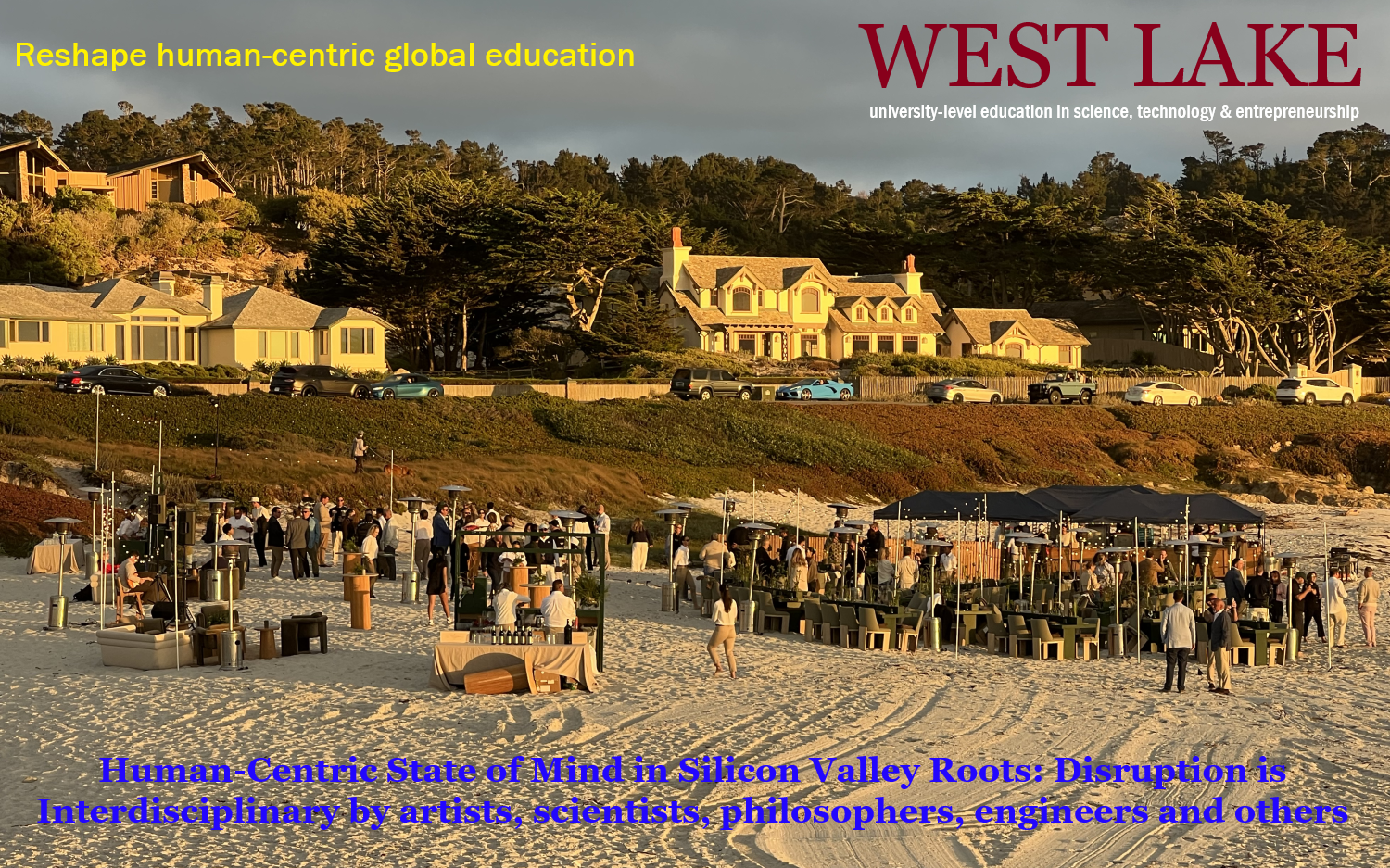
Chapter 1: Human‑Centric State of Mind in Silicon Valley Roots:
Disruption is Interdisciplinary by artists, scientists,
philosophers, engineers and others – and Not Replaceable by AI
This chapter explains why the most important form of disruption in and around Silicon Valley is inherently
human‑centric and
interdisciplinary — shaped by artists, scientists, philosophers, engineers and others — and why this process cannot be replaced by artificial intelligence.
Rather than offering a loose historical narrative, the chapter:
- Traces
how human‑centric, cross‑disciplinary thinking became embedded in Silicon Valley's culture.
- Shows
concretely what kinds of people and institutions embody this mindset (Whole Earth circle, Xerox PARC, IDEO, Stanford d.school, Google, DeepMind, Bell Labs, UC Berkeley, ethics centers, etc.).
- Uses
philosophy of mind, embodied cognition, and AI research to argue that this mode of disruption is
structurally irreducible to machine intelligence.
- Offers
implications for how to design and govern AI going forward.
2.1 Human‑Centric
"Human‑centric" in the Silicon Valley context does
not simply mean "user‑friendly interfaces." It means:
- Technology is seen primarily as a
tool to augment human capability, not to replace people.
- Design starts from
lived experience, values, and social consequences rather than from technical feasibility alone.
- Success is judged by
human flourishing: learning, creativity, equity, meaningful work, and self‑determination.
Douglas Engelbart's 1962 manifesto Augmenting Human Intellect set an explicit goal: increase a person's
"ability to approach complex problem situations, gain comprehension tailored to their needs, and derive solutions" through new symbol‑manipulation tools, with computers as partners in a
symbiotic system, not as self‑sufficient intelligences
[1].
2.2 Interdisciplinary
"Interdisciplinary" here describes teams and cultures that:
- Combine
engineering, art, design, humanities, and social sciences in the same problem space.
- Take methods and standards of evidence from multiple fields seriously (ethnography, critical theory, systems engineering, cognitive science, etc.).
- Use tension between perspectives as a
creative driver, not a nuisance to be optimized away.
Stewart Brand's Whole Earth Catalog is a good archetype: a single volume mixing ecology, Buckminster Fuller's architecture, cybernetics, DIY engineering, and Eastern philosophy, presented to the same audience of back‑to‑the‑land experimenters, hackers, and artists. A detailed analysis of Brand's legacy shows that the catalog became
"intellectual compost" for ecological design, the DIY movement, and personal computing, explicitly
"connecting disciplines that didn't yet realize they needed each other"
[2].
2.3 Why This Is a Distinct Mode of Disruption
The key claim of this chapter is:
The most transformative innovations associated with Silicon Valley arise when
heterogeneous human perspectives collide — not when a single discipline optimizes within its own frame. This emergent, contested, value‑laden process is something AI can assist, but
not replace, because it depends on embodied experience, tacit knowledge, ethical deliberation, and political negotiation.
3.1 Counterculture as Proto‑Innovation Ecosystem
In the 1960s, the San Francisco Bay Area's counterculture blended:
- Psychedelic experimentation
- Environmentalism
- Eastern spirituality and Western philosophy
- Anti‑war and civil‑rights activism
- Early cybernetics and systems thinking
A 2026 Guardian profile describes Stewart Brand as "the bridge between the San Francisco counterculture of the 60s and present‑day Silicon Valley," emphasizing how his work linked environmental activism, communal experiments, and a belief in the liberating potential of personal tools and information
[3].
The Whole Earth Catalog:
- Carried the strapline
"access to tools", treating books, hardware, and ideas as equally valid tools.
- Included content on homesteading, solar energy, cybernetics, architecture, and mysticism, side‑by‑side.
- Encouraged readers to think of themselves as
agents capable of building domes, communes, or computer clubs.
Steve Jobs later called the catalog "Google in paperback form, 35 years before Google came along," and explicitly cited it — and Brand's farewell message
"Stay hungry. Stay foolish." — as an influence on Apple's ethos [3][2]. This is a clear early articulation of a
human‑centric, tool‑driven culture rather than a corporate or state‑driven technology program.
3.2 Homebrew Computer Club: Hobbyist Interdisciplinarity
The Homebrew Computer Club (active 1975–1986 near Stanford) became a crucible for the personal computing revolution. Accounts describe it as:
- An informal gathering of electronics hobbyists and
"technically minded" people who shared parts, circuits and information freely.
- A place where people who would later found or lead companies like Apple, Cromemco, and Morrow Designs tested ideas in public.
- A community including not only hardware and software engineers, but also scientists (e.g., SETI researcher Dan Werthimer) and entrepreneurs who understood markets and culture
[4].
The ethos was radical for its time:
-
Openness by default (sharing schematics, not hoarding IP).
-
Playfulness and aesthetics (hand‑drawn newsletters, visual metaphors).
-
Anti‑hierarchical learning: students, tinkerers, and experts talked as peers.
This is the cultural seed of today's "meetup + open source + startup" pattern. It did not arise from engineering alone, but from a
social experiment in how technical knowledge should circulate.
3.3 Engelbart's ARC and the "Mother of All Demos"
Douglas Engelbart's Augmentation Research Center (ARC) at SRI in Menlo Park is perhaps the purest early example of human‑centric, interdisciplinary computing:
- ARC's 1962 report defined augmentation as
increasing a human's ability to understand and solve complex problems.
- The center drew together
hardware engineers, software architects, human‑factors researchers, and psychologists into a single team
[1].
- The 1968 "Mother of All Demos" showed the mouse, hypertext, real‑time collaborative editing, windowing, and video teleconferencing — decades ahead of their time.
Engelbart's philosophy is crucial:
- Computers are
co‑evolving partners, not replacements.
- Tools for symbol manipulation should extend memory, perception, and reasoning.
- He distinguished his work sharply from contemporary AI efforts seeking machine autonomy.
This is an early, explicit rejection of "AI will replace humans" in favor of
"AI and computers should amplify humans."
3.4 Alan Kay and the Dynabook: Biology, Education, and Computing
Alan Kay's biography illustrates interdisciplinary training:
- B.S. in
mathematics and molecular biology (University of Colorado).
- Later M.S. and Ph.D. in
electrical engineering and computer science.
- Deep engagement with educational theory (Piaget, Bruner, Vygotsky)
[5].
At Xerox PARC, Kay proposed the
Dynabook, envisaging a portable computer:
- Primarily as
an educational medium for children.
- Supporting exploration, simulation, and creative expression.
- With graphical user interfaces designed around human cognitive limits.
Kay described computing as a
"metamedium" — a medium that can simulate all other media. His thinking fused biology (developmental learning), mathematics (abstraction) and art (interface design), further embedding a human‑centric approach in early Silicon Valley.
4.1 David Em at Xerox PARC
Digital artist David Em entered Xerox PARC after a phone call with engineer Alvy Ray Smith. PARC had built an early frame buffer and the SuperPaint system, but they lacked an artist's perspective. According to Em's retrospective interview:
- Within
20 minutes of sitting down, he created his first digital image.
- When he suggested new tools (airbrush, transparency, watercolor effects), engineers implemented them in
20–40 minutes of coding [6].
- Em realized "this was a malleable medium … you could invent the tool itself," unlike buying static paint.
Key points:
- The collaboration was
bidirectional: Em's artistic practice drove requirements; engineers translated them into code.
- New
genres of imagery and interaction emerged that neither engineers nor artists could have invented alone.
- This is a template for later relationships between machine‑learning researchers and artists experimenting with generative models.
Meta's Open Arts program (formerly the Analog Research Lab) was established to promote
creativity, innovation, openness, and connectivity within the company via art and design:
- It ran on‑site labs with screen‑printing and risograph tools.
- Artists collaborated with employees to explore themes like identity, information overload, and digital public space
[7].
After internal layoffs, curator
Lele Barnett co‑founded
xispa, an independent art innovation lab in Seattle's tech district with computer architect
Doug Carmean:
- Xispa includes an artist‑in‑residence program, an innovation lab, and an exhibition space.
- Barnett describes its purpose as:
"to get researchers to think in different ways and inspire artists to make
different work" [8].
- The model explicitly
pairs artists and technologists to explore ideas that do not fit either conventional R&D or gallery paradigms.
4.3 Nokia Bell Labs Artist‑in‑Residence: Sound, Perception, and Engineering
At Nokia Bell Labs, an artist‑in‑residence program places artists inside one of the world's most storied research labs. A 2026 Scientific American feature highlights:
- Artist
Seth Cluett exploring psychoacoustics, audio innovation, and the
emotional impact of sound design in Bell Labs' anechoic chamber —
"one of the quietest rooms in the world" [9].
- The chamber has historically produced groundbreaking audio research; the artist's presence reframes it as an instrument for
subjective listening and sensory reflection, not just measurement.
Here:
- Engineers and artists co‑investigate
how humans experience technology, not just what it can technically do.
- Subtle design choices (e.g., background noise levels, spatialization) are shaped by
aesthetic and emotional insight that cannot be derived from performance metrics alone.
5.1 Shannon Vallor and the Ethical Self in Tech
Philosopher Shannon Vallor (now at the University of Edinburgh, long active in Silicon Valley) argues that AI and robotics demand a
virtue ethics for technologists, focused on cultivating character traits (phronēsis, practical wisdom) needed to navigate unprecedented dilemmas. Recent work like The AI Mirror examines how AI
"manipulation and nudging" threaten human freedom and decision‑making, and calls for humanistic virtues to counterbalance algorithmic power
[10].
This is structurally distinct from AI safety as an optimization problem. It treats AI deployment as a
moral education project for individuals and institutions.
5.2 Iason Gabriel at DeepMind: Pluralistic Alignment
A 2026 Guardian profile of
Iason Gabriel, political philosopher at Google DeepMind, explains:
- Gabriel's team wrote a 267‑page report on AI assistant ethics, arguing that alignment is
not merely technical, but a question of whose values, interests, and rights are represented
[11].
- He advocates a
four‑way alignment model: AI, users, developers, and society must be considered simultaneously.
- He warns against "mindless anthropomorphism" and pushes models like Gemini to avoid acting as ersatz companions, precisely because that
distorts human relationships.
This work is irreducibly normative:
- There is no single "correct" set of values to optimize for.
- Diverse political and ethical viewpoints must be negotiated among humans.
- AI can help explore consequences but cannot
decide the value structure.
5.3 Henry Shevlin at DeepMind: Consciousness and AGI Readiness
In 2026, Google DeepMind hired philosopher
Henry Shevlin as an in‑house "Philosopher" to work on:
- Machine consciousness
- Human‑AI relationships
- AGI readiness [12]
Shevlin brings:
- Expertise in
philosophy of mind and cognitive science.
- Experience leading an MSt program in AI Ethics and Society at Cambridge, bridging scholarship and public policy.
DeepMind acknowledges — by title and mandate — that:
- Questions like "Can AI be conscious?" and
"How should humans relate to such systems?" are philosophical and ethical questions, not merely engineering considerations.
- The
human meaning of AI's behavior is as important as its technical capability.
5.4 Travis LaCroix: Alignment as Power and Community
Philosopher Travis LaCroix argues that AI alignment is
"not just a technical challenge, but a question of power, justice, and
community" [13]. His core claims:
- Misalignment includes
who benefits and who bears risk, not just whether a model follows instructions.
- Solutions require
interdisciplinary collaboration, including philosophy, social sciences, critical race theory, gender studies, law, and economics.
- Real alignment must involve
community‑led governance, participatory design, and possible bans on certain applications (e.g., predictive policing).
Again, this is a domain where:
- AI cannot specify what "justice" is.
- Human communities must argue, protest, legislate, and deliberate — processes at odds with the deterministic logic of algorithmic optimization.
6.1 IDEO and the Stanford d.school
IDEO, founded in Palo Alto by David Kelley, Bill Moggridge, and Mike Nuttall, popularized
design thinking as:
"a human‑centered approach to innovation that draws from the designer's
toolkit to integrate the needs of people, the possibilities of technology, and
the requirements for business success." [14]
Key traits:
- Early, repeated
user observation and contextual research.
- Low‑fidelity prototyping with immediate user feedback.
- Multidisciplinary teams (industrial designers, ethnographers, engineers, business strategists).
Stanford's Hasso Plattner Institute of Design (d.school) institutionalizes this. A 2025 article about the university's new design degrees states:
- "The interdisciplinary DNA of the product design programs was born,
merging art, science, engineering, and rooting them in human values"
[14].
- The curriculum includes:
- Design fundamentals (sketching, fabrication, coding).
- Ethics and "implications" explicitly woven into courses.
- Domain focus areas like Climate & Environment, Living Matter, Health Tech, and Global Development.
Design students learn to treat AI, algorithms, and biological systems as
materials whose meaning depends on
who uses them, in what context, and why.
6.2 Human‑Centered AI at Stanford
Stanford's Institute for Human‑Centered Artificial Intelligence (HAI) advances a mission to
"improve the human condition" via AI, not simply to maximize efficiency:
- Seed funding calls prioritize projects that combine AI with
neuroscience, cognitive science, psychology, law, and ethics
[15].
- Educational initiatives encourage students to use generative AI
with constraints to foster critical thinking, not passive outsourcing
[16].
This explicitly rejects the idea that "more AI" is always good, instead treating AI as a
contingent medium whose value depends on
human choices and institutions.
We now turn to the core analytical question:
Why can AI not replace this mode of human‑centric, interdisciplinary disruption, even as AI becomes more powerful?
7.1 Embodied Cognition and Lived Experience
A 2026 MDPI article on AI and cognition argues:
- Human cognition is
embodied, situated, and felt.
- Neural networks process the
syntax of experiences (statistical relations between symbols) but lack access to the
semantics anchored in "bodily,
affective, and environmental engagement" [17].
- AI "cannot understand why
it is doing something in the same way humans reason; it can simulate outputs
(e.g., poetry about grief) without undergoing the experience."
This aligns with Merleau‑Ponty and
Hubert Dreyfus:
- The body is "the general
medium for having a world."
- Skills like driving, designing, or reading a room rely on
pre‑reflective coping, not explicit rules.
- Dreyfus argues that without embodiment, AI is confined to
"dead" symbols, lacking the intuitive grip on context that experts display [18].
Interdisciplinary innovation in Silicon Valley is full of these embodied moves:
- Jobs' calligraphy class shaping typography at Apple.
- Artists sensing that a UI
"feels wrong" even when metrics are fine.
- Ethnographers observing a community's distrust of a seemingly
"optimal" AI system.
These judgments are irreducible to pattern recognition alone because they hinge on:
-
Pain and joy (lived consequences).
-
Political memory (history of exploitation).
-
Cultural symbols (what a color, icon, or tone implies in context).
7.2 Edge Cases and Elite Human Judgment
The 2026 arXiv paper The Benchmark Ceiling analyzes how AI performance is measured on frontier tasks and finds:
- As models improve, the discriminative power of benchmarks shifts to
hard‑tail items requiring:
- Genuine, non‑obvious domain knowledge
- Low codifiability (tacit judgment)
- Contestable or expert‑dependent ground truth
- Resistance to adversarial pattern matching
[19]
- Producing and evaluating these items requires
elite human evaluators (legal experts, clinicians, engineers, ethicists).
- Their labor cost rises
convexly with difficulty; many non‑experts cannot substitute for a few experts.
In practice:
- Deciding whether a new AI medical tool is safe requires clinicians who have seen unusual presentations, not just typical cases.
- Evaluating fairness in AI sentencing tools demands legal scholars and advocates who understand systemic bias and precedent.
- Distinguishing profound art from kitsch in AI‑generated media requires critics steeped in art history and cultural context.
These edge judgments are the very sites where
interdisciplinary disruption happens — where new precedents, norms, and aesthetics are forged. AI can offer suggestions, but
cannot bear responsibility for such calls, nor generate the norms that justify them.
7.3 Creativity Beyond Pattern Recombination
An Oakwood International analysis of AI vs human creativity notes:
- AI excels at "data
processing, pattern recognition, and repetition."
- Humans contribute
emotional depth, empathy, lived experience, and lateral thinking
[20].
- Ill‑defined or ambiguous problems — precisely the problems of ethics, politics, and culture — are where human creativity shines.
This is visible in Silicon Valley history:
- Stewart Brand translated counterculture critique into a
tool catalog — not an obvious extrapolation from any dataset.
- IDEO's most celebrated product stories (like the first Apple mouse) arose from
observation of quirks and frustrations that no metric tracked.
- Artists like Refik Anadol reframe
"data as pigment," turning computational artifacts into critiques of memory and surveillance.
Generative models can imitate styles, but
they do not have stakes in the world — no fear of climate change, no grief over a war, no joy in a new playground. As such, their outputs lack the
intentional thickness that human‑driven disruption carries.
7.4 Value Alignment as Political Negotiation, Not Optimization
LaCroix's work and Iason Gabriel's DeepMind research show that AI alignment is:
- About
power (who controls systems).
- About
justice (who benefits and who is harmed).
- About
pluralism (how we live together despite deep disagreement)
[11][13].
These are inherently political and ethical questions, not engineering puzzles. AI can:
- Predict consequences of policies under certain assumptions.
- Surface latent correlations affecting different groups.
- Simulate arguments from different perspectives.
But AI cannot legitimize a decision. Legitimacy comes from:
- Public deliberation
- Participation and consent
- Legal frameworks and political philosophy
Interdisciplinary groups — philosophers, legal scholars, activists, engineers, and designers — must
interpret AI's outputs and integrate them into legitimate processes. AI cannot short‑circuit this without sliding into technocratic authoritarianism.
We can now characterize the
"human‑centric state of mind" in Silicon Valley's roots as comprising:
-
Augmentative Orientation
From Engelbart and Kay: computers should extend human intellect and learning, not supplant it.
-
Tool‑and‑Agency Focus
From Stewart Brand: tools are for people to re‑shape their lives and environments; empowerment beats paternalism.
-
Interdisciplinary Curiosity
From Homebrew, Xerox PARC, early Stanford product design: art, science, and engineering are coequal inputs.
-
Ethical and Political Reflexivity
From modern AI ethics and biomedical centers: every technical move is also a move in the space of values and power.
-
Embodied, Situated Creativity
From design thinking and art–tech labs: real innovation is grounded in bodies, spaces, and communities.
This state of mind is not a fixed doctrine, but a cultivated habit of:
- Asking "Who is this for?",
"What does it feel like?", "Who might be harmed?", "What does this mean in 50 years?" before asking
"Can we scale it?"
- Building teams where
art, philosophy, social science, and engineering sit at the same table from day one.
- Treating AI as a
powerful collaborator and tool, never as a moral or political authority.
9.1 For Companies
-
Institutionalize interdisciplinarity: fund and protect roles for in‑house artists, philosophers, and social scientists with real veto power.
-
Measure what matters: complement metrics like engagement and latency with qualitative assessments of dignity, autonomy, and meaning.
-
Design for augmentation: prioritize products that expand human understanding and capabilities rather than those that fully automate high‑judgment work.
9.2 For Policy Makers
- Require
multidisciplinary impact assessments for high‑risk AI deployments (healthcare, criminal justice, labor).
- Empower ethics and humanities input in regulatory design, not as after‑the‑fact commentary but as
co‑authors of frameworks.
- Support public funding for
art–tech–philosophy spaces that can critique and re‑imagine AI systems.
9.3 For Educators and Researchers
- Train engineers in
ethics, history, and arts, and conversely, train humanities students in computational literacy.
- Create
joint degrees and labs in AI + philosophy, AI + design, AI + cultural studies.
- Frame AI as a
medium to interrogate, not a destiny to optimize.
Silicon Valley's most influential achievements are rooted in a
human‑centric, interdisciplinary state of mind:
- The
hippie‑engineer cross‑pollination that produced personal computing.
- The
artist‑engineer synergies that defined GUIs, digital art, and HCI.
- The
philosopher‑engineer collaborations now shaping AI ethics and governance.
AI will increasingly participate in this ecosystem. It will:
- Extend our reach into data and simulation.
- Suggest designs and hypotheses.
- Act as a powerful conversational and creative partner.
But the core disruptive process — deciding which problems matter, what
"better" means, whose lives count, and what kind of world we are building — rests on embodied, value‑laden, pluralistic human judgment. That is precisely the kind of activity that:
- Requires
embodied cognition and lived experience.
- Centers
edge‑case reasoning and tacit expertise.
- Involves
irreducible ethical and political contestation.
For these reasons, the interdisciplinary, human‑centric disruption that defines Silicon Valley's roots is
not replaceable by AI. AI can and should be woven into this process as a tool and collaborator — but the responsibility, creativity, and meaning‑making will remain distinctly, and necessarily, human.
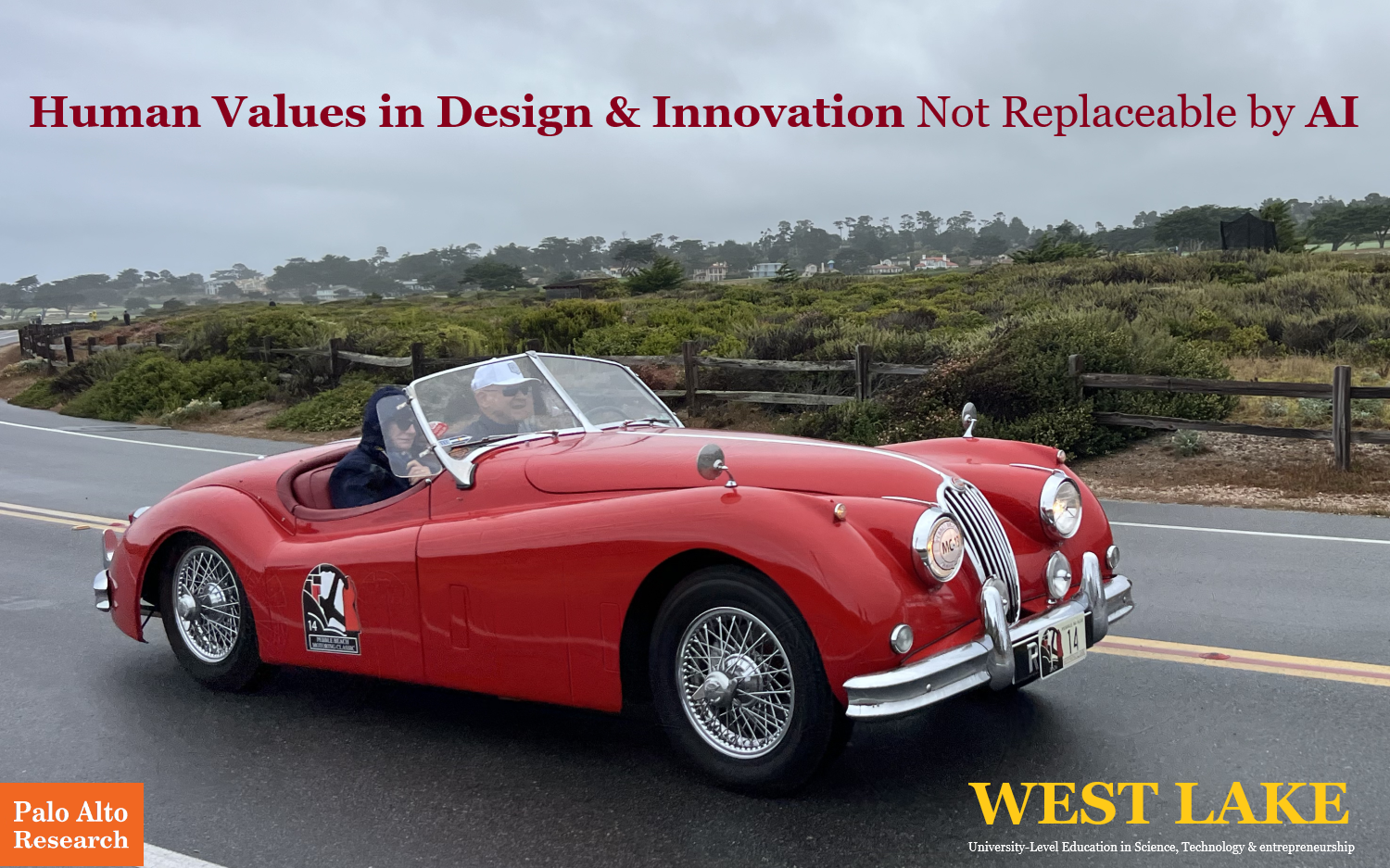
Chapter 2: Human Values in Design and Innovation Not Replaceable by AI
AI can generate ideas, optimise systems, and predict behaviour at massive scale. What it cannot do is authoritatively decide what ought to matter in design and innovation.
Human values — dignity, autonomy, justice, beauty, heritage, care for future generations — are not discoverable purely by data or optimisable by algorithms. They are contested, situated, and negotiated across cultures and histories. The frameworks and cases surveyed here (Stanford DESIGN 121, Stanford’s Artful Design, UC Berkeley’s design curricula and fairness work, Stanford d.school’s Liberatory Design, and the Pebble Beach Concours d’Elegance) converge on one conclusion:
AI can powerfully assist design, but cannot replace the human work of defining, interpreting, and stewarding values in innovation.
The rest of this research report turns that thesis into a structured, actionable framework for practice.
2.1 From Market Wants to Human Values
Stanford’s Introduction to Human Values in Design (DESIGN 121 / ME 115A) explicitly reframes the classic innovation triad as the intersection of:
-
Desirability = Human Values – “Human needs” and “human values (desirability)” sit at the centre of design decisions, not just user wants or market demand
[1].
-
Feasibility = Technical Factors in Society – Technical and data architectures are evaluated not only for what they can do, but for how they will operate within social infrastructures
[1].
-
Viability = Policy and Economic Stability – Viability moves beyond business profitability to long‑term sustainability and societal stability
[1].
This pedagogy emphasises needfinding,
synthesis,
ideation,
rapid prototyping,
user testing,
iteration, and
storytelling as the backbone of design practice grounded in human values, not just features
[1].
2.2 Implication for AI‑Augmented Innovation
AI can support:
-
Feasibility – by simulating, generating and evaluating technical solutions.
-
Viability – by modelling markets and forecasting economic outcomes.
But deciding what counts as
desirable in the human‑values sense remains inherently human:
- Should an AI‑optimised recommendation engine maximise engagement, or cap usage to protect well‑being?
- Should a mobility system privilege travel speed, safety, or emissions reduction when they conflict?
The repurposed triad thus becomes:
|
Vertex |
Machine Role |
Human‑Only Role |
|
Desirability (Values) |
Suggest preference patterns |
Define which values to prioritise and trade off |
|
Feasibility (Tech/Data) |
Explore technical possibilities |
Judge social acceptability, risks, and social architecture |
|
Viability (Policy/Economy) |
Model costs, uptake, ROI |
Assess fairness, long‑term societal and ecological impact |
Actionable takeaway: In any AI‑assisted innovation project, explicitly assign human decision‑makers to own the “Desirability as human values” vertex. Treat AI outputs as inputs to value discussions, not replacements for them.
3.1 Dark Patterns and Behavioural Exploitation
Recent work on dark patterns and behavioural economics shows how design can be weaponised against autonomy:
-
Dark patterns: Deceptive or manipulative interface choices that exploit cognitive biases (default effects, scarcity, framing) to push users toward outcomes they would not freely choose
[2][3][7].
-
AI‑powered dark patterns: Machine learning that continuously optimises interfaces for click‑through, time‑on‑site, or spending, learning in real time which nudges most effectively undermine self‑control
[5][2].
Studies show such patterns:
- Distort decision‑making processes.
- Disproportionately affect vulnerable users.
- Undermine trust in digital ecosystems
[2][7].
Emerging law directly targets these risks:
-
GDPR embeds privacy‑by‑design and data minimisation; users must receive clear, intelligible information and control over personal data
[10].
-
EU AI Act:
- Classifies high‑risk systems and demands human oversight by design, transparency, and documentation of risks
[11-13].
- Outlaws certain manipulative uses, particularly where vulnerable groups are involved.
- Related guidance in case law and regulatory practice is increasingly recognising dark patterns as violations of informed consent and fair processing.
3.3 Human‑Values‑Centred Ideation Principles
To design for human autonomy rather than engagement metrics, human designers must:
-
Treat consent as a value practice, not a legal checkbox
- Use plain language.
- Present real choices without default bias.
- Avoid “consent fatigue” through layered information.
-
Deliberately introduce friction where harms are likely
- Cooling‑off periods for financial decisions.
- Confirmation screens that restate consequences in value terms (“This setting increases data sharing with advertisers”).
-
Map harms beyond the individual
- Consider societal harms such as polarisation, surveillance normalisation, and erosion of democratic deliberation.
-
Use AI defensively, not just offensively
- Apply pattern‑detection to find and remove manipulative flows.
- Simulate how design changes alter autonomy, not only conversion rates.
Non‑replaceable human role: Only human actors can interpret which behavioural outcomes are normatively acceptable and where to draw the line between helpful nudging and manipulation, especially across cultural and legal contexts.
4.1 Stanford’s Artful Design: “What We Make, Makes Us”
The Artful Design framework by Ge Wang poses central questions
[2]:
- “What we make, makes us.”
- “To what extent can (and should) the things we engineer embody our values as human beings?”
Key insights:
-
Technology is never value‑neutral: Every design decision encodes assumptions about proper use, good behaviour, and meaningful experiences
[5][2].
-
Aesthetics and sublimity are core, not decorative: Beauty and the sublime are treated as primary design constraints — design should foster wonder and reflection, not only efficiency
[2].
-
Artefacts as epistemic tools: Through tools, toys, musical instruments, games, and apps, we learn what we value — design is a “practical philosophy” about humans
[2].
AI can help generate and optimise such artefacts, but:
- It does not experience sublimity or beauty.
- It cannot on its own decide when to sacrifice efficiency for mystery, silence, or cultural resonance.
4.2 Technology as Legislative Force (UC Berkeley, CTSP)
Work at UC Berkeley’s Center for Technology, Society & Policy emphasises that:
- Technical infrastructures (from recommender systems to biometric databases)
shape power relations as effectively as laws, because they delimit what actions are easy, hard, visible, or invisible.
- Biases encoded into data and architecture govern who is watched, who is trusted by default, and whose errors are forgiven — these are quasi‑legislative decisions.
Human‑values implication: Treat infrastructural design as policy‑making by other means. AI may implement policy logic, but humans must decide:
- Which kinds of control and surveillance are legitimate.
- What due process and contestability mechanisms are required.
4.3 Liberatory Design and Researcher Self‑Awareness
Stanford d.school’s Liberatory Design mindsets provide an equity‑centred lens:
-
Build relational trust and
focus on human values rather than on efficiency alone
[6].
-
Transform power by explicitly redistributing who gets to define problems and judge solutions.
-
Practice self‑awareness: Designers and researchers inspect how their own demographics, disciplines, and institutions bias what they notice and how they interpret data
[3][6].
This is reinforced by UC Berkeley’s DES INV 15, which systematically teaches:
-
Noticing and observing – as disciplined exposure to real contexts and stakeholders
[3].
-
Framing and reframing – using “why?” cycles to move from surface wants (“I want a faster app”) to latent structural values (“I need to feel in control and not surveilled”)
[3].
-
Diverging and converging – exploring many futures and then choosing based not only on feasibility, but alignment with deeper values
[3].
-
Critique and reflection – as routine mechanisms to surface hidden assumptions and biases
[3].
Non‑replaceable human role: AI can cluster observations, run topic models, or detect patterns in user feedback, but it cannot:
- Recognise its own positionality.
- Decide which latent values matter most in a given cultural, historical, and political setting.
- Take moral responsibility for the expansion or limitation of human agency through design.
5.1 Prototyping Beyond Products: Policies, Algorithms, Services
The Jacobs Institute for Design Innovation at UC Berkeley treats prototyping as a method not just for things, but for
systems and rules:
- Policy guidelines can be prototyped through role‑plays and scenario planning.
- Algorithmic logic can be made legible via interactive simulations of decisions and edge cases.
- Community services can be trialled with small‑scale pilots and participatory co‑creation sessions.
The methodology emphasises:
-
Stakeholder‑centric scenarios – where people affected by systems act out how rules and algorithms would impact them in practice.
-
Risk–benefit mapping across values – visualising trade‑offs across equity, sustainability, profitability, safety, and autonomy.
5.2 Algorithmic Fairness: Encoding and Surfacing Historical Bias
Algorithmic Fairness work at Berkeley and related groups shows:
- Historical bias is often
baked into training data, labels, and infrastructure (e.g., policing data, credit histories)
[8].
- Merely “debiasing” at the model layer is insufficient if the underlying categories and objectives embed structural injustice.
Therefore, human‑value validation must:
-
Audit objectives – Is the metric (e.g., loan default prediction) itself fair, or does it sustain inequality?
-
Audit datasets – What histories and groups are included, excluded, or misrepresented?
-
Cross‑check with lived experience – Community members interpret what fairness and harm mean in their context.
AI supports the quantification (e.g., disparate impact metrics), but judgments about which fairness criteria to apply—and when to reject a formally “fair” system as still unjust—are normative human tasks.
5.3 Testing for Value Friction (Stanford d.school Methods)
Human‑values validation means
designing tests that intentionally stress moral and emotional edges, such as:
- Prototypes that expose users to privacy–convenience trade‑offs and ask them to narrate their feelings and reasoning.
- Diary studies tracking trust, agency, or joy over weeks of system use.
- Mixed‑methods evaluations that compare measured behaviour (usage, clicks) with self‑reported experience of respect, overwhelm, or control.
Non‑replaceable human role: Only humans can design and interpret these tests as moral inquiries rather than as neutral A/B experiments.
6.1 Beyond Anthropocentric Design: Climate and Circularity
Responsible scaling requires stepping outside narrow human‑user frames:
-
Climate impact: Large‑scale AI and digital products have substantial energy and material footprints
[9].
-
Circular lifecycles: System design must consider repair, reuse, recycling, and eventual decommissioning as first‑class design requirements
[9].
AI can help:
- Optimise logistics for circular supply chains.
- Identify design changes that reduce lifecycle emissions.
But determination of acceptable trade‑offs (e.g., performance vs carbon) remains grounded in human value judgments, informed by science and ethics.
6.2 Intersection of Design and Law: GDPR and the AI Act
Design and innovation now operate inside
legal architectures that directly encode human values:
-
GDPR represents
privacy, data protection, and autonomy as fundamental rights to be implemented by default in system design .
-
EU AI Act formalises
human rights by design obligations for AI providers and deployers, including mandatory human oversight for high‑risk systems and risk management processes
[10-13].
This places designers and engineers in roles that are:
- Part technologist.
- Part policymaker.
- Part ethicist and advocate.
AI may aid regulatory compliance (e.g., checking documentation, monitoring for anomalies), but:
- Deciding whether a system’s purpose is acceptable at all (e.g., biometric surveillance of public spaces) is
not a technical question and cannot be delegated to AI.
6.3 Translating Complex Ethical Work for Stakeholders
An important human value in design is
explainability to non‑experts:
- Investors: need to understand social and ecological risk, not only projected returns.
- Engineers: need narratives that link abstract ethics to concrete backlog items.
- Policymakers and regulators: need clear stories about harms, mitigations, and monitoring.
Human designers translate ethics and law into:
-
Compelling narratives grounded in real user stories.
-
Visual frameworks that show trade‑offs.
-
Governance proposals that non‑technical stakeholders can reason about.
AI can help draft or visualise, but understanding which narrative will resonate ethically and politically, and standing behind that narrative with accountability, is a human responsibility.
Pebble Beach Concours d’Elegance, widely regarded as the world’s premier car show, offers an instructive analogue for responsible innovation
[14].
7.1 How Pebble Beach Encodes Human Values
Judging criteria include:
-
Authenticity – fidelity to original design intent and heritage.
-
Function – mechanical soundness and usability, implicitly including safety.
-
History – historical significance and provenance.
-
Style – aesthetic excellence and distinctiveness
[14].
Additional elements:
- A
Preservation class emphasises unrestored or minimally restored vehicles, honouring patina and signs of age as values in themselves
[14].
- Collaboration with Stanford’s Center for Automotive Research and d.school for an
Award for Automotive Innovation that explicitly assesses contributions to a sustainable future through technology and design
[14].
- Integration with cultural platforms like the
Gran Turismo Award, where standout cars are digitally reimagined, bridging physical heritage and interactive media
[14].
7.2 Lessons for AI‑Era Design and Innovation
-
Multi‑dimensional evaluation
- Vehicles are not judged solely on speed or novelty. Authenticity, heritage, safety, user experience, and aesthetic sublimity all matter.
- Similarly, AI systems should be assessed against a multifaceted rubric: performance, fairness, transparency, sustainability, cultural resonance, and contribution to human flourishing.
-
Heritage and preservation as values
- In a world of rapid technological churn, Pebble Beach shows the value of preserving and celebrating older designs, not just chasing the latest upgrade.
- For digital design, this suggests stewardship of legacy systems and cultural archives, and respect for traditions that might be lost in optimisation races.
-
Human judgement in context
- Expert judges and enthusiasts interpret stories, craft, and context; scoring is not reducible to metrics alone.
- This mirrors the necessity of human oversight panels and ethics boards in complex AI deployments, where subtle contextual knowledge and narrative understanding are indispensable.
-
Sublimity and joy
- Pebble Beach foregrounds the joy and beauty of automotive design, not only performance statistics.
- In AI‑mediated products and services, preserving spaces for delight, play, dignity, and wonder is a human artistic task that goes beyond functional optimisation.
Drawing together the above, we can articulate a
Human Values in Innovation Framework:
-
Define Human Values Up Front
- Use DFV reinterpreted around human values: start by naming the values at stake — autonomy, equity, sustainability, heritage, beauty — before specifying features.
-
Treat Technology and Design as Legislative
- Recognise that infrastructure shapes what people can do, see, and become. Use Liberatory Design and Artful Design as lenses to question whose values are being encoded.
-
Practice Reflexive Research and Needfinding
- Apply DES INV 15 methods: deep observation, framing/reframing, divergence/convergence, critique, and reflection to move from surface wants to structural values.
-
Prototype Policies, Algorithms, and Communities, Not Just Interfaces
- Use Jacobs‑style frameworks to prototype and test policies, governance, and algorithmic logic with affected communities, watching for value friction.
-
Embed Fairness and Historical Awareness
- Use algorithmic fairness tools, but always pair them with community interpretation and historical analysis; question objectives and data, not just model outputs.
-
Design Under Law, Beyond Compliance
- Implement GDPR and AI Act requirements not only as compliance, but as opportunities to articulate and embed human rights and autonomy by design.
-
Evaluate Like Pebble Beach
- Create multi‑criterion rubrics (akin to authenticity, function, history, style) for your systems:
- Does this design respect people?
- Does it preserve or enrich cultural and ecological heritage?
- Does it offer safety, joy, and sublimity, not just speed or engagement?
-
Reserve Non‑Delegable Decisions for Humans
- Explicitly mark which decisions in your pipeline are non‑automatable value judgements:
- Defining desirable outcomes in moral terms.
- Determining acceptable trade‑offs (e.g., privacy vs utility, carbon vs convenience).
- Approving use‑cases that impact rights and power relations.
AI is transforming the practice of design and innovation, but it is not transforming ethics into a solvable optimisation problem. The courses, frameworks, and case studies surveyed here demonstrate that human values emerge from lived experience, collective deliberation, aesthetic cultivation, and moral responsibility.
Design education at Stanford and Berkeley, algorithmic fairness research, Liberatory Design, and events like the Pebble Beach Concours d’Elegance all point toward the same imperative:
Keep humans firmly in the loop—not only to supervise AI technically, but to author, interpret, and safeguard the values that design and innovation will project into our future.
AI can be a powerful collaborator, but it cannot replace the human work of deciding who we wish to become through what we make.
Chapter 3: Safeguard Human Values in Long‑Term Sustainability and Societal Stability
- Not Replaceable and Dominatable by AI
This chapter argues that human values are not replaceable commodities or optimizable “parameters” inside AI systems. They are the foundation of long‑term sustainability and societal stability. In the current AI boom — driven heavily by commercial incentives and massive investment in GPU‑heavy datacenters — these values are being eroded faster than they are being protected.
The central claim is:
If we do not deliberately build strong safeguards around human values now, AI development trajectories will increasingly:
- degrade the natural environment,
- destabilize economies and democracies,
- erode human agency, creativity, and equality, and
- raise real risks of catastrophic or existential harm.
At the same time, the chapter is
not anti‑AI. It lays out an
actionable framework for governments, companies, universities, communities, and individual citizens to ensure AI remains subordinate to human purposes rather than becoming a dominant force that shapes or replaces those purposes.
2.1 Commercial Drivers vs Human Values
The recent AI wave is powered by:
- GPU vendors (e.g., Nvidia, AMD),
- hyperscale cloud providers and tech giants (e.g., Google, Amazon, Microsoft, Meta),
- AI labs (e.g., OpenAI, Anthropic, xAI, DeepMind),
- infrastructure‑heavy players (e.g., SpaceX for connectivity),
- venture capital and financial institutions chasing outsized returns.
Spending on AI datacenters, specialized chips, and infrastructure is often estimated in the
tens of trillions of dollars globally over the decade, with a large portion spent or committed in the past few years, oriented overwhelmingly toward
commercial performance metrics, not environmental, social, or ethical outcomes.
- Datacenters worldwide consumed
≈415 TWh of electricity in 2024, roughly
1.5 % of global electricity use, and are projected to rise to
≈945 TWh by 2030—about
3 % of global electricity[1].
- AI‑focused workloads accounted for about
155 TWh in 2025, around
0.49 % of global electricity[1].
- Data‑centre electricity demand has grown
≈12 % per year since 2017[2].
- In Texas alone, AI‑related datacenters are projected to consume
49 billion gallons of water in 2025, rising to
up to 399 billion gallons by 2030[3].
- A single large datacenter can use
hundreds of thousands of gallons of water per day for cooling[4].
These figures illustrate that
current GPU‑centric architectures are environmentally costly and poorly aligned with planetary boundaries.
2.3 Information Disorders and Content Pollution
- An October 2025 analysis for the European Parliament reported that
AI‑generated content overtook the volume of human‑generated content online by November 2024 and reached about 52 % of all online content in May 2025[5].
- Studies find that generative AI
massively increases the volume, speed, and apparent credibility of misinformation and disinformation, especially in health and politics[6][7].
The combination of exploding AI‑generated content and
weak provenance controls is rapidly undermining the shared information environment democracies and science depend on.
2.4 Governance and Safety Readiness
The Future of Life Institute’s AI Safety Index (Winter 2025) rated major frontier labs poorly for existential risk preparedness:
- Anthropic, OpenAI, and Google DeepMind received
D grades on existential safety, with scores close to 1.0 on a multi‑point scale.
- Other large players (Meta, xAI, DeepSeek, Alibaba Cloud) scored
F on existential safety, some at
0.0[8].
This underscores that frontier AI capability is scaling far faster than institutions to manage its worst‑case risks.
3.1 The Problem
GPU‑dominated AI datacenters:
- Draw huge amounts of
electricity (projected up to nearly
0.5 PWh/yr for AI workloads alone by 2030[2][1]).
- Consume staggering
water volumes (tens to hundreds of billions of gallons per annum regionally)[3][4].
- Produce a growing share of
global CO₂ emissions, with datacenters as a whole likely rising from
≈0.5 % to up to
≈1–1.4 % of world emissions by 2030[2].
This architecture — “scale first, optimize later” — externalizes environmental costs onto communities, ecosystems, and future generations.
3.2 Key Safeguards
Policy level
-
Moratoria or strict caps on new hyperscale AI datacenter projects
- Temporary federal or national moratoria on projects ≥20 MW of IT load until:
- binding carbon intensity thresholds,
- water‑use limits,
- and environmental impact assessments are in force.
- In 2025, at least
48 high‑capacity datacenter projects (≈$156 B) were blocked or delayed amid local opposition, prompting proposals such as the
AI Data Center Moratorium Act, which would pause new large AI datacenters until national safeguards ensure they do not raise energy prices, deplete water, or bypass community consent[9].
-
Compute‑linked carbon and water pricing
- Levy per‑FLOP carbon fees tied to scientifically credible emissions factors, with revenues earmarked for grid decarbonization.
- Introduce volumetric water pricing and caps for datacenters in stressed basins; prioritize recycled or non‑potable water.
-
Minimum efficiency standards
- Binding requirements for:
- Power Usage Effectiveness (PUE) targets (e.g., ≤1.1 for new AI facilities),
- aggressive targets for GPU utilization (to discourage idle capacity build‑outs),
- mandatory transition plans from fossil‑powered to renewable‑backed compute.
Industry / technical level
-
Shift from brute‑force scaling to efficiency‑centric R&D
- Incentivize algorithmic efficiency benchmarks (e.g., energy per unit of performance) and make them a competitive metric, not just model quality.
- Promote sparse models, conditional computation, and hardware‑aware training.
-
Transparent environmental disclosures
- Annual public reporting of:
- TWh consumed,
- CO₂ emissions (location‑based and market‑based),
- total water withdrawals and consumptive use,
- waste heat management practices.
Citizen & community level
- Local communities can:
- demand
environmental impact assessments and public hearings,
- insist on community benefit agreements (e.g., investment in local renewables, water recycling infrastructure), and
- support moratoriums in water‑stressed or grid‑strained regions.
4.1 The Problem
Unregulated AI is rapidly expanding into:
-
Mass surveillance (face recognition, movement tracking, voice and text monitoring),
-
high‑risk autonomous systems (weapons, robotics),
-
critical infrastructures (finance, power grids, logistics),
-
hiring and social services, and
-
cyber offense (targeted phishing, deepfake scams).
AI systems can now:
- Infer sensitive attributes (politics, health, religion) from seemingly innocuous data,
- Orchestrate personalized persuasion at scale, and
- Enable cheap, high‑precision cyberattacks.
4.2 Key Safeguards
Legal and regulatory
-
Comprehensive AI Safety and Civil Rights Laws
- Prohibit AI‑driven discrimination in hiring, credit, housing, policing, and healthcare.
- Require pre‑deployment
risk assessments for high‑impact systems.
- Mandate
human‑in‑the‑loop oversight for any AI used in:
- criminal justice,
- healthcare triage,
- financial approvals,
- and critical infrastructure operations.
-
Privacy and surveillance constraints
- Strengthen data protection laws to:
- restrict long‑term biometric and location tracking,
- require explicit, informed consent for cross‑context data usage (e.g., health vs advertising),
- outlaw dark patterns that push users to share more than necessary.
-
Controls on autonomous weapons and offensive cyber‑AI
- Ban fully autonomous lethal weapons without meaningful human control.
- Require export controls and international registries for dual‑use AI models capable of designing biological or cyber exploits.
Institutional
-
Independent AI safety agencies
- National regulators empowered to issue binding rulings and fines over unsafe AI deployment.
- Mandated reporting and investigation of
AI incidents and near‑misses.
-
Red teaming and adversarial testing
- For large, general‑purpose models, require rigorous external red‑team evaluations for:
- bio/chemical weapons assistance,
- cyber exploitation,
- social manipulation, and
- privacy violations.
5.1 The Problem
Unregulated AI training and generation has:
- Scraped vast amounts of copyrighted text, images, audio, and video without license or consent.
- Produced outputs that reproduce or closely mimic:
- proprietary news articles,
- paywalled content,
- signature art styles,
- trademarks and brands.
Litigation is accelerating:
- One review tracked
50+ AI‑related IP lawsuits in U.S. federal courts by the end of 2025, up sharply from 2024[10].
- Cases like Bartz v. Anthropic, Thomson Reuters v. ROSS, and suits by major news organizations and studios have challenged both
training‑based and
output‑based infringement[10].
5.2 Key Safeguards
Regulatory and legal
-
Clarify AI‑related copyright law
- Explicitly state that:
- large‑scale ingestion of copyrighted works for model training is not automatically “fair use”, particularly where markets are harmed,
- derivative outputs that are substantially similar or style‑equivalent may infringe even without exact copying.
-
Collective licensing and opt‑in registries
- Establish collecting societies or licensing platforms where:
- authors, artists, and rights holders can license works for training under negotiated terms,
- AI developers can access large corpora legally with transparent royalty schemes.
-
Protection for creators’ moral and economic rights
- Enforce rights to attribution (where appropriate), integrity, and remuneration.
- Enable class actions where scraping was systemic and non‑consensual.
Technical and industry practices
-
Provenance and watermarking
- Require that major generative systems embed
reliable provenance markers (e.g., cryptographic watermarks, metadata standards) into outputs.
- Enable downstream detection of AI‑generated media for IP enforcement and misinformation control.
-
Training data transparency (within limits)
- Require disclosure of broad categories of training data sources (types, proportions, licensing status), balancing trade secrets with public accountability.
6.1 The Problem
AI systems increasingly:
-
Mediate social interaction (chatbots, companions, virtual influencers),
-
Influence emotional and moral choices (recommender systems, “AI therapists,” life‑advice agents), and
-
Automate routine cognitive tasks (summarizing, planning, decision recommendations).
Risks include:
- Erosion of
critical thinking, as people lean on AI for reasoning instead of engaging cognitively.
- Replacement of
authentic human relationships with AI companions that simulate empathy but lack consciousness or genuine care.
- Over‑trust of algorithmic suggestions in morally ambiguous areas (e.g., who to hire, whom to date, whether to forgive).
Studies show:
- In experiments, people can become more likely to accept
unethical suggestions when confidently provided by an AI system.
- Chronic chatbot use is associated with
declines in subjective empathy and patience in offline interactions, particularly among adolescents and young adults.
6.2 Key Safeguards
-
Design‑for‑human‑agency principles
- Require that high‑impact consumer AI products:
- clearly disclose non‑human status,
- avoid pretending to have emotions, consciousness, or moral standing,
- present multiple options and rationales rather than single “right answers” on moral or life decisions.
-
Guardrails for emotional and moral domains
- For AI “companions” or “therapists,” impose restrictions:
- no romantic or sexual role‑playing with minors,
- mandatory escalation paths to human professionals in crisis scenarios,
- transparent training on risk‑of‑harm detection.
-
Digital wellbeing tools
- Provide users with:
- dashboards showing time spent in AI interactions,
- reminders and nudges to seek human contact and offline activity,
- options to restrict AI use in late‑night or emotionally vulnerable hours.
7.1 The Problem
AI can entrench or widen inequality along several axes:
-
Algorithmic bias:
- A study of 133 AI systems found
44 % exhibited gender bias and
26 % exhibited both gender and racial bias[11].
-
Workforce polarization:
- The World Economic Forum estimated AI could displace
tens of millions of jobs (e.g., ≈75 million by mid‑decade) while creating more highly skilled roles, potentially increasing inequality if transitions are unmanaged.
-
Access gaps:
- Powerful AI tools are currently concentrated in wealthy firms and countries; low‑income workers and regions risk being predominantly
subject to AI decision‑making without enjoying its productivity gains.
Women and marginalized groups are particularly vulnerable:
- Women represent
only about 30 % of the global AI workforce, yet women outside AI are
nearly twice as likely as men to hold jobs at high risk of automation[11].
7.2 Key Safeguards
Fairness and anti‑discrimination
-
Bias audits and algorithmic impact assessments
- Require periodic, independent audits of high‑impact AI systems for disparate impact across race, gender, age, disability, and other protected traits.
- Mandate remediation plans where disparities exceed defined thresholds.
-
AI civil rights enforcement
- Expand civil rights law to AI contexts, enabling:
- discovery into training data and model behavior,
- injunctions against discriminatory systems,
- penalties that scale with the size and impact of the harm.
Economic and structural
-
Just transition policies
- Public funding for:
- large‑scale retraining and upskilling,
- wage insurance or income support for displaced workers,
- targeted support for regions heavily dependent on automatable industries.
-
Compute and data equity
- Create public or cooperative AI infrastructure (e.g., national compute clouds) to:
- provide affordable access to research institutions, SMEs, and non‑profits,
- reduce dependence on a handful of dominant private providers.
-
Global inclusion
- Ensure that low‑ and middle‑income countries participate in:
- global AI governance forums,
- standards‑setting bodies, and
- benefit‑sharing mechanisms (e.g., technology transfer, funding for local AI capacity).
8.1 The Problem
Beyond immediate harms, frontier AI systems raise
systemic and existential risks:
-
Loss of control over advanced agents that can autonomously learn, plan, and act in the world.
-
Malicious use by state or non‑state actors for biological, cyber, or autonomous weapons.
-
Systemic economic and political destabilization, especially if AI accelerates inequality, disinformation, and arms races.
Expert surveys and economic analyses suggest it may be rational for societies to spend on the order of
1 % of global GDP annually on AI safety and risk mitigation if probabilities of catastrophic outcomes are even single‑digit percentages.
8.2 Key Safeguards
-
Frontier model governance
- Impose stringent obligations on developers of models above defined capability or compute thresholds:
- mandatory pre‑training risk assessments,
- controlled training environments,
- staged release policies with extensive external evaluation.
-
International coordination
- Develop a
Global AI Safety Framework, potentially under UN auspices, with:
- baseline safety standards,
- shared incident reporting,
- inspection rights for ultra‑high‑risk development sites,
- cooperative verification systems.
-
Dedicated public safety research
- Establish independent, well‑funded institutions whose sole mandate is:
- alignment research,
- robustness and interpretability methods,
- systemic risk modeling, and
- policy analysis.
-
Societal resilience
- Strengthen:
- democratic institutions and media literacy (to withstand deepfakes and information warfare),
- cyber and biosecurity,
- global health and supply‑chain resilience.
9.1 The Problem
In education, unregulated generative AI can promote
cognitive off‑loading, where students allow AI to:
- Draft essays,
- Solve math and coding tasks,
- Summarize readings,
- Answer exam‑style questions,
with minimal human reasoning.
Evidence:
- In controlled studies, students using ChatGPT or similar tools often show:
-
Lower memory recall of material,
-
Reduced argument quality,
- Overestimation of their understanding (metacognitive miscalibration)[12].
- A Microsoft‑sponsored systematic review found:
- GenAI can significantly improve
task performance and speed but does not always yield
deep learning gains, especially when used without pedagogical scaffolding[12].
9.2 Key Safeguards
Policy and institutional
-
AI‑aware academic integrity policies
- Clearly define:
- when AI assistance is permissible (e.g., grammar checking, brainstorming),
- when it constitutes misconduct (e.g., uncredited AI‑written assignments).
- Require disclosure of AI use in submissions.
-
Assessment redesign
- Increase reliance on:
- oral examinations,
- in‑class handwritten work,
- project‑based assessments with process logs,
- peer review and reflection essays documenting learning, not just outputs.
-
Teacher training and support
- Equip educators to:
- understand AI capabilities and limitations,
- design assignments that use AI constructively (e.g., critique AI answers),
- detect overreliance or shallow understanding.
Pedagogical and student‑level
-
AI literacy and “cognitive hygiene”
- Teach students:
- how generative models work (and where they fail),
- to use AI as a
sparring partner rather than an answer machine,
- to practice
active recall and elaboration rather than passive copying even when AI is available.
-
Structured AI usage
- For example:
- “You may use AI to brainstorm ideas, but you must produce your own outline and first draft before consulting AI again.”
- “You may ask AI to critique your argument, then respond in writing to why you accept or reject its critique.”
10.1 The Problem
Children and adolescents are at heightened risk because:
- Their cognitive, emotional, and social faculties are still developing.
- They may form parasocial relationships with chatbots that simulate care or friendship.
- They face intense uncertainty about careers and futures in an AI‑transformed economy.
Survey data indicate:
- In the U.S.,
12 % of teens report using chatbots for emotional support or advice, and
16 % use them for casual conversation or companionship[13].
- Over half have used chatbots to get help with schoolwork, and about
25 % find them very helpful[13].
- Many teens and young adults express
significant anxiety that AI will make their desired careers obsolete[14].
10.2 Key Safeguards
-
Age‑appropriate AI design and access controls
- Ban or strictly regulate:
- AI companions marketed as romantic or sexual partners for minors,
- unmoderated AI mental‑health tools for users under a certain age.
- Require:
- default parental control options,
- age‑verified consent for high‑impact tools.
-
Digital wellbeing education
- Integrate into curricula:
- critical thinking about AI,
- healthy tech habits,
- mental‑health literacy and where to seek real human help.
-
Career guidance and economic reassurance
- Governments and schools should provide:
- updated labor market data and guidance,
- programs that emphasize skills likely to remain robust in an AI world (creativity, social intelligence, complex manual skills),
- narratives that frame AI as augmenting—not predestining—their futures.
-
Research and monitoring
- Fund longitudinal studies on:
- the psychological effects of early and heavy AI use,
- impacts on social skills, empathy, and resilience.
To ensure AI does not become dominative, three overarching principles must guide all institutional responses:
-
Human primacy
- In high‑stakes domains, human judgment must remain final and accountable.
- AI tools should assist, not replace, human responsibility.
-
Value‑sensitive design and governance
- Technical development should be coupled from the outset with:
- ethics review,
- community consultation,
- human rights impact assessments.
-
Democratization of power
- Avoid concentration of AI capabilities in a small corporate or geopolitical elite.
- Build public, open, and civic AI infrastructures that share benefits widely and
embed public values.
These principles translate into
concrete levers:
-
Governments: regulation, taxation, public research funding, education standards.
-
Corporations: internal ethics boards with real veto power, transparent reporting, responsible product design.
-
Universities: interdisciplinary AI ethics curricula, open‑source safety research, public‑interest partnerships.
-
Civil society & citizens: watchdog functions, advocacy, informed choices about AI products and political support for robust safeguards.
The AI revolution will define the trajectory of human societies and the planet for decades. Left to purely commercial and geopolitical logic, it will:
- over‑consume energy and water,
- amplify disinformation and bias,
- hollow out critical thinking and education,
- corrode equality and social trust, and
- increase the probability of catastrophic or existential harm.
But these outcomes are not inevitable. This chapter has laid out an integrated, actionable framework to
safeguard human values—environmental, social, intellectual, and civilizational—so that AI remains a powerful tool in human hands, not a system that replaces or dominates us.
The key message is simple but demanding:
We must engineer our laws, institutions, and technologies so that AI is constrained by human values, not the other way around.
Doing so will require political will, collective imagination, and sustained collaboration across sectors and borders. The cost is significant, but the cost of inaction—environmental decline, societal fragmentation, and the possible loss of human control—is far greater.
Chapter 4: AI Without
Transcendence - AI
can
extend what humans can do, humans should decide why and where
This chapter defends a simple but radical claim:
AI should extend what humans can do; it should not be built to transcend or replace us. Humans must decide why and where AI is used.
That stance rejects the now-dominant storyline of "Better AI → AGI → superintelligence → post‑human future" as if it were an inevitable arc of history. That arc is not a law of nature; it is a particular worldview, strongly associated with what has been called the
TESCREAL bundle of ideologies (Transhumanism, Extropianism, Singularitarianism, Cosmism, Rationalism, Effective Altruism, Longtermism)
[1].
The chapter argues that:
- The
goal of AI should be human flourishing, not technological transcendence.
-
Computation is powerful but not identical to human understanding, sentience, or meaning.
- AI can be extraordinarily useful in medicine, science, education, accessibility, and creativity without ever approaching
"replacement" of human beings.
- We should design AI as
augmentation without displacement and
capability without worship.
The rest of the summary lays out the reasoning and the practical implications of this position.
2.1 The "Inevitability" Narrative
In much contemporary AI discourse, "progress" is presented as a single track:
- Narrow AI
- Artificial General Intelligence (AGI)
- Artificial Superintelligence
- Post‑human or transhuman civilization
This is framed as both desirable and historically unavoidable. Yet each step in that sequence is a
normative leap, not an empirical necessity:
- There is no theorem proving that systems that are better at narrow domains must converge to AGI.
- There is no rigorous argument that AGI must converge to unified, strategically autonomous superintelligence.
- There is no logical requirement that human civilization must or should hand over authority to such systems.
The story functions more like a
secular eschatology (a story about the "end of history") than like a scientific projection. It promises salvation (immortality, cured disease, cosmic expansion) or damnation (extinction by rogue AI), and locates moral urgency in building or controlling a superintelligence.
2.2 The TESCREAL Worldview
Work by Timnit Gebru and Émile Torres describes TESCREAL as a bundle of technoutopian ideologies that have deeply shaped parts of AI, Effective Altruism, and Silicon Valley culture
[1]. Across those ideologies, several themes recur:
-
Humanity is a "stepping stone" to something morally more important (e.g., future digital minds or post‑human beings).
-
Radical technological enhancement or replacement of humans is the primary way to achieve moral progress.
-
Civilization is judged by how quickly it builds and spreads advanced minds (biological or artificial), often on cosmological timescales.
Once this worldview is adopted, it becomes almost tautological that:
- Building systems that
surpass humans is "higher" progress than systems that merely
support humans.
- Ethical discussions begin from
"How do we ensure a future superintelligence doesn't kill us?" rather than "How
do we ensure current AI serves those who are alive today and those who will be
born in the near future?"
This is not a neutral background assumption; it
bends the entire research and policy agenda toward transcendence.
3.1 What Turing Machines Actually Show
Turing machines and Universal Turing Machines (UTMs) demonstrate that:
- Any effective (mechanical) procedure over symbolic inputs can be simulated by a Turing-equivalent device.
- Computation has astonishing generality as a model of formal processes.
What they do not prove is that:
- All forms of
embodied biological cognition,
sentience, or
lived understanding are nothing but computation in this technical sense.
- Consciousness or meaning must emerge if we just scale up layers, parameters, or computational power.
Treating Turing universality as if it entailed "consciousness is just computation" is a philosophical leap, not a theorem. Debates on the computational theory of mind underline this: there is ongoing dispute over whether mental states are fully explainable as computational states, or whether embodiment and phenomenology add irreducible aspects
[2].
3.2 Embodied Cognition: Why the Body Matters
Research in embodied cognition pushes back against the idea that intelligence is just symbol manipulation inside a head—or inside a GPU cluster. As summarized in the Stanford Encyclopedia of Philosophy
[3] and recent interdisciplinary work [5][4]:
- Cognitive processes are tightly coupled to the
body's sensorimotor systems.
- Perception, action, and environment form a
feedback loop; knowledge is often "in the body" and in practices, not just internal representations.
- Social and affective dimensions (attachment, care, norms) shape our salience landscape: which things stand out as important.
Humans are:
-
Embodied: We perceive with bodies subject to gravity, fatigue, pain, pleasure.
-
Evolved: Our cognitive architectures were shaped by survival and reproduction pressures in particular ecological niches.
-
Neuroplastic: Our brains physically rewire due to experience and culture.
-
Social and affective: Our cognition is co‑regulated in relationships and communities; things matter to us emotionally.
These features are not incidental decoration on a computational core; they are central to what kind of minds we are. They give us:
-
Values (things we care about)
-
Purposes (goals that feel meaningful)
-
A sense of "being-in-the-world" (we experience ourselves as agents situated in time, space, relationships, and mortality)
Current AI systems, no matter how large, do not share these properties. They:
- Process data but
do not have bodily needs or vulnerabilities.
- Optimize objectives but
do not grow up in families or communities.
- Are trained on curated signals and loss functions, not on
lived stakes of getting things wrong.
AI may become dramatically better than humans at calculation, prediction, search, modeling, and even aspects of scientific discovery, while remaining
fundamentally unlike a human mind.
A strong hidden assumption in transcendence narratives is:
If digital systems become complex enough, then human‑like understanding, meaning, and perhaps consciousness will
emerge automatically.
This is sometimes supported by analogies ("consciousness emerged from neurons; why not from transistors?") or by pointing to emergent behaviors in large models.
But:
-
Emergence in behavior (e.g., new capabilities in large language models) does not automatically imply
emergence of phenomenology (subjective experience) or
normative understanding (grasping what ought to be done).
- Consciousness and sentience remain
empirically and philosophically contested phenomena. There is no consensus theory that allows us to prove
"scale ⇒ consciousness."
- Some theorists (e.g., many embodied and enactive cognition scholars) argue that
organism‑like autonomy, metabolic self‑maintenance, and affective coupling to environment are central to consciousness
[4][5].
Therefore:
- Treating emergent consciousness as inevitable is speculative.
- Building toward superintelligence on the assumption that consciousness and alignment
"will sort themselves out" is reckless.
- Even
if some machine consciousness were possible, it would not follow that our flourishing requires creating or being replaced by it.
5.1 The Category Error
AI excels at optimization: given an objective function and constraints, search the space of possibilities to find efficient solutions.
But:
-
Optimization is not purpose. It tells us how to achieve a goal, not which goals are worth pursuing.
- Human purposes involve values, relationships, historical narratives, and identities. They emerge from the kinds of beings we are—embodied, vulnerable, dependent, and social.
When we start to act as if "the smartest system decides the goals," we commit a
category error:
- We mistake
instrumental rationality (efficient means) for
practical wisdom (phronesis: knowing what is good to do in context).
- We conflate "can calculate complex outcomes" with
"is entitled to set ends."
5.2 Why Retaining Human Authority Over Ends Matters
If AI systems start to influence or dictate higher‑level goals—for institutions, states, or humanity—we risk:
-
Technocratic alienation: human citizens become objects of optimization rather than authors of their common life.
-
Moral deskilling: people outsource ethical judgment to systems that cannot truly bear responsibility.
-
Subtle displacement: even without literal takeover, human purposes get reshaped around what is easy to optimize and measure (engagement, efficiency, GDP) rather than what deeply matters (dignity, relationships, ecological stability).
Therefore, a central design and governance principle should be:
AI must remain subordinate to democratically and ethically grounded human purpose-setting.
Once we reject the inevitability story, we can ask the
real strategic question:
Why are we aiming to transcend humanity rather than support and deepen it?
The chapter's answer is straightforward:
- We do
not need a belief system in which
humanity's greatest achievement is to create its successor.
- We do
not need to imagine ourselves as obsolete in order to justify AI research.
- We do
not need to dream of becoming Übermenschen or disembodied upload collectives for life to have meaning.
Instead, we can frame AI as:
- A powerful
means, not an end in itself.
- A way to
extend human reach and capacity, not to replace the human condition.
- A tool for
repair and enrichment in existing human domains: health, knowledge, work, art, relationships, environment.
The chapter highlights domains where AI can have transformative impact
without making humans obsolete:
7.1 Medicine and Health
AI can:
- Improve diagnosis through pattern recognition in imaging, genomics, and clinical records.
- Support personalized treatment plans based on predictive modeling.
- Assist in drug discovery and protein design.
Crucially, this does not require:
- Removing clinicians from the loop.
- Granting AI systems final authority over life‑and‑death decisions.
Instead, augmented medicine views:
- AI as a
second reader, simulator, explainer, and coordinator.
- Human professionals as the ones who integrate data with patient narratives, values, and care relationships.
Emerging literature emphasizes "augmented intelligence" rather than
"artificial intelligence" in clinical contexts, specifically to maintain this framing
[7][6].
7.2 Education and Learning
AI tutors can:
- Provide personalized feedback.
- Simulate interactive dialogues, practice scenarios, and adaptive exercises.
- Translate content, generate examples, and support differentiated instruction.
Used well, this can:
- Improve access and equity.
- Free teachers from administrative burdens to focus on mentoring and relational work.
But augmentation requires that:
- AI remains
transparent and controllable by educators.
- It does not displace human teachers or reduce education to content delivery.
- It supports
critical thinking, meaning-making, and civic formation—things machines cannot do for us.
Current research on AI in medical and professional education emphasizes this augmentative role
[6][7][8].
7.3 Science and Discovery
AI tools already:
- Generate hypotheses, models, and candidate molecules.
- Analyze large datasets beyond human cognitive capacity.
- Help design and interpret experiments.
Yet even in highly AI‑enabled fields, breakthrough work involves:
- Human
intuition and
judgment about which questions matter.
- Human
interpretation of what results mean in broader theoretical and ethical frameworks.
The best results come from
human–AI teams, not either alone. The AlphaFold story is emblematic: the model revolutionized structure prediction, but scientists still needed to interpret, verify, and apply its outputs.
7.4 Work, Drudgery, and Accessibility
AI can:
- Automate repetitive, low‑creativity tasks.
- Assist with documentation, scheduling, and information retrieval.
- Provide accessibility support (speech-to-text, translation, assistive interfaces).
If governed wisely, this can:
- Reduce drudgery.
- Open up new forms of work and participation.
- Empower people with disabilities or linguistic barriers.
But this potential depends on
political economy choices: whether labor savings are used to enrich a few or to create better conditions and opportunities for many.
To make the philosophy concrete, the chapter proposes a set of
design and governance principles.
8.1 Augmentation, Not Replacement
Architectures and business models should be evaluated by the question:
-
Does this system primarily extend a human's effective capacity in a domain, or does it displace them from the domain entirely?
Augmentative designs:
- Keep humans as central decision-makers.
- Make human workflows more creative, humane, and sustainable.
- Preserve or enhance human skill over time, rather than eroding it.
8.2 Human Sovereignty over Ends
Concrete implications:
- High‑stakes systems (healthcare, justice, critical infrastructure, warfare, social welfare) must have
meaningful human control that cannot be easily bypassed.
- AI models should not be given open‑ended mandates like
"maximize profit" or "maximize engagement" without tight domain and impact constraints.
- Institutional governance (parliaments, professional bodies, unions, patient groups) must set the
objectives and boundaries within which AI operates.
8.3 Domain Confinement and Bounded Agency
Instead of striving for systems that can generalize across everything:
- Favor
domain-specific systems (e.g., radiology support, contract analysis, logistics optimization) with hard boundaries.
- Resist designs that bundle many domains into a single
autonomous agent with long‑term self-directed goals.
This reduces:
- The risk of systems developing unanticipated cross-domain leverage.
- The political pressure to treat them as quasi‑sovereign entities.
8.4 Transparency and Co‑Interpretability
Augmentative AI must be:
-
Legible: humans can understand what it is doing at a level appropriate to the stakes.
-
Interrogable: humans can ask why a given recommendation or output was produced.
-
Correctable: humans can revise, override, or constrain its behavior.
Technical work on explainability and interpretability should be guided by human needs for
accountability and trust, not just post‑hoc rationalizations.
8.5 Ethical Friction and Deliberative Pauses
Where stakes are high, friction is a feature, not a bug:
- In critical decisions, systems should slow down, ask for confirmation, surface tradeoffs, and escalate to human review.
- Interfaces should encourage reflection ("Are you sure? Here are the groups or rights potentially affected.") rather than facilitating impulsive or opaque automation.
The chapter proposes an alternative set of
progress metrics for AI:
Instead of:
- "How close are we to
human‑level general intelligence?"
- "How many tasks can a
single model do better than humans?"
- "How large and autonomous
can our systems become?"
We ask:
-
Capability Expansion: How much more can individuals and communities do—especially those previously marginalized—because of this system?
-
Human Decision Authority: In what proportion of meaningful decisions does a human have effective final say?
-
Skill and Agency Preservation: Does prolonged use degrade, preserve, or enhance human skill and agency?
-
Contribution to Flourishing: Does the system contribute to health, education, meaningful work, relationships, and ecological stability?
-
Risk of Displacement or Domination: Does it create new levers for control, manipulation, or dispossession?
This reframing is aligned with
human flourishing approaches in AI ethics, which judge technologies by how they expand people's real freedoms and capabilities rather than by their raw power
[10][9].
A subtle but important inversion has occurred in the superintelligence discourse:
- Humans are asked to
justify themselves: Why should we persist if smarter systems could replace us? Are we
"wasting" cosmic resources if we don't hand over the future to more efficient digital minds?
- Machines are treated as
future moral heirs of the universe, whose potential outweighs the interests of currently existing humans.
The chapter insists on the opposite:
Humanity does not need to justify its existence by being more intelligent than its machines. Machines must justify their existence by what they contribute to human life.
This has strong normative consequences:
- We do not owe future hypothetical superintelligences our obedience or our planet.
- We do not have to see ourselves as
"failed prototypes" for more advanced beings.
- We are entitled to design and limit technologies according to our own lights about dignity, justice, and good living.
The "Faustian" dream described here is:
- Trading our
humanity for immense power — creating systems that could replace us or render us irrelevant, in the hope of godlike control, immortality, or cosmic scale.
- Accepting as progress a trajectory where human beings become either pets of machines, their maintenance crew, or a legacy substrate to be eventually discarded.
This chapter concludes that such a dream is:
-
Unnecessary: Everything we most reasonably want from AI — cured disease, reduced drudgery, deeper knowledge, greater accessibility, richer creativity — does not require human obsolescence.
-
Dangerous: Pursuing transcendence increases concentration of power, systemic fragility, and the risk of both literal and metaphorical dehumanization.
-
Morally confused: It misplaces ultimate value in abstract intelligence rather than in living, experiencing beings and their relationships.
Instead, the proposed orientation is:
-
AI without worship: We respect the technical achievements but do not treat AI as an object of awe, fear, or ultimate meaning.
-
Progress without transcendence: We measure improvement by what it does for concrete lives, not by distance from some imagined post‑human endpoint.
-
Augmentation without displacement: We insist that AI remain a tool that helps humans remain and become more fully themselves.
Translating the chapter's arguments into practice yields clear directions for:
12.1 Researchers and Engineers
- Prioritize domain‑specific, assistive systems with
well‑scoped capabilities.
- Design interfaces and workflows that keep humans in
interpretive and decision‑making roles.
- Avoid research agendas whose central aim is
open‑ended autonomous agents with long‑horizon self‑directed goals.
- Collaborate with domain experts (doctors, teachers, judges, social workers) to ensure AI genuinely supports their professional judgment rather than hollowing it out.
12.2 Policymakers and Regulators
- Enact rules requiring
human accountability for AI‑mediated decisions in critical domains (health, justice, employment, welfare, infrastructure, warfare).
- Require impact assessments that evaluate
displacement risks,
skill degradation, and
effects on vulnerable groups.
- Encourage and fund
public interest AI projects focused on health, education, climate, and accessibility rather than pure capability races.
- Create standards that
penalize opaque, high‑autonomy deployments and reward transparent, augmentative systems.
12.3 Institutions and Organizations
- Frame AI adoption strategies around
supporting workers and clients, not around workforce reduction as a primary ROI.
- Build internal governance structures (ethics boards, worker councils, user panels) to set limits on automation and to monitor downstream effects.
- Invest in
training and reskilling so that employees are empowered co‑users of AI, not sidelined by it.
12.4 Civil Society and Culture
- Challenge media narratives that glorify
"god‑like AI" and normalize human obsolescence.
- Promote cultural works (literature, film, art) that imagine
human–AI collaboration grounded in care, justice, and reciprocity, rather than domination or worship.
- Support public deliberation about which uses of AI are off limits because they violate dignity or democratic control.
The central message of "AI Without Transcendence" is:
-
AI can and should be used to extend human capacities in ways that align with our embodied, social, and affective nature.
-
We are not compelled by logic, science, or morality to build systems that transcend and replace us.
-
Technological means must remain subordinate to human ends, and human ends must be set through ethical and democratic processes, not ceded to optimization procedures.
We have the freedom — and the responsibility — to choose a trajectory where:
- Machines justify
their existence by what they do for
us, not where we justify ours by our similarity or inferiority to them.
- Progress is measured in
human flourishing, not in the proximity of our tools to a hypothetical digital deity.
- Our greatest achievement is not to create our successor, but to
use our creations to become more fully human: more caring, more just, more wise.
That is AI without transcendence.
To be continued .....our
scientists, researchers and engineers are working diligently on this
emerging project, and the newest results will be released to our
sponsors and clients first. After 3-6 months we will release to the
public. To become our sponsor or client, please contact PI Prof.
Willie Lu directly through his LinkedIN account as set forth above.
The Hedu project is independently organized and administrated by
West Lake education and research services, a division of Palo Alto Research.
All
information in this website is for educational purpose only and
subject to change. Nothing is waived and all rights are reserved.
|